Tag: fuel-cell

  • Hyundai Tucson Fuel Cell and California Drivers Make a Lunar Visit

    Hyundai Tucson Fuel Cell Side ViewHyundai Tucson Fuel Cell has made an achievement which is worth reviewing. The car is so fuel efficient that its California-based drivers have accumulated enough emissions-free miles to reach the lunar surface and return. Well, there were emissions, but they comprise of clean water vapor only.

    The trip to the moon and back isn’t actually the same every time. If you ask why, this is because it varies with each lunar orbit. Of course, there is an average round-trip distance which is estimated at 477,800 miles.

    SEE ALSO: Hyundai Tucson Fuel Cell Vehicle Will Attract Customers With Additional Features

    Since the introduction of Tucson Fuel Cells in June last year, Hyundai has sold more than 70 examples to the customer from the United States. The car has been also the first mass-produced fuel cell on the market.

    A Moon Rock Souvenir from Lunar Visit. Hypothetically.

    Hyundai Tucson Fuel Cell with Moon Rock Present

    But let me tell you more about the “Moon-thing”. If such small fleet of only 70 hydrogen-powered fuel cell vehicles can achieve this mileage and in only few short months, this also signifies that the zero-emissions vehicles have huge potential. We can then only imagine what the future filled with emission-less hydrogen vehicles holds for us.

    Precisely, the owners of the Tucson Fuel Sell needed only 240 days to go to the moon. More to that is that they needed 120 days for the return.

    But how the precise miles can be estimated so accurately, one might ask. This is because Hyundai service engineers receive periodic mileage updates from Tucson Fuel Cell vehicles in Southern California. Therefore a calculation of the cumulative mileage is possible.

    Benefits of Driving a Fuel Cell Vehicle

    Hyundai Tucson Fuel Cell is an example of a car, which has a lot of advantages over conventional or even other alternative fuel-powered vehicles. Firstly, the hydrogen fuel is capable of covering a range of 265 miles between fill-ups. Secondly, its driving range and vehicle performance are just slightly affected by weather condition, regardless hot or cold.

    Third, they are about the same size as the typical gasoline vehicles. At last, fuel cell vehicles are completely production scalable, meaning that they can range from very small to very large vehicles: from sweet minis to trucks.

    Oh, and the best thing of all is that they are absolutely environmentally friendly. And eventually the planet can benefit either. Who’s voting for more of these? I’m the first one on the list.

    Source: Hyundai 

  • Hyundai Tucson Fuel Cell Vehicle Will Attract Customers With Additional Features

    Hyundai‘s zero-emission hydrogen-powered Tucson Fuel Cell machine continues to attract customers, that desire a versatile and clean car. And now, despite the wonderful feedback, for 2016 Hyundai team will offer the Fuel Cell vehicle with additional gadgets: HomeLink connectivity, digital compass and two additional color options.


    Furthermore, the Tucson Fuel Cell customers will be granted with an advanced electric vehicle, that produces its own electricity from hydrogen. Future is here, ha! As you know, hyundai has developed the Fuel Cell technology to alleviate some of the traditional battery powered vehicles. The Tucson Fuel Cell is a really flexible vehicle, that anyone can use for his daily needs, when it comes to personal transport.

    SEE ALSO: Hyundai ix35 is the First Mass Produced Fuel Cell EV

    As you know, the benefits of hydrogen fuel are numerous and already well-known: the fuel can be produced from numerous sources, including directly from water sources. And in addition, this is one of the cleanest fuels, that is almost 100 per cent environmentally friendly.

    And in addition to the good news, California approved a plan to develop numerous hydrogen refuel stations, that will be built in the next several years. Furthermore, the prices of the fuel will go down, so it won’t be that expensive.

    The Fuel Cell technology is really a masterpiece, that can already replace the traditional battery packs from vehicles and it is expected to be one of the main energy sources for vehicles in the near future.

    Source: Hyundai

  • Toyota FCHV Handling The Polar Vortex

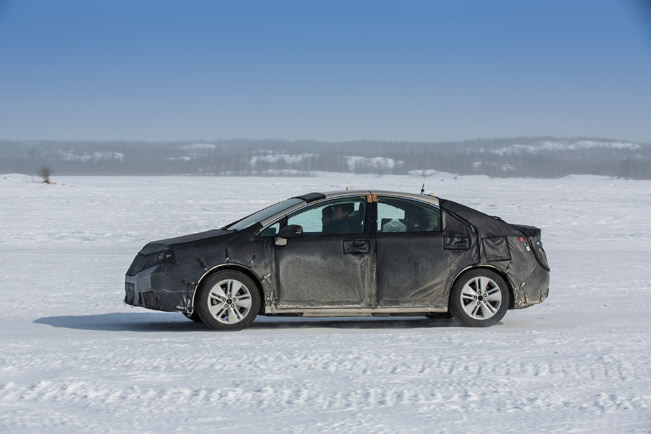
    2014-Toyota-FCHV-cold-testing-shadow2014-Toyota-FCHV-cold-testing-mediumThe Toyota FCV in the flesh. Well, not really. But it’s a report from the Toyota testing fleet on how things are going in everyday situations. Today, we get to see how the cars have handled the polar vortex: a weather phenomenon that has crippled most of the East Coast, but has also provided the ideal test ground for mechanical endurance.

    Proton Onsite – a firm which operates a total of ten Toyota FCHV-adv fuel cell vehicles – claims that even single digit temperatures don’t affect the efficiency of the drivetrains:

    “We had another snow storm Tuesday night and this morning the temperature was 3 degrees”, says Mark Schiller, Proton vice president of business development. “I went out to my Toyota FCHV-adv and brushed off a foot of snow before starting the car right up. No problem.”

    When compared to a purely electric vehicle, the fuel cell car has the upper ground in terms of real-life application: an almost zero effect over the performance even in the harshest environments. Schiller claims to still get around 300 miles on a single tank

    Apparently, over the last decade, the Toyota fuel cell fleet has logged millions of miles in some of the most extreme climates on the planet. From Yellowknife, Canada (temperatures as low as -30 degrees Celsius) to the Death Valley (severe heat), Toyota have tried them all.

    There’s still a lot of testing to do, but in 2015 when FCHVs hit the road, it will all be worth it.

    2014-Toyota-FCHV-cold-testing-medium-2

    Source: Toyota

  • 12 Months to Toyota FCV Production

    Toyota-FCV-concept-medium

    News from the future. The Toyota FCV (Fuel Cell Vehicle) is almost ready. The production model reveal is only 12 months away. Is this the beginning of the end of the hybrid car? Fingers crossed.

    What’s wrong with hybrids you ask? Well, they are slow, unimaginative, their range never meets the expectations, their batteries are dependent on the weather, they take days to recharge, and, believe it or not, they are still sort of bad for the environment.

    Hydrogen, on the other hand, is the most abundant chemical element in the universe and using it as fuel produces zero emissions. In order to make electricity, fuel-cells acquire oxygen from the environment and add hydrogen to make a chemical reaction which releases energy and a waste product known as water. Toyota engineers are adamant that you could go for about 500 miles on a single tank of hydrogen. Technically, on two tanks – the Toyota FCV actually has two 70 MegaPascal each. We don’t know why that’s relevant. There are no other certain figures, however, except an estimated system output of at least 100kW. Oh, and there’s the price – $108,00. Too much for a Camry you think? Would you consider plugging it in your electrical grid at home then? Because you can and a single charge can satisfy your needs for about a week. Also, it looks pretty amazing. We are especially fond of these LED indicators hidden within the fenders. It’s supposed to gave a “flowing liquid” door profile and a wave-motif fuel cap while the back end draws inspiration from the stem of a catamaran. Right.

    Toyota are anticipating the widespread use of hydrogen fuels for cars to be common sometime in the 2020s. Because of the FCV, Toyota see themselves as pioneers, and while no one can take that away from them, we can’t neglect Honda’s audacious attempts to mull in the Honda Clarity. In any case, Toyota seems to be pretty serious about the technology. They are already developing fuel-cell buses, forklifts and other industrial vehicles. Greener days are to come if this trend keeps up.

    Source: Toyota

  • 2013 Hyundai ix35 Fuel Cell

    Hyundai has announced the 2013 ix35 Fuel Cell, which has been selected for the second consecutive year by the European Commission-backed Fuel Cells and Hydrogen Joint Undertaking (FCH JU) to demonstrate the real-world benefits of hydrogen fuel cell technology.

    The world’s first production fuel cell electric vehicle, the ix35 Fuel Cell, will be made available throughout 2013 to members of the European Parliament, European Commission officials and other policymakers for test drives in Brussels, Belgium.

    “We are delighted that the FCH JU has chosen the ix35 Fuel Cell as its European demonstration vehicle and look forward to working with them to promote the benefits of hydrogen and fuel cell technology.  We are sure that the leading policymakers and opinion-formers who drive this remarkable vehicle will find its ability to deliver performance and comfort without compromising its eco-friendly nature withtailpipe emissions highly compelling.”, commented President of Hyundai MotorEurope B.K. Rimsaid.

    Using Hyundai’s proprietary technology, the ix35 Fuel Cell’s fuel cell stack converts hydrogen into electricity, which turns the vehicle’s motor. The only emission generated is water.

    The ix35 Fuel Cell can be refuelled with hydrogen in only a few minutes. 0-100 km/h in 12.5 seconds and a top speed of 160 km/h (100 mph). It can travel up to 594 km (369 miles) on a single tank of fuel.

    Hyundai ix35 Fuel Cell specifications

    Length 4410 mm
    Width 1820 mm
    Height 1655 mm
    Driving range on one fill-up 594 km
    Vehicle efficiency 0.95 kg H2 / 100 km
    Top speed 160 km/h
    Acceleration, 0 to 100 km/h 12.5 seconds
    Fuel cell output power 100 kW (136 ps)
    Energy storage system 24 kW lithium-ion polymer battery
    Fuel Hydrogen (700 bar, 5.6 kg)
    Exhaust gas Water vapour

    Source: Hyundai

  • Honda Insight Hybrid to Make World Debut at the Detroit Motor Show

    Honda has today given the first glimpse of the American specification, production version of the all-new 2010 Insight hybrid will make its world debut in January 2009 at the Detroit Motor Show.

    This first image of the US version of Honda’s latest production hybrid shows how the Insight Concept, first shown at Paris in October 2008, will be transferred into an aerodynamically inspired, athletic looking road car. The new five-passenger, five-door Insight is powered by a lighter, more compact version of Honda’s IMA hybrid system and will go on sale in the spring. (more…)