
The new Freelander 2 TD4_e is Land Rover‘s most fuel-efficient vehicle to date. Featuring a new intelligent Stop/Start system, it is the first production vehicle to incorporate technologies from the company’s programme of sustainable engineering initiatives, collectively named ‘e_TERRAIN TECHNOLOGIES’.
On the standard EU4 cycle, the CO2 emissions of the Freelander 2 TD4_e are reduced by 8 per cent*, compared with the outgoing manual diesel Freelander 2. Moreover, in additional tests, Land Rover engineers have measured fuel savings approaching 20 per cent in heavy urban traffic.
The 8 per cent improvement equates to a CO2 emissions reduction of 15 g/km compared with the standard Freelander 2 TD4 manual (from 194 g/km to 179 g/km*). In terms of fuel efficiency, consumption is improved from 37.7 mpg to 41.3 mpg*.
These gains, coupled with the added benefits of the gearshift indicator light, software developments and efficiencies from low-rolling-resistance tyres, make the Freelander 2 TD4_e the most fuel-efficient production Land Rover ever built.
Phil Popham, Land Rover’s managing director, said: “The Stop/Start Freelander 2 is the first production vehicle to benefit from the massive ?700 million investment in sustainable technologies by Jaguar and Land Rover. From mid-2009, the Stop/Start feature will be included as standard on all Freelander 2 TD4 manual models, with no associated increase in list prices.”
Land Rover’s new Stop/Start system improves fuel efficiency in urban and stop-start driving. The vehicle automatically shuts down the engine in appropriate conditions, resulting in zero tailpipe emissions and saving fuel that would otherwise be used idling the engine when stationary. When the driver is ready to move off, the engine instantly re-starts.
Sophisticated controls ensure that the Stop/Start system does not compromise the needs of either the driver or the vehicle. For the engine to shut down, the vehicle must be stationary, the gearbox in neutral and the clutch pedal raised. To re-start, the driver simply depresses the clutch and the enhanced starter motor engages the engine, ready for when first gear is selected.
The Stop/Start system is automatically activated each time the ignition is turned on, although there is a switch on the fascia to disable the system, if the driver so desires.
Added fuel economy benefits
Along with the intelligent Stop/Start system, the Freelander 2 TD4_e includes a series of additional enhancements that help to deliver fuel economy and CO2 benefits.
A new gearshift indicator light in the instrument pack advises the driver when to change gear if a higher gear will allow the vehicle to operate more fuel-efficiently. This is calculated by the Freelander 2 TD4_e’s fully mapped engine.
Software developments to the driveline systems on the Freelander 2 TD4_e generate CO2 benefits without reducing Land Rover’s renowned capability.
Land Rover engineers are also collaborating with tyre suppliers to drive improvements to fuel economy through reduced rolling losses. Tyre characteristics including rolling resistance are optimised for the entire range of available tyre sizes on Freelander 2 models.
End of Life Vehicle Certification
The Freelander 2 is the first Land Rover to achieve compliance with the ‘EU Directive 2005/64/EC on the type approval of motor vehicles with regard to their reusability, recyclability and recoverability’ ahead of forthcoming legislation. This refers to the fact that 85 per cent of the vehicle is reusable or recyclable, while a further 10 per cent by mass is recyclable or recoverable.
THE LAND ROVER STOP/START SYSTEM IN MORE DETAIL
Behind the Stop/Start system lies an intensive engineering programme, which encompasses a surprisingly large number of the vehicle’s systems and components.
Refined Stop/Start operation
Land Rover engineers have invested considerable effort in safeguarding levels of engine refinement. To reduce the engine shake associated with some diesel engines when stopping, the Freelander 2 TD4_e features controlled throttle closing and ramps down fuel in a smooth fashion, while the alternator is also turned off during the shut-down procedure, reducing load on the engine. A software feature change and revised engine calibration further aid smooth shut-off, while engine shake on start-up is reduced by the Freelander 2’s optimised engine-mounting strategy and inherent tuning.

Uncompromised durability
The increased frequency of stop-start cycles over the lifetime of the Freelander 2 TD4_e will lead to increased use of the vehicle’s affected components, so enhanced durability of these components was a priority for the Freelander 2’s engineering team. They developed a new heavy-duty starter motor, a new ring gear, a new dual mass flywheel friction control plate and an absorption glass mat battery. These new features ensure that the Freelander 2 TD4_e delivers characteristic Land Rover all-terrain performance and that the system’s operation is always rapid and reliable.
- Enhanced starter motor
The more frequent stop and start activity means that demands on the starter motor are forecast to increase up to threefold during the lifetime of the Freelander 2 TD4_e. To accommodate the durability demands on the vehicle’s 2 kW starter motor, a number of changes have been made. The grease seals have been enhanced significantly and new hard-wearing copper-tungsten contact material has been sourced and specified across the TD4_e range to enhance wear resistance within the starter solenoid.
- New ring gear
An all-new ring gear is specified for all TD4_e models to cope with the increased frequency of starts. The ring gear is attached to the engine flywheel and comes into contact with the starter motor each time the engine is started. The new ring gear is manufactured from a harder grade of steel and contains over 25 per cent more carbon to improve durability.
- Dual mass flywheel friction plate
Diesel-powered Freelanders with manual gearboxes have always featured a dual mass flywheel to ensure engine refinement at start, stop and low speeds. A new Polyetheretherketone friction control plate has been developed for the Freelander TD4_e. This is able to withstand seven times the pressure of the outgoing plate, to ensure greater levels of refinement under even greater start and stop demands.
- Absorption glass mat battery
New absorption glass mat technology has been developed, which offers deeper discharge and recharge characteristics and reduces battery deterioration under much heavier usage. Fine glassfibre matting has been introduced to sit pressurised between the new absorption glass mat battery plates. This aids the battery’s longevity in two ways: by allowing the electrolyte to function normally under greater pressure and by providing mechanical support for the plates, reducing battery degradation.
Intelligent technologies
Land Rover engineers focus on the introduction of intelligent, appropriate technologies, and the Freelander 2 TD4_e is no exception. In congested traffic, when the Stop/Start technology will shut down the engine frequently, other features and technologies will not be compromised, so in-car entertainment, climate control, Bluetooth, driver information and other electronic systems will continue to function.
Technologies such as the new voltage quality module, the battery monitoring system, the brake vacuum sensor and the enhanced climate control system have been developed to ensure that such services continue uninterrupted in a stop situation.
- Voltage quality module
The voltage quality module maintains critical vehicle systems, safety and occupant comfort. It supplies a constant voltage around the vehicle’s electronic components during a stop-start, ensuring that key services continue uninterrupted by the sudden outrush of amps from the battery.This technology is effectively a direct current converter, which can convert low voltages, such as that experienced during a stop, to a stable higher level for short but crucial boosts, ranging from one to five seconds in duration.
- Battery monitoring system
This system monitors the battery’s ‘state of health’ to ensure that the Stop/Start feature functions reliably. The technology is constantly at work, measuring factors such as natural battery degradation, ambient temperature, charge and discharge activity and voltage, to make sure there is enough power available for an effective stop-start.If any of these factors show a low measurement, the Stop/Start feature is overridden and the engine will continue running until more battery power is available.
- Brake vacuum sensor
The Freelander 2’s brake system is specified with significant vacuum reserves, but these reserves can become depleted for a number of reasons, such as use of the brake pedal when the engine is switched off. Ultimately this would lead to vacuum reserves becoming exhausted, which would affect the brake servo’s operation and pedal loads, in some cases causing them to rise substantially.To mitigate this, the brake vacuum sensor is specified on all Freelander 2 TD4_e models, and if vacuum reserves fall to a level that will affect brake pedal loads, the system overrides the Stop/Start function until the brake vacuum is replenished – ensuring brake pedal loads are maintained.
- Enhanced climate control system
A number of changes have been made to the Freelander 2 TD4_e’s climate control system to help ensure occupant comfort and reduce misting during stop-start situations.One significant change is the introduction of an auxiliary water pump. On conventional vehicles, the water pump shuts down with the engine, but on TD4_e models, the introduction of the auxiliary water pump maintains the flow of coolant during engine shutdown, keeping a steady cabin temperature.The climate control system monitors cabin temperature and maintains fan speed at a level that will protect the battery’s state of charge when the engine is shut down. In extreme hot or cold conditions, extended stops, or if an occupant selects a higher fan speed during a stop, the engine will re-start if necessary to preserve occupant comfort.
Evaporator temperature, the factor that gives rise to screen misting, is also monitored and the enhanced climate control system will periodically cool the evaporator as necessary to mitigate misting during a stop-start. The system operates the windscreen defrost shutter and, if the evaporator is wet, the shutter will remain closed for a few seconds after an engine restart until the vapour is dissipated, again mitigating windscreen misting.
LAND ROVER e_TERRAIN TECHNOLOGIES
The Freelander 2 TD4_e is just one element of Land Rover’s comprehensive green technology roadmap, which will drive the company to increasingly lower emissions and more sustainable technologies in the coming years. This is a key part of the ?700 million investment in sustainable technologies being made by Jaguar and Land Rover.
Land Rover engineers are working on a series of advanced propulsion technologies and lightweight structures aimed at bringing CO2 emissions down to class-leading levels. This doesn’t mean sacrificing core Land Rover values: the renowned all-terrain capabilities of its future vehicles could actually be improved by some of the exciting new powertrain technologies, such as the Electric Rear Axle Drive (ERAD) announced at the British International Motor Show in London earlier this year.
The company’s ambitious programme for continuing CO2 reduction stretches well into the future. For example, Land Rover is developing future hybrid and other green technologies in conjunction with the UK Government’s Technology Strategy Board (TSB).
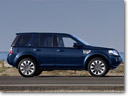
 2015 Land Rover Freelander Metropolis is the most luxurious Freelander built so far. The flagship vehicle is based on the previous HSE LUX specification. It will offer its occupants premium Windsor leather, electrically adjustable seats and a panoramic sunroof. In addition, standard features also include xenon headlights, reversing camera and 19-inch diamond-turned alloy wheels. Metropolis is joined in the range by the new SE and SE Tech models, which will also include revised powertrain options. Land Rover announced that the vehicle is set to make a UK debut at Royal Windsor Horse Show.

 2013 Land Rover Freelander 2 has just been officially unveiled, and now shows a premium look enhanced comfort, convenience and driving enjoyment. In addition, Land Rover has equipped it with new colours, exterior design features, upgraded equipment levels and wide choice of refined and economical diesel engines.


 Land Rover has achieved an extremely important milestone in the manufacturing process of its Freelander 2 model by completing its 250,000th example at Company’s Halewood plant.
 Unichip Europe offers U-Connect plug and play ECU upgrade for the 2.2 litre Land Rover Freelander 2 TD4.
 2011 Land Rover Freelander 2 will go on sale in the UK from the end of September, this year. The facelifted version of the model features a new 2.2 litre diesel engine with either 150PS or 190PS. Furthermore, the SUV has minor updates to the exterior and interior. Last, but not least, 2011 Freelander 2 will be available with a new Premium Pack option.
 The first official Freelander 2 TD4_e was produced at the Jaguar Land Rover assembly facility at Halewood today. The new vehicle is Land Rover’s most fuel-efficient to date and is the world’s first SUV to feature an intelligent Stop-Start system.