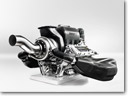
 2014 FIA Formula One World Championship is introducing a radical technical regulation changes. The cars that will compete will be powered by new powertrain technology, with a powerful turbocharged internal combustion engine coupled with energy recovery systems.
Furthermore, the power output will be increased up to unseen levels in over five years. Two types of energy will propel the cars – internal combustion and electrical energy. The first unit will produce power through consumption of traditional carbon-based fuel, while the second will be harvested from exhaust and braking by two motor generator units. Of course, both will work in harmony. Such engines are to be called now “Power Units”.
Since these announcements have been made, Renault came up with the statement that it is entirely prepared for this technical revolution by introducing the Energy F1-2014 Power Unit.
The new Power Unit key elements include the following:
- 1.6-litre turbocharged V6 internal combustion engine
- Direct injection
- Maximum engine speed of 15,000rpm
- Potent Energy Recovery Systems incorporating two motor generator units – the MGU-H, recovering energy from the exhaust and the MGU-K recovering energy from braking
- Electrical energy recovered stored in a battery
- Combined maximum power output of 760 hp (559 kW), on a par with previous V8 generation
- Double restriction on fuel consumption: fuel quantity for the race limited to 100 kg (-35% from 2013) with fuel flow rate limited to 100 kg/hr max (unlimited under V8 regulations)
- Engine development is frozen during the season, only changes for fair and equitable reasons are permitted
- 5 Power Units permitted per driver per year
To go further into details, the internal combustion V6 engine includes cylinders arranged in two banks of 3 cylinders arranged in a ‘V’ configuration over a common crankshaft. It has a displacement of 1.6 litres and will make around 600 hp (441 kW) alone.
Furthermore, all Power Units must include direct fuel injection (DI). This is a key sub-system at the heart of the fuel efficiency and power delivery of the power unit. Here fuel is sprayed directly into the combustion chamber and not into the inlet port upstream of the inlet valves. The fuel-air mixture is formed within the cylinder.
Next, the turbocharger utilizes exhaust gas energy to enhance the density of the engine intake, thus producing more power. In addition, it allows smaller engine to make much more power than its size would normally permit, while the exhaust energy is converted to mechanical shaft power by an exhaust turbine. The mechanical power from the turbine is then used by the compressor and the MGU-H.
You might ask what is MGU-H. The answer is simple: on the Renault Energy F1, the turbo rotation speed is primarily controlled by the MGU-H, however a wastegate is needed to keep full control in any circumstance. In comparison, on conventional turbo engines, a wastegate is used in combination with a turbocharger to control the high rotation speeds of the system. In fact, the wastegate is a control device that allows excess exhaust gas to by-pass the turbine and matches the power produced by the turbine to that needed by the compressor.
MGU-H is connected to the turbocharger and acts like a generator by absorbing power from the turbine shaft to convert heat energy from the exhaust gases. The electrical energy can be later directed to the MGU-K or stored in the battery.
On the other hand, the MGU-K operates as a generator that recovers some of the kinetic energy during braking. In addition, it also converts it into electricity. When the car accelerates, the MGU-K is powered by the Energy Store and the MGU-H. In these cases it acts as a motor and propels the car.
At last, the Battery or Energy Store consumes recovered Heat and Kinetic Energy. The stored energy can be utilized by the vehicle with the MGU-K or can be also utilized to accelerate the turbocharger with the MGU-H. The result is two times more power and the energy contributing to performance is ten times greater.
Renault Energy F1-2014 Power Unit Technical Specifications
|
ENERGY F1-2014 |
| Engine |
| Displacement |
1.6L V6 |
| Number of cylinders |
6 |
| Rev limit |
15,000rpm |
| Pressure charging |
Single turbocharger, unlimited boost pressure (typical maximum 3.5 bar abs due to fuel flow limit) |
| Fuel flow limit |
100 kg/hr (-40% from V8) |
| Permitted Fuel quantity per race |
100 kg (-35% from V8) |
| Configuration |
90° V6 |
| Bore |
80mm |
| Stroke |
53mm |
| Crank height |
90mm |
| Number of valves |
4 per cylinder, 24 |
| Exhausts |
Single exhaust outlet, from turbine on car centre line |
| Fuel |
Direct fuel injection |
| Energy Recovery Systems |
| MGU-K rpm |
Max 50,000 rpm |
| MGU-K power |
Max 120kW |
| Energy recovered by MGU-K |
Max 2MJ/lap |
| Energy released by MGU-K |
Max 4 MJ/lap |
| MGU-H rpm |
>100,000rpm |
| Energy recovered by MGU-H |
Unlimited (> 2MJ/lap) |
| General |
| Weight |
Min 145 kg |
| Number of Power Units permitted per driver per year |
5 |
| Total horsepower |
600hp (ICE) + 160hp (ERS) |
Source: Renault
 Although Infiniti made a successful involvement in Formula One, the team definitely doesn’t want to stop here. For the 2016 season, the brand decided to be a technical partner to the recently-created Renault Sport Formula One team. And by all it appears like this will be a powerful alliance: imagine blended product of Infiniti’s energy resource and Renault’s drivetrain systems. Hopefully this will really be the beginning of something incredible in the world of Formula 1.


 Jenson Button, Vodafone McLaren Mercedes team’s Formula One driver has picked up his exclusively special Mercedes-Benz C-Class DR520 Estate ride from Mercedes-Benz World.
 Heikki Kovalainen, the famous F1 driver has tested the award-winning sport coupe Lotus Evora at the Lotus Cars’ own test track.
 Group Lotus has revealed the Lotus Exige S Type 72, a mid-engined sportscar that pays tribute to the most successful Formula One car of all time, the Lotus Type 72 F1 car.
 The base of this race car is the Lotus Evora Type 124, which was introduced earlier this year. There are number of changes, which has been made the car specially for endurance races.


 Organiser Live Promotions has announced that Race Retro, the international historic motorsport show, will be held from Friday 12th to Sunday 14th March 2010, returning to Stoneleigh Park, Warwickshire. After its extremely successful first year as owners, Live has also chosen the Alfa Romeo as its celebrated marque as the Italian manufacturer celebrates its centenary year.
 Both were revolutionary and triumphant: in the summer of 1959 Alec Issigonis presented his concept for a small car which, with its transverse-mounted front four-cylinder engine and space for four occupants plus luggage, was to become a byword for economy of space and driving fun.
 Few, if any, automobiles have been as awe-inspiring as the show-stopping prototypes and “fuori serie” cars designed by Stile Bertone – the Alfa Romeo Carabo, the Lancia Stratos Zero and the Lamborghini LP500 prototype to name just a few
 Caparo T1, the fastest performance supercar from Caparo Vehicle Technologies, is now available in its new Race Extreme version. The vehicle, aimed specifically at the high end of the track day market, boasts the car’s utmost race specification and is set to deliver the ultimate driving experience.
 Usain Bolt, 100 and 200m Olympic Champion at Beijing 2008, fulfilled his dream driving a F430 Spider at Monte Carlo, on a section of the Formula One city circuit.
 The new 2008 Mercedes-Benz Motorsports Collection is the perfect outfit for a sporty appearance at the trackside. The Collection is now available from authorised Mercedes-Benz dealers in the product categories of Formula One, Vodafone McLaren Mercedes, SLR, DTM, AMG and Accessories.