Tag: Evija

  • Lotus Evija Fittipaldi

    The world’s most powerful production car – the stunning Lotus Evija hypercar – now delivers even more exclusivity and desirability. Inspired by the past to enhance the future, Lotus has unveiled the Evija Fittipaldi, a tribute to one of the greatest car-and-driver pairings that Formula 1 has ever seen.

    That driver is, of course, Emerson Fittipaldi, the young Brazilian racer who joined Lotus and became a legend, cementing his place in F1 history in 1972. Behind the wheel of the now-iconic Lotus Type 72 and winning five of that season’s 11 races, Fittipaldi secured the Drivers’ Championship for himself and the Constructors’ Championship for Team Lotus.

    Exactly 50 years on, the Lotus Evija Fittipaldi is a fitting celebration of that partnership. Just eight examples of the all-electric two-seater are being hand-built at Hethel in Norfolk, UK – the global HQ of Lotus sports car design and manufacturing – and all are sold. Customer deliveries will begin early next year. It is the latest project from Lotus Advanced Performance, the bespoke design and experiential division of the business launched earlier this year.

    Showcasing the world-famous black and gold colour scheme – also 50 years old in 2022 – the hand-painted exterior and numerous other unique design features have been created to commemorate this amazing collaboration. They include a hand-tinted plan view of the Type 72 etched into the exposed carbon fibre roof, and Fittipaldi’s signature hand-stitched into the dashboard.

    And perhaps the most emotive detail of all is the rotary dial on the floating central instrument panel. It has been hand-crafted from recycled original Type 72 aluminium, ensuring a genuine piece of the iconic F1 racer is part of each Evija Fittipaldi.

    Such a special car deserved a special world premiere; customers, their families and other VIP guests have taken part in an exclusive, once-in-a-lifetime experience day at Hethel to celebrate the launch of the new car and the iconic Type 72.

    Guest of honour was Emerson Fittipaldi himself, who said: “It’s fantastic to be back at Hethel for such a special occasion. I’ve really enjoyed being a part of this project and it’s been a wonderful experience revealing the car to some of the new owners. Having the opportunity to drive both the Evija Fittipaldi and my championship-winning Type 72 Formula 1 car on the test track at Hethel has been an incredible experience.”

    Other highlights of the day included the first time in history that all eight surviving examples of the Type 72 – hence the number of Evija cars being built – were brought together in one place and run on the Hethel test track.

    Simon Lane, Director, Lotus Advanced Performance, commented: “The word ‘legend’ is often overused, but this project has brought together the Lotus Evija hypercar, Emerson Fittipaldi, the Type 72 race car and our brand’s celebrated Formula 1 heritage. No argument, that is four legitimate legends, all collaborating to deliver a truly unique hypercar and a world premiere that was a real ‘pinch yourself’ moment.”

    He added: “Production of the Evija has commenced at Hethel, and these eight cars are a very special celebration of this important moment in our history.”

    The bespoke specification of the Lotus Evija Fittipaldi starts with its unique paint finish, which includes its designation written on the body work in gold lettering to the side of the rear window. Complementing it are black and gold ‘Type 72’ wheels complete with anodized centre lock surrounds – red on the left side of the car and green on the right – as well as black and gold brake calipers.

    Decals that celebrate the Type 72’s race victories from the 1972 season are presented on the active rear wing, while a number 8 has been applied to the B-pillar. Fittipaldi raced with that number on his car during the 1972 season, including for his win at the British Grand Prix. A carbon and gold Lotus nose badge completes the exterior styling.

    Inside, the theme of luxury and bespoke design continues. Black leather interior with gold contrast stitching can be found throughout the cabin, along with exclusive roof liner stitching, plus gold finishes to the air vent surrounds, centre rotary dial, start/stop button and pedals.

    The car has been developed with the generous support of Classic Team Lotus, the historic motorsport business run today by the family of Lotus founder Colin Chapman to maintain and operate Lotus F1 cars. Also based in Hethel just across the road from Lotus, it hosted the gala dinner at the launch event.

    Clive Chapman, Managing Director, commented: “Emerson Fittipaldi and my father enjoyed a very special relationship, and their spectacular success was a brilliant team effort by the dedicated designers and mechanics at Team Lotus. One of motorsport’s most admired drivers, it is always emotional whenever Emerson is reunited with the Lotus Type 72, which he describes as the greatest car he ever raced.”

    He added: “Bringing together the Lotus Evija, the Lotus Type 72, the black and gold livery and Emerson Fittipaldi, all in celebration of his World Championship victory 50 years on – need I say more?”

    Despite its incredible power and performance, the driver remains at the centre of the Lotus Evija experience, just as it was for the Emerson Fittipaldi and the Type 72. The technical specification and performance figures of the Lotus Evija Fittipaldi are truly astonishing; more than 2,000 PS makes it the most powerful series production car in the world, creating more than 1,700Nm of torque. The 0-62 mph (0-100 km/h) is completed in under three seconds, and 0-186 mph (0-300 km/h) takes nine seconds from a standing start. The limited maximum speed is 217 mph (350 km/h). The full technical specification is detailed in the table below.

    From one world champion to another, earlier in the week Jenson Button visited Lotus to test drive the Evija and Emerson’s Type 72 on the famous Hethel test track. It was the first time Jenson had seen the Evija in production and took one out on track to give it a shake down before the launch of Evija Fittipaldi. Quickly getting up to speed Jenson drove the car around the 2.2-mile test track, testing the car’s ride, handling and performance. He was also seen unleashing the power in several standing starts. Full of praise when he jumped out of the driver’s seat of the world’s most powerful production car. Jenson commented: “It sounds like a jet engine! You think of an EV as quiet but it’s not. The torque is astronomical. It’s amazing, it puts a big smile on your face. It feels like a spaceship, the drivability and direction in the steering certainly lets you know you are driving a Lotus; I am amazed by the agility of it. Itt is a Lotus of the future and I can’t wait to drive my own Evija.”

    Jenson also got the chance to turn back the clock and drive Emerson’s 1972 Lotus Type 72. The car that helped Emerson clinch his first driver’s championship. Jenson Button added: “It’s lovely to get into a bit of racing history. There isn’t a lot of space, but everything is in the right position. It was easy to heel and toe. It’s a real privilege to drive such a special car.”

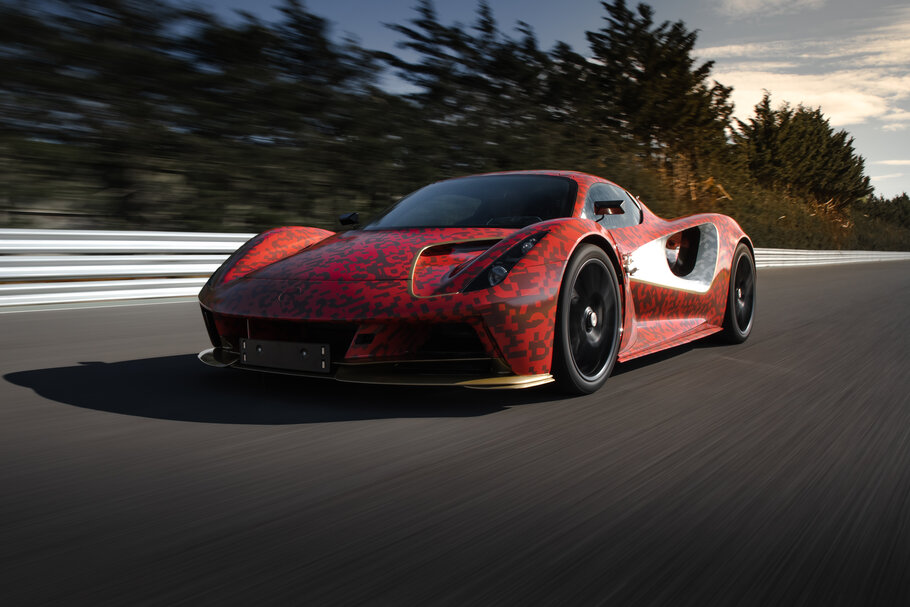
    A stunning piece of contemporary automotive design – the work of a team led by Lotus Design Director Russell Carr – the Evija features a dramatic Venturi tunnel through each rear quarter, giving it a truly breath-taking presence. This ‘porosity’ means optimised airflow, with air channelled not just over, under and around the Evija but through it, maximising downforce while minimising drag. Its front splitter aids grip while channelling cooling air to the battery pack, E-motors and brakes, and active aero features such as a Formula 1-style DRS (Drag Reduction System) bestow the Evija with cutting-edge performance. With driving dynamics overseen by the team of Gavan Kershaw, the world-renowned Vehicle Attributes Director for Lotus, the Evija is a car like no other.

    The first Lotus road car to feature a one-piece carbon fibre monocoque chassis, the cabin – from the fully adjustable race-style seats to the multi-function steering wheel – is the very pinnacle of motorsport-inspired road car design and technology.

    Just as the Lotus Evija is defining a new era of pure electric performance, so the Lotus Type 72 remains the most successful racing car not just of its day, but in F1 history. In 2019 Autosport magazine named it the greatest ever F1 car. A revelation both on the drawing board and on the track, the Type 72 was the first racing car to incorporate aerodynamics as part of its initial design. The integrated rear wing and front splitter were designed specifically to allow the car to slice through the air while also creating vital downforce.

    The Type 72’s air intake was relocated above the driver’s head, ensuring undisturbed and clean air could be sucked straight into the engine, while its radiators were placed in the sidepods of the car rather than the nose. This not only increased cooling efficiency but improved weight distribution – and therefore performance – in the process.

    The same approach was also taken for the brakes, mounting them inboard rather than on each wheel to aid cooling as the tops of the discs protruded through the bodywork. The Type 72 was the first of what became the traditional “wedge on wheels” designs that soon inspired every other competitor on the grid.

    Lotus Evija Fittipaldi technical specification

    Powertrain Pure electric, 4WD
    Power 1500kw (4 x 375kw) / 2,039 PS
    Battery power 93 kW
    Torque 1,704 Nm with torque vectoring
    0-100 km/h (0-62 mph) Under three seconds
    0-300 km/h (0-186 mph) Under nine seconds
    Max speed Electronically limited to 350 km/h / 217 mph
    All-electric range (WLTP Combined) 250 miles (402 km) *
    Charging time (350kWh charger) 18 mins
    Weight 1,887 kg *
    Production run Maximum of 130 cars
    Overall dimensions (L/W/H) 4,459 / 2,000 / 1,122 mm
    Start of Production 2022

    * Target figure

  • Lotus partners with the UK’s most creative photographers to celebrate muse global design award for Evija

    Processed with VSCO with l9 preset

    Lotus is celebrating the all-electric Evija hypercar’s latest award win with a gallery of new images taken during a unique and inspiring collaboration with some of the UK’s most creative photographic talent.

    The celebrations mark the results of the prestigious 2020 MUSE Global Design Awards, where the Lotus Evija took overall victory in the Automotive Transportation category.

    The eight exclusive photoshoots took place in and around Duke of London, a former 1930s soap factory in West London transformed into a stunning motoring venue and tribute to all things automotive. Lotus invited each photographer to attend for one-on-one private access to the Evija, allowing them to choose how and where to shoot the hypercar – in their own style – in any location around the site. The results are now available at their respective Instagram feeds.


  • Lotus stuns Goodwood Speedweek with Evija dynamic public debut

    2020 Lotus Evija1

    The all-electric Lotus Evija hypercar makes its dynamic public debut at Goodwood SpeedWeek this weekend.  The Evija will be in action on the historic race track and will be taking part in a variety of high-octane activities, including the Supercar Run.

    Three pre-production examples of the Evija are supporting SpeedWeek, one complete in a vibrant Lotus ‘Solaris Yellow’ finish and two prototypes wrapped in stunning black and gold, recalling iconic Lotus liveries of the past.  The prototypes also feature a stylised image of the famous West Sussex circuit, accompanied by the words ‘Lotus x Goodwood: Creating History since 1948’ – acknowledging the year of the very first Lotus car and the first motorsport event at Goodwood.

    Among the first outside of the engineering team to experience Evija is Lord March (Charlie, 25, son of the event host, the Duke of Richmond), who commented: “The Evija is unbelievable – the power, the speed, I’ve never experienced anything like it – it was exceptional. This new dawn of electric hypercars brings ultimate motoring to life for a new generation and a younger audience. The advancement in electric cars over the last 10 years is astonishing.  There is a huge amount of growth potential for these machines to continue allowing us to keep enjoying and driving high performance cars.  Lotus continues to appeal to both the inner driver and the inner child in all of us – so much fun, and ultimately for the driver to control and enjoy.”

    Gavan Kershaw, Director of Vehicle Attributes, Lotus, added: “We’re having a great time demonstrating the Evija here at Goodwood.  Bringing the cars to an event like this is a welcome break from the hundreds of hours spent on proving grounds, where there’s a huge amount of open space and long straights to test the car’s performance limits. Goodwood is a fast and flowing circuit with numerous undulations in the surface, and so is a fantastic test and demonstration for the Evija as it’s the type of environment where many owners will use the car.”

    He added: “We hope the TV coverage of the event will show people what an amazing vehicle it is, and we can’t wait to be back next year.”

    Car fans can see the Lotus Evija on the ITV network, with multiple programmes on different channels across the weekend. See local TV listings for full details.

    Lotus has also published a new US LOT Blog on the Evija, hosted on the Lotus media website here. It details how elements of the Evija have been consciously designed to meet the exacting standards of company founder Colin Chapman, and how that helps make the car a true Lotus.

    More than 50 historic Lotus cars are scheduled to take part in Goodwood SpeedWeek. They include:

    • Lotus 25 – the car driven by Jim Clark car during the 1963 F1 season when he won the Drivers’ Championship
    • Lotus 18 – the car in which Sir Stirling Moss won the 1961 Monaco Grand Prix
    • Lotus 49 – the car in which Graham Hill won the Monaco Grands Prix in 1968 and 1969
    • Lotus 72-5 – Emerson Fittipaldi’s car from the 1970 season
    • Lotus 72-7 – Emerson Fittipaldi’s main car from the 1972-73 seasons, and the car in which he won the most F1 races – five in total
    • Lotus 79 – Mario Andretti’s main car from the 1978 season
  • Lotus Evija development car

    2021 Lotus Evija development car1

    Lotus today reveals further details on the Evija all-electric hypercar in a stunning new film featuring an engineering development vehicle testing on the 2.2-mile track at Hethel.

    At the wheel is Gavan Kershaw, Director of Vehicle Attributes for Lotus, who provides extensive new commentary on key elements of the Evija project. At almost five minutes long and using on-board cameras to reveal new views of the car, it’s the most detailed insight yet into the dynamic excellence of Britain’s first all-electric hypercar.

    The film has been launched as the Evija takes center stage at this week’s Salon Prive Concours d’Elegance, the UK’s most exclusive motor show. It’s staged in the beautiful gardens of Blenheim Palace, a UNESCO World Heritage site in heart of the Oxfordshire countryside.

    In the film, Kershaw reveals how from the earliest discussions about what the Evija should be, the goal was to create a hypercar with genuine everyday usability. He reveals new details on the progressive deployment of power and torque through the car’s five drive modes:

    • Range mode is limited to 1,000PS of power and 800Nm of torque and intelligently switches the Evija from four-wheel drive to rear-wheel drive to maximize the distance available from the battery and its intelligent power management system.
    • City provides greater power control and decreases the level of regenerative braking for urban environments.
    • Tour provides automatically switchable four-wheel or rear-wheel drive, delivering over 1,400PS of power with torque-vectoring.
    • Sport delivers performance figures of 1,700PS and 1,700Nm linked to stability control systems to increase traction levels.
    • Track mode is the most extreme, boosting power delivery to the maximum 2,000PS. It delivers the highest level of torque-vectoring with the Evija’s Drag Reduction System (DRS) available on request. The chassis setting is automatically switched to Track.

    Also included in the film are exclusive dynamic views of the battery pack located immediately behind the two seats, echoing the classic mid-mounted powertrain layout of so many Lotus cars. As Kershaw explains, this creates an optimum weight distribution and makes the Evija exceptionally maneuverable as it races towards its top speed of more than 200mph.

    As with all Lotus cars past, present, and in the future, agile handling and exceptional steering are embedded in the brand’s DNA. Kershaw explains they were among the top priorities in setting the performance characteristics of the Evija: “Lotus cars are very nimble, inspiring great confidence when being driven, and the Evija is no different to that,” he states.

    The Lotus Evija marks the start of an exciting new chapter in the history of an iconic and much-loved British sports car brand. With class-leading in-gear acceleration and an output of 2,000 PS – making it the most powerful series-production road car ever built – it sets new standards in the global hypercar market.

    Satisfying a brief to be the most powerful and dynamically accomplished road car in the history of the company, the Evija represents a thrilling new high watermark for Lotus driving performance. As well as signaling the beginning of a contemporary new Lotus design language, the Evija is a bold statement of intent about the brand’s future ambition to be a truly global performance car company.

  • Lotus reveals details of new Evija via a digital configurator – check it out!

    2020 Lotus Evija Digital ConfiguratorAs the Evija moves closer to massive production, Lotus team has revealed how buyers of the all-electric hypercar can specify their own vehicle.

    The exclusive vehicle features tons of customizable options and offers the chance to become a completely unique automobile, thanks to Lotus’ personalization program. The 2,000hp two-seater can be specified with exclusive exterior components and finishes, neat interior touches and changes, all along with some drivetrain exclusive specifications.

    Production of the Evija will start later in 2020 and the first year’s allocation is already designed to customers all around the world. The starting point of every cars’ specs is the all-new touch-screen setup. It is designed exclusively for this Lotus lineup and features ultra-sharp graphics that provide the occupants with photo-realistic images and animations. Such features allow the customers to build and personalize their own car form the ground up and visualize it from every angle inside and out. Sweet!

    2020 Lotus Evija Digital Configurator

    Furthermore, thanks to the advanced imaging technique, known as ray-tracing, buyers can even place their Evija into numerous environments around the world in order to see how the local sunlight levels affect the expression of the machine. How cool is that?

    In fact, Lotus has released some images of new Evija captured from the configurator – they show a car set inside the Lotus Design studios at Hethel, UK, brand’s global home since 1966.

    SEE ALSO: Buggati’s jewel: the most expensive vehicle in the world!

    This configurator is merely one element of the entire Evija experience. At regular intervals during the purchase process, each customer will receive some gifts and tons of additional goodies that accompany the elegant and super-exclusive Evija.

    2020 Lotus Evija Digital Configurator

    Stick with us for further details!

    Source: Lotus 

  • Lotus Evija makes its debut with a launch of 130 units

    2020 Lotus Evija All-new Lotus Evija hypercar will make its North American debut this month at the Monterey Car Week stage. This is the world’s first British all-electric machine in the segment features dramatic exterior design and sets a new standard for performance rates.

    Evija adopts innovative thinking and ingenuity, which has always been part of Lotus’ DNA. With a total of 2000hp, this remains one of the most powerful production cars ever created. Exclusively designed in the UK, there will be mere 130 units created.

    Remaining one of the most anticipated machines of 2019, Evija is scheduled to appear at The Quail: A Motorsports Gathering and at of Quail Lodge & Golf Club events. A few days later, on Sunday 18 August, Evija will appear a Pebble Beach Concours d’Elegance – one of world’s most prestigious and best-known car collection competitions.

    In fact, the North American debut of Lotus Evija will ensure that Monterey Car Week audience will have the chance to see the vehicle’s striking exterior for themselves. Following this event, Evija will be at Galpin Lotus in Los Angeles.

    SEE ALSO: Peugeot reveals details for new 3008 SUV Concept machine! Check it out!

    Furthermore, there will be a number of formal “agreements to purchase” due to the high level of interest in the car. Lotus team has also confirmed a customer from Miami, Florida to become the first North American to buy an Evija.

    Source: Lotus