Tag: E90

  • The Reasons Behind the 450 Horsepower of this BMW M3 E90 by MR Car Design

    MR Car Design BMW M3 E90 CLUBSPORT front viewWe haven’t heard about MR Car Design for a long time now. In fact it has been almost two years since we wrote about a project made by the tuners. It seems that during this time the ambitious car freaks did not stop the hard work. In fact their latest project looks fantastic and features exclusive changes to some vital parts.

    Under the attention of the talented tuning company is the fourth generation BMW M3 E90. It was initially under a Clubsport transformation, and it was time for MR Car Design to do the engine software optimization.

    SEE ALSO: Retro Styling For MR Car Design Volkswagen Beetle

    Software Optimization

    After the software changes done to the engine, the result is 450 HP (331 kW) and 430 Nm (317 lb-ft) of torque. The tops speed was also boosted and now reaches above 300 km/h (180 mph). In addition, the installed Evo exhaust system has significant part of the fulminate Performance of this M3. The new exhaust and all of the “surgical” changes on this BMW are all work of the Clubsport team.

    Exterior Changes

    And have you spotted the huge 19-inch black rims, which were coated with Michelin Pilot Sport Cup tires in 245/35-19 on front and 265/35-19 on the rear axle. The tuners also installed spacer plates of 10 mm on the front and 15 mm on rear axle, KW Clubsport variant 2 coilovers with camber regulation combined with H&R stabilizer kit, and the yellow painted Stoptech braking system.

    Sportier Interior

    MR Car Design BMW M3 E90 CLUBSPORT Interior

    The cabin was also a subject of transformation. Here we can spot the Wiechers rollover bar with cross, black Schroth safety belts type Profi III-FE and a rear strut brace. The remarkable windshield wedge and the M-typical coloring at the forefront are also unique for this project.

    We find this BMW M3 really great and hope you leave your opinion in the comment section below.

    Source: MR Car Design via Miranda Media 

  • The BMW E90 M3 – A Vorsteiner Project

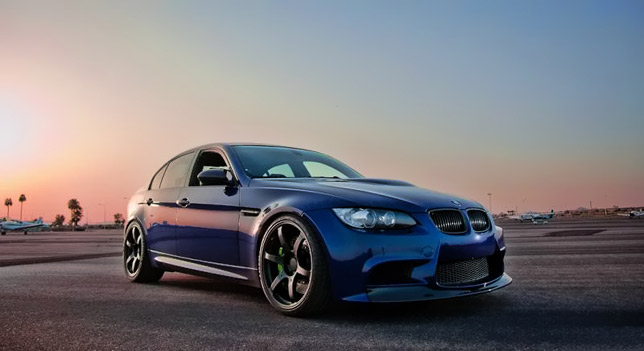
    Vorsteiner-M3-Sedan-thumbVorsteiner seem to be preoccupied these days with BMWs. More specifically, the M3 range. Well, this time it’s not actually Vorsteiner. It’s one of their dealers – Vivid Racing, based in Glibert, Arizona. They have taken a 2008 BMW M3 Sedan (E90) and have spiced it up in the name of aesthetics. At least, that’s how some people see it.

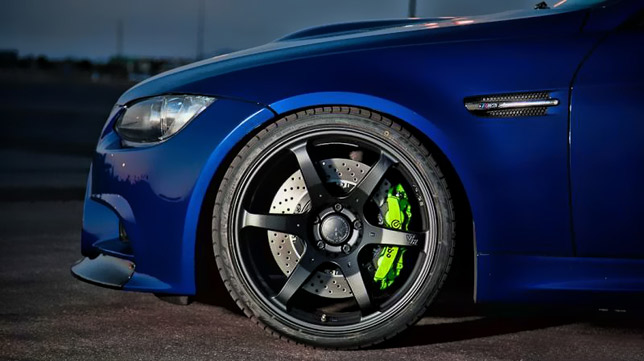
    Power is not up, but Vivid Racing are considering it as the bar for more performance is now up. By the bar, I mean the stopping power – four new Brembo 380mm crossed drilled rotors complete with six-piston calipers at the front and four-piston ones at the back.

    The handling may also benefit from the newly installed H & R springs and sway bars that give the beemer some more rigidity and a lower stance. For the aerodynamics, Vivid have gone for the Vorsteiner GTS3 Carbon Fiber Front Bumper that comes with an air splitter, and a Vorsteiner Carbon Fiber Boot Lid. The rear also gets a Carbon Fiber diffuser for an overall complete feel.

    Subtle, lean and sleek. We like it.

    BMW M3 (E90) by Vivid Racing
    BMW M3 (E90) by Vivid Racing
    BMW M3 (E90) by Vivid Racing
    BMW M3 (E90) by Vivid Racing
    BMW M3 (E90) by Vivid Racing
    BMW M3 (E90) by Vivid Racing
    BMW M3 (E90) by Vivid Racing
    BMW M3 (E90) by Vivid Racing

    Source: Vorsteiner

  • Prior Design BMW 3-series E90 PD-M

    Prior Design has announced a complete styling package for all BMW E90 models except the M3, of course. The Widebody-Kit not only gives the saloon more aggressiveness, but improves the airflow as well.
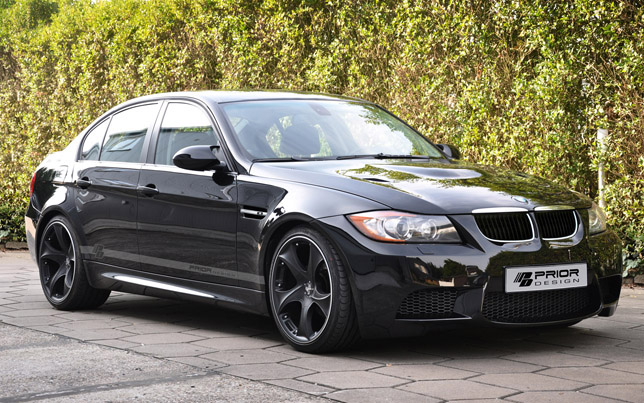
    All parts are made from Dura-Flex, which is a high quality material, characterized by exccelent surface structure that provides sufficient flexibility and stability. Furthermore, all parts are easy to paint, so you won’t have any problems with matching the original colour of the car.

    The package consists of  Front Bumper, a pair of Side Skirts, a pair of Front Fenders, Rear Bumper, a peir of Rear Widenings and all mounting materials. TÜV parts certificate is also included.

    If this is not enough, you can always order PD-M Front Bonnet, Rear Trunk and Mirror Panels.

    Prior Design BMW 3-series e90 PD-M
    Prior Design BMW 3-series e90 PD-M

    Source: Prior Design

  • 5 Most Aerodynamic Family Saloons on the Market

    BMW E90 3 Series - Front Angle View

    We have all heard the idiom “This … has the aerodynamics of a brick” at one time or another and it is not by accident that the expression has become universally popular among automotive enthusiasts. It turns out, in fact, that when it comes to aerodynamics (which in a car determines a number of characteristics, including but not limited to top speed, fuel consumption, and noise inside) you pretty much cannot do any worse. How do we know? Well, some really smart people invented the ‘drag coefficient’, which is a useful number to measure the frontal area resistance of a solid object in air or liquid. When this solid object is a brick, the number equals 2.

    Back to cars, ever since people recognized that cars and carriages are not the same thing, car manufacturers started to pay more attention to aerodynamics as part of their efforts to make their cars go faster, be more stable, and look better (although the latter turned out to be way more than a function of wind resistance). All in all, in the last half a century aerodynamics has had a crucial role in shaping our concept about the attributes of a car’s exterior.

    So what are the 5 cars of today, which are most brick-un-like in terms of their Cd (the accepted designation of drag coefficient)?

    5. Opel Insignia

    So it is not only beautiful but also efficient in the way it slips through the air. The 2009 European ‘Car of the Year’ award winner has been a total hit so far with its sales in Europe and is well-received on the US market, as well, where it appears with a Buick badge. Of course, the Insignia has its faults – the scarce rear passenger leg room is something the vast majority of automotive journalists who have tested the car agree on. Another thing they agree on, however, is its successful design, which is not only pleasing to the eye but also responsible for a Cd of only 0.27.

    4. BMW E90 3 Series

    In our minds, BMW’s have never won people over through their aerodynamic design – something which has been the reserved territory of brands, such as Citroen for example. Still, despite the fact that the little bimmer is quite different to look at when compared to the renaissance-like shapes of the Insignia, it has the same Cd value of 0.27 as the Opel. That is, only if it bears a 318i/320i badge  – the reason is that larger wheels and fatter tires, as well as a few other exterior tweaks, increase the Cd number slightly in the name of better stability and driving security.

    1-3. Japanese Wedges versus the Three-Pointed Star: A Three-Way Tie!

    There are three cars, which occupy the top of this ranking: the Mercedes-Benz E-Class, the Toyota Prius, and the Honda Insight. They all share a drag coefficient of just 0.25 and two of them – the Prius and the Insight – also share a largely similar design concept. In fact, to use the word ‘share’ would not be entirely correct because the Insight came in 2008 in response to the Prius’ considerable market success and stole its silhouette in an attempt to steal its sales. Nowadays, however, we are all quite used to automotive anonymity and other such examples abound, so it is hardly scandalous. While the two cars have the same Cd value, the Honda needs it a bit more to compensate for the smaller gasoline engine it packs (1.5 vs. 1.8 liters).

    Unlike the above two cars, whose hybrid nature and green marketing obligations force them to be as aerodynamic as possible, the E-Class Mercedes is built around the idea of comfort and luxury. It is the most prestigious and expensive car in this ranking and has the most conventional visual profile of the lot. Therefore, we consider it a small miracle that it manages to equal the achievement of the Japanese ‘eco-wedges’. Hat tip to Mercedes, therefore, as they have found a way to win in one more category without giving up any of their traditional qualities!

  • The evolution of BMW M3 series

    The ultimate driving machine. This is how they call BMW M3 series. And it is for a reason. The MOTORSPORT division of BMW did their best to deliver the best possible experience from a BMW .

    How it all began

    In 1986 the first M3(1986-1992) was introduced. It was on the basis of E30 and had a 2,3 4 cylinder engine with 195 hp. The reason why the first M3 was actually produced was to homologate the car for the tourist car championship where it would compete with the Mercedes 190 EVO. Two more engines were used for the first M3. A 2 litre, 4 cylinder engine and also a 2,5 delivering the massive 250 hp, still naturally aspirated. The 2,0 version could be easily recognized, it lacked the curves of the wide arches. It seems like the M3 version does not have much in common with the regular e30. Besides the hood, roof panel, and sunroof it did not have much in common. These 4 cylinder engines were only reserved for the M3, and so was the firm suspension.

    The 6 cylinders(E36)

    Although nowadays 6 cylinders in a row is almost dead as conception, when the E36 M3 showed on the market, things seemed a little different. 1992 – the new M3 was introduced. With a 3 litre engine, 6 cylinders and output of 286hp. At first all M3s were based on coupe, but later the sedan and convertible models could also carry the M3 badge. Later in the production a more powerful engine was to be used  – a 3,2 with 321hp . What is interesting, models sold in North America had 240 hp, regardless 3,0 or 3,2. Also, the 6 speed gearbox was never available in North America.

    A special version – the M3 CSL is definitely worth mentioning. This model was sold with a trunk full of goodies to improve the performance of the car. Why they were not put directly into the car? Very simple, buying this version, the customer would sign a legal paper that they were aware installation of the latter would void the warranty of the car.

    The production of E36 M3 seized in December 1999 with the convertibles being produced last.

    The E46 M3

    The next M3 came in October 2000. The engine is a 3,2 liter with code S54 – 343 hp available.  What is new is the SMG II drivelogic transmission. It is basically the standard 6 speed manual but with electrohydraulically actuated clutch pedal. The E46 also had a CSL version, which is a real sports car that one could drive home.  This version is cut off in terms of all unnecessary gadgets you do not need for the track, it does not even come with AC, stereo or navigation system.

    What’s on the market now?

    Well, it is the E90/92/93. First introduced in 2007 it did have a thing or two to show. The new M3 was a totally different car compared to its predecessors. First of all it has two more cylinders. Despite the return of the turbo mania, the new M3 is naturally aspirated. To be more precise it is a 4,0 litre v8 engine with  420 hp available at 8300 rpm. The latest M3 comes with a 6 speed manual or the optional M-DKG transmission which reduces the 0-100 time with 2 tenths of a second. The E92 M3 also has a light weight carbon-fiber roof to reduce the weight and lower the centre of gravity. At first the new M3 was supposed to be called… M4, but BMW realized this might not be well perceived by the customers and people who liked the traditions created more than 20 years ago. Many people say that market researchers and accountants are more and more involved in the build of cars. It seems like this has had some impact on the ultimate driving machine. The convertible suffers from the heavy mechanics that take care of the roof and the result is 1880 kg curb weight – not a good prerequisite for agility and speed.

    A special model is also available(A special M3, ironic right). It is called the GTS. The 4,0 litre engine has been further developed to become 4,4 and to provide 450hp. What is more, it weighs about 150 kg less than the regular M3 making it a true beast on the road… or track. The production of GTS started in May 2010. Today all 250 GTS M3s have been sold.

    To be continued…

  • Superchips boosted BMW’s 3.0d

    Superchips are ready with another performance package specially for BMW. This time they offer a new ECU remap for the mighty 3.0 liter straight-six diesel. The engine is mounted on 3er (E90/E91/E92/E93), 5er (F10), 7er (F01), GT (F07), X5 (E70), X6 (E71).

    The 2993cc BMW diesel engine originally develops around 240hp (it varies for different models) and 520Nm of torque. The effect of the ECU remap is 44bhp at 4183RPM and 90Nm of torque at 2222RPM. (more…)

  • BMW E90 320d – Test Drive

    The E90 3 series was introduced in 2004 and came available in March 2005. It became BMW AG’s best selling automobile. E90 is the fifth generation of the BMW 3rd Series. The estate is designated as E91, coupe E92 and coupe cabriolet E93. (more…)

  • AC Schnitzer High Performance Brake System for BMW M3

    Enjoy unrestricted driving comfort and be prepared for every situation: you can achieve both with the AC Schnitzer high performance brake system for the BMW M3 (E90, E92, E93). The high quality brake system offers excellent performance and values which are usually only achieved by sports cars. (more…)