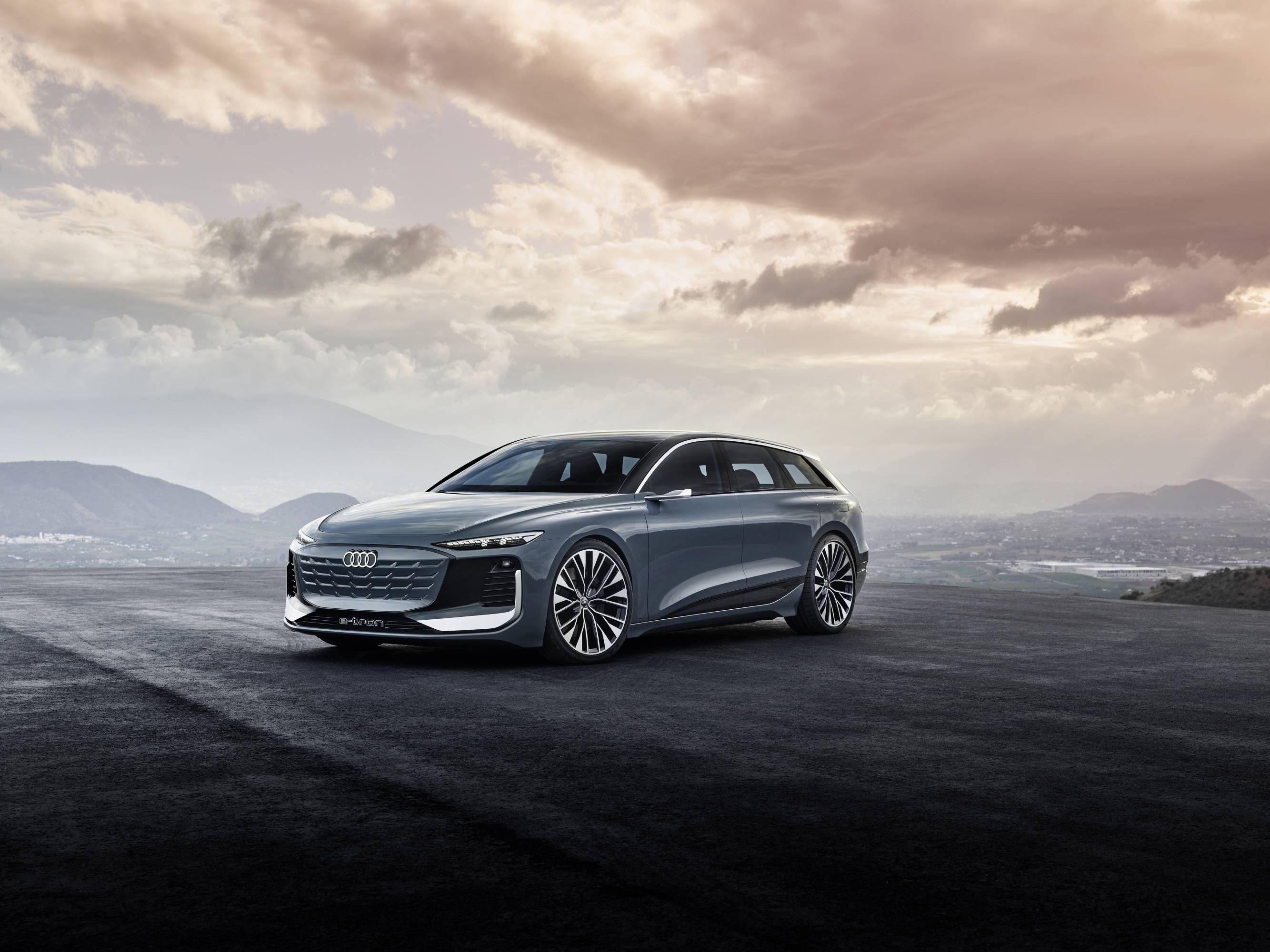
Tag: e-tron

  • Audi Q6 e-tron offroad concept

    Audi is redefining electric off-road potential with its striking Q6 e-tron concept, a vehicle built to merge raw capability with emotional design. This prototype isn’t just about power—though its dual motors churn out 380 kW—it’s engineered to conquer extremes. A reimagined portal axle system, distinct from traditional designs, amplifies torque at the wheels by 50%, allowing the vehicle to scale gradients as steep as 45 degrees. To put that into perspective: while most off-roaders might tackle rugged trails, this concept crawls up near-vertical challenges with ease.

    The Q6’s bold stance comes from a 160 mm lift in ride height and a track widened by 250 mm, giving it an almost imposing presence. But beneath the rugged exterior lies Audi’s signature innovation. Engineers started with a simple question: How do you craft an electric vehicle that thrills? Their answer was a ground-up redesign of portal axles, integrated into both front and rear hubs. The result? A jaw-dropping 13,400 Nm of combined torque at the wheels—enough to redefine what “off-road performance” means, even for a brand synonymous with Vorsprung durch Technik (progress through engineering).

    Built on Audi’s Premium Platform Electric (PPE), the same foundation as the production Q6 e-tron, this concept doesn’t sacrifice efficiency for brawn. While its top speed is capped at 175 km/h—plenty for off-grid adventures—the focus remains on pushing boundaries. Later this decade, Audi plans to showcase the concept’s capabilities in action at events like the 2025 F.A.T. Ice Race, with teasers rolling out on their social channels. For now, it stands as a tantalizing glimpse into an electric future where adventure isn’t just possible—it’s electrified.

  • Audi RS e-tron GT project 513-2

    Audi of America announced a limited offering of just 75 units of the 2023 Audi RS e-tron GT project_513/2. Developed in collaboration between Audi of America and Audi exclusive, customers now have the opportunity to drive a version of the e-tron GT that most closely resembles the prototype car. This limited edition leverages the original design used for global prototype testing with “e-tron” camouflage script on both the exterior and interior, and is exclusive to the U.S. market.

    Exterior design

    The RS e-tron GT project_513/2 is the first Audi to offer a camouflage graphics-skinned and wrapped exterior from the factory. Camouflage graphics are often used by Audi for initial testing, and are designed to create confusion for onlookers that may be looking to capture the latest glimpse into automotive exterior design and technology before it is made public.

    The exclusivity of the project is underlined by leveraging the internal code name as a special edition.

    The project_513/2 represents the project naming convention which defines the product’s segment, generation, and body style. This naming is crafted early in the development process and is typically kept internal.

    Audi exclusive leveraged the red and black color theme from the original prototype test mules, and presents for the first time “red” Audi rings on the front and rear of the exterior. Unique 21-inch aero wheels finished in black are framed with both front and rear ceramic brakes painted in red. Furthermore, the rear quarter glass is etched with the “project_513/2” logo that underlines its exclusivity.

    Interior Design

    The interior is inspired by its exterior colors and design elements using red and black colored accents as well as Audi exclusive interior elements unique to the edition. The air vents have been painted in the exact red color used for the exterior Audi rings, while red also appears on other details such as the steering wheel, floor mats, and the Fine Nappa leather honeycomb stitched seats.

    The dashboard introduces an Audi design first – Carbon fiber inlays with camo graphics that mimic the exterior design. These graphics include an innovative “partial matting” patented process, which is just a few thousandths of a millimeter deep, all primarily created by hand. The overall process includes the first component to be masked with a special foil, followed by glass media material that is pulled over the component using a suction jet method creating a distinctive, consistent look.

    For the first time on an Audi, the center armrest leather is embossed with the name of a special edition with “project_513/2”. In addition, the RS e-tron GT project_513/2 introduces an innovative e-tron background on the standard 10.1” MMI infotainment screen that includes an exclusive “project_513/2” logo in the bottom corner.

    Additionally, the RS e-tron GT project_513/2 presents an extensive list of standard equipment:

    • Fine Nappa leather seats with honeycomb stitching
    • 18-way front sport seat with ventilation and massage
    • Ceramic brakes with red caliper
    • Rear wheel steering
    • Power steering plus
    • Audi exclusive interior
    • 21“ 5-double-spoke concave design wheels in black finish
    • Dinamica headliner
    • HD Matrix-design LED headlights with Audi laser light
    • Carbon fiber roof
    • Carbon fiber exterior door inlays
    • Carbon fiber mirror caps
    • Illuminated Carbon fiber door sills inlays with RS logo

    Pure performance

    The Audi RS e-tron GT project_513/2 leverages the thrilling performance of the RS e-tron GT – Audi’s fastest 0-60 mph accelerating production model. Performance comes from two different motors (one on the front axle, and one on the rear axle) producing a combined 637 horsepower – making acceleration to 60 mph possible in just 3.1 seconds.

    Enhancing performance and precision handling at all speeds, the project_513/2 comes with standard rear wheel steering. This unique system allows the rear wheels to turn up to 2.8 degrees in the opposite direction of the front wheels at speeds up to about 30 mph for a tighter turning radius, while above 30 mph they turn in the same direction for greater stability and dynamics.

    Already have an e-tron GT? Audi has you covered

    Last year, Audi of America introduced the e-tron GT camouflage Indoor car cover for sale at audi-collection.com. The Indoor car cover holds the same camouflage wrap available on the RS e-tron GT project_513/2 made from a breathable and anti-static material, tailored specifically to fit your e-tron GT. The e-tron GT camouflage cover features black and white “e-tron” nomenclature underlined with elements of red and black color just like the limited edition model. For those customers that may not be fortunate enough to get one of the 75 limited edition units, the car cover will make anyone’s e-tron GT or RS e-tron GT look like they have the prototype in their garage.

    To further celebrate the exclusivity of each individual project_513/2, customers will receive a never before offered special edition VIN art. The VIN art portraits are printed on a thin aluminum plate with a high-gloss surface and are derived from the Vehicle Identification Number – exhibiting a detailed art print expression of the customer’s vehicle in high-resolution for display.

    The 2023 Audi RS e-tron GT project_513/2 is slated to be on sale this spring.

    MSRP pricing detail

    Model
    2023 RS e-tron GT project_513/2 $179,900

    Price excludes $1,495 destination charge, $595 metallic paint charge, sales taxes, title, options, and dealer charges. Dealer sets actual price.

  • Audi SQ8 Sportback e-tron quattro

    With the Audi e-tron, the premium manufacturer entered the age of electromobility in 2018, marking the start of the electric future for the four rings. Since then, the model has been setting standards in the electric luxury-class SUV segment. The new Audi Q8 e-tron is now building on the success story of this electric pioneer. The top-of-the-line electric SUV and crossover impress with their optimized drive concept, improved aerodynamics, higher charging performance, and battery capacity and increased range of up to 582 kilometers in the SUV version (in accordance with the WLTP) and up to 600 kilometers in the Sportback version (in accordance with the WLTP). Significant changes, especially at the front of the vehicle, lend the new flagship SUV a fresher appearance.

    Since the introduction of the Audi e-tron around four years ago and sales of 150,000 units, Audi has been following a systematic electric roadmap. Its electric portfolio now comprises eight models. By 2026, it will have more than 20. At that point, Audi will only be releasing fully electric models on the global market. “With our corporate strategy ‘Vorsprung 2030’, we’ve set a fixed date for our withdrawal from combustion engines and clearly decided that Audi will be a fully electric brand within 11 years,” said Markus Duesmann, Chairman of the Board of Management of AUDI AG. “The new Audi Q8 e-tron, with its improved efficiency and range and refined design, is another important component in our electric portfolio to get people excited about electromobility with emotional models that are suitable for everyday use.” Audi Board Member for Technical Development Oliver Hoffmann also focused on the customer benefits enhanced by these refinements. “In the new Q8 e-tron, we were able to significantly increase both battery capacity and charging performance. This allowed us to achieve an optimal balance between energy density and charging capacity, as well as to increase efficiency,” Hoffmann said. “On top of that, we improved the motors, progressive steering, and chassis control systems – and thus the dynamic driving characteristics that are typical of Audi in all versions of the Q8 e-tron.”

    New face, new name, new corporate identity

    By calling this model the Q8, Audi is making a clear statement that the Audi Q8 e-tron is the top model among its electric SUVs and crossovers. The Audi Q8 e-tron and Q8 Sportback e-tron are immediately identifiable as fully electric models at first glance. This is thanks to the new front and rear designs with the characteristic Singleframe mask, the inverted grille, and blade above the redesigned rear diffuser, which systematically carry Audi’s electric design language forward. An exclusive highlight on the edition S line package is the Singleframe grille, which is finished in body color.

    As a prestigious electric SUV model from Audi, the Q8 e-tron ushers in the new corporate identity with a two-dimensional design of the four rings on the exterior. In order to elevate the family logo as a central element, Audi highlights the vehicle’s face with the projection light Singleframe. Additionally, the Q8 e-tron is the first model to feature the new model badge with Audi lettering on the B-pillar.

    Maximum amount of space and comfort

    With a vehicle length of 4.915 meters, a width of 1.937 meters, and a height of 1.619 meters for the Sportback and 1.633 meters for the SUV, the Q8 e-tron offers a maximum amount of space and comfort. The SQ8 e-tron and SQ8 Sportback e-tron are each two millimeters lower and 39 millimeters wider. Its wheelbase of 2.928 meters allows for a lot of legroom in the back seats too. It has a generous storage volume of 569 liters for the SUV and 528 liters for the Sportback. There are also 62 liters available in the front storage area, the so called “frunk”.

    Three drivetrain variants

    For both body shapes, three drivetrain variants with electric all-wheel drive can be selected. With their two motors, the base models of the Audi Q8 50 e-tron and the Audi Q8 Sportback 50 e-tron generate 250 kW in boost mode and 664 Nm of torque, and they get a range of up to 491 km (SUV) and up to 505 km (Sportback), in accordance with the WLTP.

    With their two motors, the Audi Q8 55 e-tron and Audi Q8 Sportback 55 e-tron generate 300 kW in boost mode and 664 Nm of torque. Their ranges are up to 582 km for the SUV and up to 600 km for the Sportback, in accordance with the WLTP. Their top speed, and that of the Q8 50 e-tron, is limited to 200 km/h.

    The top-end Audi SQ8 e-tron and Audi SQ8 Sportback e-tron are powered by three motors. Their boost performance amounts to 370 kW and 973 Nm of torque.

    The range of the S models is up to 494 km for the SUV and up to 513 km for the Sportback. Their top speed is limited to 210 km/h.

    More battery capacity and higher charging performance

    Two battery sizes can be selected. The battery of the Q8 50 e-tron has a storage capacity of 89 net kilowatt-hours (95 gross kWh), while the more powerful versions of the Q8 55 e-tron and SQ8 e-tron have 106 net kWh (114 gross kWh). Thanks to an adjustment to the battery management system, the battery capacity usable for customers has increased as well. At a high-powered charging station, the Audi Q8 50 e-tron reaches a maximum charging performance of 150 kW. With the Q8 55 e-tron and SQ8 e-tron, the maximum charging performance increases to up to 170 kW. The big battery can be charged from ten to 80 percent during a roughly 31-minute charging stop – under ideal conditions, this corresponds to a range of up to 420 kilometers (according to WLTP). At an AC charging station or wallbox, the Audi Q8 e-tron charges at up to 11 kW. Audi offers an optional AC charging performance of up to 22 kW.

    Under ideal conditions, the Audi Q8 50 e-tron can completely charge in around nine hours and 15 minutes (22kW: around four hours and 45 minutes) using alternating current. The big battery’s numbers are around 11 hours and 30 minutes at 11 kW and six hours at 22 kW. The Audi Q8 e-tron comes standard with the Plug & Charge function. At compatible charging stations, the vehicle authorizes itself when inserting the charging cable and activates the charging point. Billing happens automatically. The new charging service Audi charging, which is set to launch in 2023 and will in the future replace the existing e-tron Charging Service, will allow for convenient access to around 400,000 public charging points across Europe. The e-tron route planner provides reliable support when searching for charging points along your route.

    Revised rear-axle motor and electric torque vectoring for better dynamics

    For the new Audi Q8 e-tron, the asynchronous motor concept on the rear axle was modified. Instead of 12 coils generating the electromagnetic field, there are now 14. The motor consequently generates a stronger magnetic field with similar electricity input, which in turn allows for more torque. If this isn’t needed, the electric motor requires less energy to generate torque. This lowers consumption and increases range. With the e-tron range’s S model, Audi used a three-motor concept for the first time in large-scale production.

    This was refined for the new SQ8 e-tron. A 124-kW electric motor is at work on the front axle. On the rear axle, there are two electric motors each with 98 kW of output that each separately power a rear wheel. This allows for a boost performance of up to 370 kW. The drive torque can be distributed across both rear electric motors between both wheels within a split second.

    Balancing act between comfort and sportiness

    The new Audi Q8 e-tron comes standard with an air-spring suspension with controlled shock absorption. The height of the car body can be varied by a total of 76 millimeters, depending on the driving situation. To optimize the lateral dynamics of the vehicle, its air-spring tuning was adjusted. Moreover, its electronic stability control (ESC) will allow for even more maneuverability in the future – especially in tight corners. The Audi Q8 e-tron handles these with noticeably more agility thanks to its revised progressive steering. The gear ratio of the steering system was changed so that the steering responds much more quickly, even when making delicate steering movements. The effect of the direct steering ratio is supported by more rigid suspension bearings on the front axle. Steering movements are thus transmitted to the wheels more directly, and feedback from steering reactions is improved as well. All the chassis control systems were adjusted, but they remain balanced and perfectly attuned – true to the Audi DNA.

    Further improved aerodynamics

    With the Audi Q8 e-tron, the topic of aerodynamics was a top priority. This resulted in a reduction of the drag coefficient from 0.26 to 0.24 cw for the Q8 Sportback e-tron and from 0.28 to 0.27 cw for the Q8 e-tron. The wheel spoilers mounted on the underbody help divert airflow around the wheels. The spoilers on the front axle were enlarged, and the Audi Q8 Sportback e-tron now has spoilers on the rear wheels as well. With the SQ8 Sportback e-tron, spoilers are only mounted on the rear axle. In the area around the grille, this is the first time an Audi model has had a self-sealing system in addition to the electric shutters that automatically close the radiator. This system further optimizes the airflow at the front of the car and prevents undesired losses.

    Convenient parking with remote park assist plus

    There are around 40 driver assistance systems available in the Audi Q8 e-tron. Up to five radar sensors, five cameras and 12 ultrasonic sensors provide environmental information that’s then analyzed by the central driver assistance control unit. Something new is remote park assist plus, which will be available to order starting in 2023. With its help, the Audi Q8 e-tron can maneuver into even the tightest parking spaces. Customers can control the parking procedure through the myAudi app on their smartphones. When the car reaches its final position in the parking space, it automatically switches off, puts on the parking brake, and locks the doors. To leave the parking space, the motor is powered on through the myAudi app, then the vehicle maneuvers out enough for comfortable entry.

    Digital Matrix LED headlights

    The Q8 e-tron optionally comes with digital Matrix LED headlights. While driving on the highway, the orientation light marks the car’s position in the lane and helps the driver remain securely in the center in narrow spaces. Three other new features are available as well: enhanced traffic information, the lane light with a direction indicator and the orientation light on country roads.

    Luxury-class interior

    The glass panorama roof makes the interior appear lighter and reinforces the sense of airiness and expansiveness. The glass elements open and close electronically. The blackout sunshades are controlled just as conveniently. When it’s open, the two-part glass roof improves the climate in the interior thanks to efficient ventilation. An integrated wind deflector reduces wind noise as well. As an alternative to the standard two-zone automatic climate control, Audi is also offering four-zone automatic climate control and an air quality package. The three-stage ventilation provides for comfortable seating, even at high outdoor temperatures. This is available for the standard seats, whose leather is intricately perforated. The highly adjustable individual contour seats are the highlight among the interior options. In addition to pneumatic seat and backrest adjustments, they can also be ordered with a massage function. All furnishings come with optional decorative inlays of porous wood veneers such as grainy ash and sycamore, aluminum or, for the S line and edition S line versions, a carbon fiber structure. New additions include light brown walnut wood and a sustainable technical material made partially from recycled PET bottles.

    High-resolution touch displays and voice control

    Like all luxury-class Audi models, the Q8 e-tron uses the MMI touch response operating system. Its two large high-resolution displays – the top one with a 10.1-inch diagonal and the bottom one with an 8.6-inch diagonal – replace nearly all conventional switches and knobs. Beyond operation with the two touch displays, a lot of features can be activated through natural voice control. The digital display and operating concept in the Audi Q8 e-tron is rounded out by the standard Audi virtual cockpit with full HD resolution. Specific graphics depict all the important aspects of electric driving, from charging performance to range. On request, a heads-up display can be added. On the German market, the Audi Q8 e-tron will come standard with MMI Navigation plus. Its media center supports the high-speed data transmission standard LTE Advanced, and it has an integrated WiFi hotspot for the passengers’ mobile devices. The navigation system intelligently recommends destinations based on previously traveled routes. On top of that, the Audi connect Navigation and Infotainment package includes car-to-X services.

    Materials from recycling processes

    The Audi Q8 e-tron will be certified as net-carbon-neutral for customers in Europe and the USA. Audi also uses recycled materials for some components in the Audi Q8 e-tron. These materials, treated through a recycling process, reduce the amount of resources used and ensure a closed, efficient and sustainable material loop.

    In the interior of the Audi Q8 e-tron, Audi uses recycled materials for insulation and damping, as well as for carpeting. The decorative inlay above the display, called the Tech Layer, is available with a new anthracite-colored technical material that’s partially composed of recycled PET bottles. With the S line equipment package, the sport seats are upholstered in synthetic leather and the microfiber material Dinamica. Dinamica is made from up to 45 percent polyester fibers that are manufactured from recycled PET bottles, used textiles and fiber residue. In contrast to previous microfiber quality, the production of Dinamica is also solvent-free – another contribution to environmental protection.

    Furthermore, some safety-related components that partially comprise mixed automotive plastic waste treated through a chemical recycling process are used for the first time – specifically, the plastic covers for the seatbelt buckles. As part of the PlasticLoop project, Audi worked with the plastics manufacturer LyondellBasell to establish a process in which chemical recycling will be used for the first time to reuse mixed automotive plastic waste in the series production of the Audi Q8 e-tron. In this process, jointly implemented with LyondellBasell, plastic components from customer vehicles that can no longer be repaired are dismantled and separated from foreign materials such as metal clips before being shredded and processed into pyrolysis oil through chemical recycling. This pyrolysis oil is then used as a raw material in the production of new plastics in a mass-balance approach.

    Market launch in spring 2023

    The market launch of the new Audi Q8 e-tron and Audi Q8 Sportback e-tron, which will be available to order starting in mid-November, is planned to happen at the end of February 2023 in Germany and the most important European markets. In the USA, the model is expected to come to the market at the end of April. The base price for the Audi Q8 e-tron in Germany will be 74,400 euros.

  • Audi SQ8 e-tron quattro

    With the Audi e-tron, the premium manufacturer entered the age of electromobility in 2018, marking the start of the electric future for the four rings. Since then, the model has been setting standards in the electric luxury-class SUV segment. The new Audi Q8 e-tron is now building on the success story of this electric pioneer. The top-of-the-line electric SUV and crossover impress with their optimized drive concept, improved aerodynamics, higher charging performance, and battery capacity and increased range of up to 582 kilometers in the SUV version (in accordance with the WLTP) and up to 600 kilometers in the Sportback version (in accordance with the WLTP). Significant changes, especially at the front of the vehicle, lend the new flagship SUV a fresher appearance.

    Since the introduction of the Audi e-tron around four years ago and sales of 150,000 units, Audi has been following a systematic electric roadmap. Its electric portfolio now comprises eight models. By 2026, it will have more than 20. At that point, Audi will only be releasing fully electric models on the global market. “With our corporate strategy ‘Vorsprung 2030’, we’ve set a fixed date for our withdrawal from combustion engines and clearly decided that Audi will be a fully electric brand within 11 years,” said Markus Duesmann, Chairman of the Board of Management of AUDI AG. “The new Audi Q8 e-tron, with its improved efficiency and range and refined design, is another important component in our electric portfolio to get people excited about electromobility with emotional models that are suitable for everyday use.” Audi Board Member for Technical Development Oliver Hoffmann also focused on the customer benefits enhanced by these refinements. “In the new Q8 e-tron, we were able to significantly increase both battery capacity and charging performance. This allowed us to achieve an optimal balance between energy density and charging capacity, as well as to increase efficiency,” Hoffmann said. “On top of that, we improved the motors, progressive steering, and chassis control systems – and thus the dynamic driving characteristics that are typical of Audi in all versions of the Q8 e-tron.”

    New face, new name, new corporate identity

    By calling this model the Q8, Audi is making a clear statement that the Audi Q8 e-tron is the top model among its electric SUVs and crossovers. The Audi Q8 e-tron and Q8 Sportback e-tron are immediately identifiable as fully electric models at first glance. This is thanks to the new front and rear designs with the characteristic Singleframe mask, the inverted grille, and blade above the redesigned rear diffuser, which systematically carry Audi’s electric design language forward. An exclusive highlight on the edition S line package is the Singleframe grille, which is finished in body color.

    As a prestigious electric SUV model from Audi, the Q8 e-tron ushers in the new corporate identity with a two-dimensional design of the four rings on the exterior. In order to elevate the family logo as a central element, Audi highlights the vehicle’s face with the projection light Singleframe. Additionally, the Q8 e-tron is the first model to feature the new model badge with Audi lettering on the B-pillar.

    Maximum amount of space and comfort

    With a vehicle length of 4.915 meters, a width of 1.937 meters, and a height of 1.619 meters for the Sportback and 1.633 meters for the SUV, the Q8 e-tron offers a maximum amount of space and comfort. The SQ8 e-tron and SQ8 Sportback e-tron are each two millimeters lower and 39 millimeters wider. Its wheelbase of 2.928 meters allows for a lot of legroom in the back seats too. It has a generous storage volume of 569 liters for the SUV and 528 liters for the Sportback. There are also 62 liters available in the front storage area, the so called “frunk”.

    Three drivetrain variants

    For both body shapes, three drivetrain variants with electric all-wheel drive can be selected. With their two motors, the base models of the Audi Q8 50 e-tron and the Audi Q8 Sportback 50 e-tron generate 250 kW in boost mode and 664 Nm of torque, and they get a range of up to 491 km (SUV) and up to 505 km (Sportback), in accordance with the WLTP.

    With their two motors, the Audi Q8 55 e-tron and Audi Q8 Sportback 55 e-tron generate 300 kW in boost mode and 664 Nm of torque. Their ranges are up to 582 km for the SUV and up to 600 km for the Sportback, in accordance with the WLTP. Their top speed, and that of the Q8 50 e-tron, is limited to 200 km/h.

    The top-end Audi SQ8 e-tron and Audi SQ8 Sportback e-tron are powered by three motors. Their boost performance amounts to 370 kW and 973 Nm of torque.

    The range of the S models is up to 494 km for the SUV and up to 513 km for the Sportback. Their top speed is limited to 210 km/h.

    More battery capacity and higher charging performance

    Two battery sizes can be selected. The battery of the Q8 50 e-tron has a storage capacity of 89 net kilowatt-hours (95 gross kWh), while the more powerful versions of the Q8 55 e-tron and SQ8 e-tron have 106 net kWh (114 gross kWh). Thanks to an adjustment to the battery management system, the battery capacity usable for customers has increased as well. At a high-powered charging station, the Audi Q8 50 e-tron reaches a maximum charging performance of 150 kW. With the Q8 55 e-tron and SQ8 e-tron, the maximum charging performance increases to up to 170 kW. The big battery can be charged from ten to 80 percent during a roughly 31-minute charging stop – under ideal conditions, this corresponds to a range of up to 420 kilometers (according to WLTP). At an AC charging station or wallbox, the Audi Q8 e-tron charges at up to 11 kW. Audi offers an optional AC charging performance of up to 22 kW.

    Under ideal conditions, the Audi Q8 50 e-tron can completely charge in around nine hours and 15 minutes (22kW: around four hours and 45 minutes) using alternating current. The big battery’s numbers are around 11 hours and 30 minutes at 11 kW and six hours at 22 kW. The Audi Q8 e-tron comes standard with the Plug & Charge function. At compatible charging stations, the vehicle authorizes itself when inserting the charging cable and activates the charging point. Billing happens automatically. The new charging service Audi charging, which is set to launch in 2023 and will in the future replace the existing e-tron Charging Service, will allow for convenient access to around 400,000 public charging points across Europe. The e-tron route planner provides reliable support when searching for charging points along your route.

    Revised rear-axle motor and electric torque vectoring for better dynamics

    For the new Audi Q8 e-tron, the asynchronous motor concept on the rear axle was modified. Instead of 12 coils generating the electromagnetic field, there are now 14. The motor consequently generates a stronger magnetic field with similar electricity input, which in turn allows for more torque. If this isn’t needed, the electric motor requires less energy to generate torque. This lowers consumption and increases range. With the e-tron range’s S model, Audi used a three-motor concept for the first time in large-scale production.

    This was refined for the new SQ8 e-tron. A 124-kW electric motor is at work on the front axle. On the rear axle, there are two electric motors each with 98 kW of output that each separately power a rear wheel. This allows for a boost performance of up to 370 kW. The drive torque can be distributed across both rear electric motors between both wheels within a split second.

    Balancing act between comfort and sportiness

    The new Audi Q8 e-tron comes standard with an air-spring suspension with controlled shock absorption. The height of the car body can be varied by a total of 76 millimeters, depending on the driving situation. To optimize the lateral dynamics of the vehicle, its air-spring tuning was adjusted. Moreover, its electronic stability control (ESC) will allow for even more maneuverability in the future – especially in tight corners. The Audi Q8 e-tron handles these with noticeably more agility thanks to its revised progressive steering. The gear ratio of the steering system was changed so that the steering responds much more quickly, even when making delicate steering movements. The effect of the direct steering ratio is supported by more rigid suspension bearings on the front axle. Steering movements are thus transmitted to the wheels more directly, and feedback from steering reactions is improved as well. All the chassis control systems were adjusted, but they remain balanced and perfectly attuned – true to the Audi DNA.

    Further improved aerodynamics

    With the Audi Q8 e-tron, the topic of aerodynamics was a top priority. This resulted in a reduction of the drag coefficient from 0.26 to 0.24 cw for the Q8 Sportback e-tron and from 0.28 to 0.27 cw for the Q8 e-tron. The wheel spoilers mounted on the underbody help divert airflow around the wheels. The spoilers on the front axle were enlarged, and the Audi Q8 Sportback e-tron now has spoilers on the rear wheels as well. With the SQ8 Sportback e-tron, spoilers are only mounted on the rear axle. In the area around the grille, this is the first time an Audi model has had a self-sealing system in addition to the electric shutters that automatically close the radiator. This system further optimizes the airflow at the front of the car and prevents undesired losses.

    Convenient parking with remote park assist plus

    There are around 40 driver assistance systems available in the Audi Q8 e-tron. Up to five radar sensors, five cameras and 12 ultrasonic sensors provide environmental information that’s then analyzed by the central driver assistance control unit. Something new is remote park assist plus, which will be available to order starting in 2023. With its help, the Audi Q8 e-tron can maneuver into even the tightest parking spaces. Customers can control the parking procedure through the myAudi app on their smartphones. When the car reaches its final position in the parking space, it automatically switches off, puts on the parking brake, and locks the doors. To leave the parking space, the motor is powered on through the myAudi app, then the vehicle maneuvers out enough for comfortable entry.

    Digital Matrix LED headlights

    The Q8 e-tron optionally comes with digital Matrix LED headlights. While driving on the highway, the orientation light marks the car’s position in the lane and helps the driver remain securely in the center in narrow spaces. Three other new features are available as well: enhanced traffic information, the lane light with a direction indicator and the orientation light on country roads.

    Luxury-class interior

    The glass panorama roof makes the interior appear lighter and reinforces the sense of airiness and expansiveness. The glass elements open and close electronically. The blackout sunshades are controlled just as conveniently. When it’s open, the two-part glass roof improves the climate in the interior thanks to efficient ventilation. An integrated wind deflector reduces wind noise as well. As an alternative to the standard two-zone automatic climate control, Audi is also offering four-zone automatic climate control and an air quality package. The three-stage ventilation provides for comfortable seating, even at high outdoor temperatures. This is available for the standard seats, whose leather is intricately perforated. The highly adjustable individual contour seats are the highlight among the interior options. In addition to pneumatic seat and backrest adjustments, they can also be ordered with a massage function. All furnishings come with optional decorative inlays of porous wood veneers such as grainy ash and sycamore, aluminum or, for the S line and edition S line versions, a carbon fiber structure. New additions include light brown walnut wood and a sustainable technical material made partially from recycled PET bottles.

    High-resolution touch displays and voice control

    Like all luxury-class Audi models, the Q8 e-tron uses the MMI touch response operating system. Its two large high-resolution displays – the top one with a 10.1-inch diagonal and the bottom one with an 8.6-inch diagonal – replace nearly all conventional switches and knobs. Beyond operation with the two touch displays, a lot of features can be activated through natural voice control. The digital display and operating concept in the Audi Q8 e-tron is rounded out by the standard Audi virtual cockpit with full HD resolution. Specific graphics depict all the important aspects of electric driving, from charging performance to range. On request, a heads-up display can be added. On the German market, the Audi Q8 e-tron will come standard with MMI Navigation plus. Its media center supports the high-speed data transmission standard LTE Advanced, and it has an integrated WiFi hotspot for the passengers’ mobile devices. The navigation system intelligently recommends destinations based on previously traveled routes. On top of that, the Audi connect Navigation and Infotainment package includes car-to-X services.

    Materials from recycling processes

    The Audi Q8 e-tron will be certified as net-carbon-neutral for customers in Europe and the USA. Audi also uses recycled materials for some components in the Audi Q8 e-tron. These materials, treated through a recycling process, reduce the amount of resources used and ensure a closed, efficient and sustainable material loop.

    In the interior of the Audi Q8 e-tron, Audi uses recycled materials for insulation and damping, as well as for carpeting. The decorative inlay above the display, called the Tech Layer, is available with a new anthracite-colored technical material that’s partially composed of recycled PET bottles. With the S line equipment package, the sport seats are upholstered in synthetic leather and the microfiber material Dinamica. Dinamica is made from up to 45 percent polyester fibers that are manufactured from recycled PET bottles, used textiles and fiber residue. In contrast to previous microfiber quality, the production of Dinamica is also solvent-free – another contribution to environmental protection.

    Furthermore, some safety-related components that partially comprise mixed automotive plastic waste treated through a chemical recycling process are used for the first time – specifically, the plastic covers for the seatbelt buckles. As part of the PlasticLoop project, Audi worked with the plastics manufacturer LyondellBasell to establish a process in which chemical recycling will be used for the first time to reuse mixed automotive plastic waste in the series production of the Audi Q8 e-tron. In this process, jointly implemented with LyondellBasell, plastic components from customer vehicles that can no longer be repaired are dismantled and separated from foreign materials such as metal clips before being shredded and processed into pyrolysis oil through chemical recycling. This pyrolysis oil is then used as a raw material in the production of new plastics in a mass-balance approach.

    Market launch in spring 2023

    The market launch of the new Audi Q8 e-tron and Audi Q8 Sportback e-tron, which will be available to order starting in mid-November, is planned to happen at the end of February 2023 in Germany and the most important European markets. In the USA, the model is expected to come to the market at the end of April. The base price for the Audi Q8 e-tron in Germany will be 74,400 euros.

  • Audi Q8 Sportback e-tron quattro

    With the Audi e-tron, the premium manufacturer entered the age of electromobility in 2018, marking the start of the electric future for the four rings. Since then, the model has been setting standards in the electric luxury-class SUV segment. The new Audi Q8 e-tron is now building on the success story of this electric pioneer. The top-of-the-line electric SUV and crossover impress with their optimized drive concept, improved aerodynamics, higher charging performance, and battery capacity and increased range of up to 582 kilometers in the SUV version (in accordance with the WLTP) and up to 600 kilometers in the Sportback version (in accordance with the WLTP). Significant changes, especially at the front of the vehicle, lend the new flagship SUV a fresher appearance.

    Since the introduction of the Audi e-tron around four years ago and sales of 150,000 units, Audi has been following a systematic electric roadmap. Its electric portfolio now comprises eight models. By 2026, it will have more than 20. At that point, Audi will only be releasing fully electric models on the global market. “With our corporate strategy ‘Vorsprung 2030’, we’ve set a fixed date for our withdrawal from combustion engines and clearly decided that Audi will be a fully electric brand within 11 years,” said Markus Duesmann, Chairman of the Board of Management of AUDI AG. “The new Audi Q8 e-tron, with its improved efficiency and range and refined design, is another important component in our electric portfolio to get people excited about electromobility with emotional models that are suitable for everyday use.” Audi Board Member for Technical Development Oliver Hoffmann also focused on the customer benefits enhanced by these refinements. “In the new Q8 e-tron, we were able to significantly increase both battery capacity and charging performance. This allowed us to achieve an optimal balance between energy density and charging capacity, as well as to increase efficiency,” Hoffmann said. “On top of that, we improved the motors, progressive steering, and chassis control systems – and thus the dynamic driving characteristics that are typical of Audi in all versions of the Q8 e-tron.”

    New face, new name, new corporate identity

    By calling this model the Q8, Audi is making a clear statement that the Audi Q8 e-tron is the top model among its electric SUVs and crossovers. The Audi Q8 e-tron and Q8 Sportback e-tron are immediately identifiable as fully electric models at first glance. This is thanks to the new front and rear designs with the characteristic Singleframe mask, the inverted grille, and blade above the redesigned rear diffuser, which systematically carry Audi’s electric design language forward. An exclusive highlight on the edition S line package is the Singleframe grille, which is finished in body color.

    As a prestigious electric SUV model from Audi, the Q8 e-tron ushers in the new corporate identity with a two-dimensional design of the four rings on the exterior. In order to elevate the family logo as a central element, Audi highlights the vehicle’s face with the projection light Singleframe. Additionally, the Q8 e-tron is the first model to feature the new model badge with Audi lettering on the B-pillar.

    Maximum amount of space and comfort

    With a vehicle length of 4.915 meters, a width of 1.937 meters, and a height of 1.619 meters for the Sportback and 1.633 meters for the SUV, the Q8 e-tron offers a maximum amount of space and comfort. The SQ8 e-tron and SQ8 Sportback e-tron are each two millimeters lower and 39 millimeters wider. Its wheelbase of 2.928 meters allows for a lot of legroom in the back seats too. It has a generous storage volume of 569 liters for the SUV and 528 liters for the Sportback. There are also 62 liters available in the front storage area, the so called “frunk”.

    Three drivetrain variants

    For both body shapes, three drivetrain variants with electric all-wheel drive can be selected. With their two motors, the base models of the Audi Q8 50 e-tron and the Audi Q8 Sportback 50 e-tron generate 250 kW in boost mode and 664 Nm of torque, and they get a range of up to 491 km (SUV) and up to 505 km (Sportback), in accordance with the WLTP.

    With their two motors, the Audi Q8 55 e-tron and Audi Q8 Sportback 55 e-tron generate 300 kW in boost mode and 664 Nm of torque. Their ranges are up to 582 km for the SUV and up to 600 km for the Sportback, in accordance with the WLTP. Their top speed, and that of the Q8 50 e-tron, is limited to 200 km/h.

    The top-end Audi SQ8 e-tron and Audi SQ8 Sportback e-tron are powered by three motors. Their boost performance amounts to 370 kW and 973 Nm of torque.

    The range of the S models is up to 494 km for the SUV and up to 513 km for the Sportback. Their top speed is limited to 210 km/h.

    More battery capacity and higher charging performance

    Two battery sizes can be selected. The battery of the Q8 50 e-tron has a storage capacity of 89 net kilowatt-hours (95 gross kWh), while the more powerful versions of the Q8 55 e-tron and SQ8 e-tron have 106 net kWh (114 gross kWh). Thanks to an adjustment to the battery management system, the battery capacity usable for customers has increased as well. At a high-powered charging station, the Audi Q8 50 e-tron reaches a maximum charging performance of 150 kW. With the Q8 55 e-tron and SQ8 e-tron, the maximum charging performance increases to up to 170 kW. The big battery can be charged from ten to 80 percent during a roughly 31-minute charging stop – under ideal conditions, this corresponds to a range of up to 420 kilometers (according to WLTP). At an AC charging station or wallbox, the Audi Q8 e-tron charges at up to 11 kW. Audi offers an optional AC charging performance of up to 22 kW.

    Under ideal conditions, the Audi Q8 50 e-tron can completely charge in around nine hours and 15 minutes (22kW: around four hours and 45 minutes) using alternating current. The big battery’s numbers are around 11 hours and 30 minutes at 11 kW and six hours at 22 kW. The Audi Q8 e-tron comes standard with the Plug & Charge function. At compatible charging stations, the vehicle authorizes itself when inserting the charging cable and activates the charging point. Billing happens automatically. The new charging service Audi charging, which is set to launch in 2023 and will in the future replace the existing e-tron Charging Service, will allow for convenient access to around 400,000 public charging points across Europe. The e-tron route planner provides reliable support when searching for charging points along your route.

    Revised rear-axle motor and electric torque vectoring for better dynamics

    For the new Audi Q8 e-tron, the asynchronous motor concept on the rear axle was modified. Instead of 12 coils generating the electromagnetic field, there are now 14. The motor consequently generates a stronger magnetic field with similar electricity input, which in turn allows for more torque. If this isn’t needed, the electric motor requires less energy to generate torque. This lowers consumption and increases range. With the e-tron range’s S model, Audi used a three-motor concept for the first time in large-scale production.

    This was refined for the new SQ8 e-tron. A 124-kW electric motor is at work on the front axle. On the rear axle, there are two electric motors each with 98 kW of output that each separately power a rear wheel. This allows for a boost performance of up to 370 kW. The drive torque can be distributed across both rear electric motors between both wheels within a split second.

    Balancing act between comfort and sportiness

    The new Audi Q8 e-tron comes standard with an air-spring suspension with controlled shock absorption. The height of the car body can be varied by a total of 76 millimeters, depending on the driving situation. To optimize the lateral dynamics of the vehicle, its air-spring tuning was adjusted. Moreover, its electronic stability control (ESC) will allow for even more maneuverability in the future – especially in tight corners. The Audi Q8 e-tron handles these with noticeably more agility thanks to its revised progressive steering. The gear ratio of the steering system was changed so that the steering responds much more quickly, even when making delicate steering movements. The effect of the direct steering ratio is supported by more rigid suspension bearings on the front axle. Steering movements are thus transmitted to the wheels more directly, and feedback from steering reactions is improved as well. All the chassis control systems were adjusted, but they remain balanced and perfectly attuned – true to the Audi DNA.

    Further improved aerodynamics

    With the Audi Q8 e-tron, the topic of aerodynamics was a top priority. This resulted in a reduction of the drag coefficient from 0.26 to 0.24 cw for the Q8 Sportback e-tron and from 0.28 to 0.27 cw for the Q8 e-tron. The wheel spoilers mounted on the underbody help divert airflow around the wheels. The spoilers on the front axle were enlarged, and the Audi Q8 Sportback e-tron now has spoilers on the rear wheels as well. With the SQ8 Sportback e-tron, spoilers are only mounted on the rear axle. In the area around the grille, this is the first time an Audi model has had a self-sealing system in addition to the electric shutters that automatically close the radiator. This system further optimizes the airflow at the front of the car and prevents undesired losses.

    Convenient parking with remote park assist plus

    There are around 40 driver assistance systems available in the Audi Q8 e-tron. Up to five radar sensors, five cameras and 12 ultrasonic sensors provide environmental information that’s then analyzed by the central driver assistance control unit. Something new is remote park assist plus, which will be available to order starting in 2023. With its help, the Audi Q8 e-tron can maneuver into even the tightest parking spaces. Customers can control the parking procedure through the myAudi app on their smartphones. When the car reaches its final position in the parking space, it automatically switches off, puts on the parking brake, and locks the doors. To leave the parking space, the motor is powered on through the myAudi app, then the vehicle maneuvers out enough for comfortable entry.

    Digital Matrix LED headlights

    The Q8 e-tron optionally comes with digital Matrix LED headlights. While driving on the highway, the orientation light marks the car’s position in the lane and helps the driver remain securely in the center in narrow spaces. Three other new features are available as well: enhanced traffic information, the lane light with a direction indicator and the orientation light on country roads.

    Luxury-class interior

    The glass panorama roof makes the interior appear lighter and reinforces the sense of airiness and expansiveness. The glass elements open and close electronically. The blackout sunshades are controlled just as conveniently. When it’s open, the two-part glass roof improves the climate in the interior thanks to efficient ventilation. An integrated wind deflector reduces wind noise as well. As an alternative to the standard two-zone automatic climate control, Audi is also offering four-zone automatic climate control and an air quality package. The three-stage ventilation provides for comfortable seating, even at high outdoor temperatures. This is available for the standard seats, whose leather is intricately perforated. The highly adjustable individual contour seats are the highlight among the interior options. In addition to pneumatic seat and backrest adjustments, they can also be ordered with a massage function. All furnishings come with optional decorative inlays of porous wood veneers such as grainy ash and sycamore, aluminum or, for the S line and edition S line versions, a carbon fiber structure. New additions include light brown walnut wood and a sustainable technical material made partially from recycled PET bottles.

    High-resolution touch displays and voice control

    Like all luxury-class Audi models, the Q8 e-tron uses the MMI touch response operating system. Its two large high-resolution displays – the top one with a 10.1-inch diagonal and the bottom one with an 8.6-inch diagonal – replace nearly all conventional switches and knobs. Beyond operation with the two touch displays, a lot of features can be activated through natural voice control. The digital display and operating concept in the Audi Q8 e-tron is rounded out by the standard Audi virtual cockpit with full HD resolution. Specific graphics depict all the important aspects of electric driving, from charging performance to range. On request, a heads-up display can be added. On the German market, the Audi Q8 e-tron will come standard with MMI Navigation plus. Its media center supports the high-speed data transmission standard LTE Advanced, and it has an integrated WiFi hotspot for the passengers’ mobile devices. The navigation system intelligently recommends destinations based on previously traveled routes. On top of that, the Audi connect Navigation and Infotainment package includes car-to-X services.

    Materials from recycling processes

    The Audi Q8 e-tron will be certified as net-carbon-neutral for customers in Europe and the USA. Audi also uses recycled materials for some components in the Audi Q8 e-tron. These materials, treated through a recycling process, reduce the amount of resources used and ensure a closed, efficient and sustainable material loop.

    In the interior of the Audi Q8 e-tron, Audi uses recycled materials for insulation and damping, as well as for carpeting. The decorative inlay above the display, called the Tech Layer, is available with a new anthracite-colored technical material that’s partially composed of recycled PET bottles. With the S line equipment package, the sport seats are upholstered in synthetic leather and the microfiber material Dinamica. Dinamica is made from up to 45 percent polyester fibers that are manufactured from recycled PET bottles, used textiles and fiber residue. In contrast to previous microfiber quality, the production of Dinamica is also solvent-free – another contribution to environmental protection.

    Furthermore, some safety-related components that partially comprise mixed automotive plastic waste treated through a chemical recycling process are used for the first time – specifically, the plastic covers for the seatbelt buckles. As part of the PlasticLoop project, Audi worked with the plastics manufacturer LyondellBasell to establish a process in which chemical recycling will be used for the first time to reuse mixed automotive plastic waste in the series production of the Audi Q8 e-tron. In this process, jointly implemented with LyondellBasell, plastic components from customer vehicles that can no longer be repaired are dismantled and separated from foreign materials such as metal clips before being shredded and processed into pyrolysis oil through chemical recycling. This pyrolysis oil is then used as a raw material in the production of new plastics in a mass-balance approach.

    Market launch in spring 2023

    The market launch of the new Audi Q8 e-tron and Audi Q8 Sportback e-tron, which will be available to order starting in mid-November, is planned to happen at the end of February 2023 in Germany and the most important European markets. In the USA, the model is expected to come to the market at the end of April. The base price for the Audi Q8 e-tron in Germany will be 74,400 euros.

  • Audi Q8 e-tron quattro

    With the Audi e-tron, the premium manufacturer entered the age of electromobility in 2018, marking the start of the electric future for the four rings. Since then, the model has been setting standards in the electric luxury-class SUV segment. The new Audi Q8 e-tron is now building on the success story of this electric pioneer. The top-of-the-line electric SUV and crossover impress with their optimized drive concept, improved aerodynamics, higher charging performance, and battery capacity and increased range of up to 582 kilometers in the SUV version (in accordance with the WLTP) and up to 600 kilometers in the Sportback version (in accordance with the WLTP). Significant changes, especially at the front of the vehicle, lend the new flagship SUV a fresher appearance.

    Since the introduction of the Audi e-tron around four years ago and sales of 150,000 units, Audi has been following a systematic electric roadmap. Its electric portfolio now comprises eight models. By 2026, it will have more than 20. At that point, Audi will only be releasing fully electric models on the global market. “With our corporate strategy ‘Vorsprung 2030’, we’ve set a fixed date for our withdrawal from combustion engines and clearly decided that Audi will be a fully electric brand within 11 years,” said Markus Duesmann, Chairman of the Board of Management of AUDI AG. “The new Audi Q8 e-tron, with its improved efficiency and range and refined design, is another important component in our electric portfolio to get people excited about electromobility with emotional models that are suitable for everyday use.” Audi Board Member for Technical Development Oliver Hoffmann also focused on the customer benefits enhanced by these refinements. “In the new Q8 e-tron, we were able to significantly increase both battery capacity and charging performance. This allowed us to achieve an optimal balance between energy density and charging capacity, as well as to increase efficiency,” Hoffmann said. “On top of that, we improved the motors, progressive steering, and chassis control systems – and thus the dynamic driving characteristics that are typical of Audi in all versions of the Q8 e-tron.”

    New face, new name, new corporate identity

    By calling this model the Q8, Audi is making a clear statement that the Audi Q8 e-tron is the top model among its electric SUVs and crossovers. The Audi Q8 e-tron and Q8 Sportback e-tron are immediately identifiable as fully electric models at first glance. This is thanks to the new front and rear designs with the characteristic Singleframe mask, the inverted grille, and blade above the redesigned rear diffuser, which systematically carry Audi’s electric design language forward. An exclusive highlight on the edition S line package is the Singleframe grille, which is finished in body color.

    As a prestigious electric SUV model from Audi, the Q8 e-tron ushers in the new corporate identity with a two-dimensional design of the four rings on the exterior. In order to elevate the family logo as a central element, Audi highlights the vehicle’s face with the projection light Singleframe. Additionally, the Q8 e-tron is the first model to feature the new model badge with Audi lettering on the B-pillar.

    Maximum amount of space and comfort

    With a vehicle length of 4.915 meters, a width of 1.937 meters, and a height of 1.619 meters for the Sportback and 1.633 meters for the SUV, the Q8 e-tron offers a maximum amount of space and comfort. The SQ8 e-tron and SQ8 Sportback e-tron are each two millimeters lower and 39 millimeters wider. Its wheelbase of 2.928 meters allows for a lot of legroom in the back seats too. It has a generous storage volume of 569 liters for the SUV and 528 liters for the Sportback. There are also 62 liters available in the front storage area, the so called “frunk”.

    Three drivetrain variants

    For both body shapes, three drivetrain variants with electric all-wheel drive can be selected. With their two motors, the base models of the Audi Q8 50 e-tron and the Audi Q8 Sportback 50 e-tron generate 250 kW in boost mode and 664 Nm of torque, and they get a range of up to 491 km (SUV) and up to 505 km (Sportback), in accordance with the WLTP.

    With their two motors, the Audi Q8 55 e-tron and Audi Q8 Sportback 55 e-tron generate 300 kW in boost mode and 664 Nm of torque. Their ranges are up to 582 km for the SUV and up to 600 km for the Sportback, in accordance with the WLTP. Their top speed, and that of the Q8 50 e-tron, is limited to 200 km/h.

    The top-end Audi SQ8 e-tron and Audi SQ8 Sportback e-tron are powered by three motors. Their boost performance amounts to 370 kW and 973 Nm of torque.

    The range of the S models is up to 494 km for the SUV and up to 513 km for the Sportback. Their top speed is limited to 210 km/h.

    More battery capacity and higher charging performance

    Two battery sizes can be selected. The battery of the Q8 50 e-tron has a storage capacity of 89 net kilowatt-hours (95 gross kWh), while the more powerful versions of the Q8 55 e-tron and SQ8 e-tron have 106 net kWh (114 gross kWh). Thanks to an adjustment to the battery management system, the battery capacity usable for customers has increased as well. At a high-powered charging station, the Audi Q8 50 e-tron reaches a maximum charging performance of 150 kW. With the Q8 55 e-tron and SQ8 e-tron, the maximum charging performance increases to up to 170 kW. The big battery can be charged from ten to 80 percent during a roughly 31-minute charging stop – under ideal conditions, this corresponds to a range of up to 420 kilometers (according to WLTP). At an AC charging station or wallbox, the Audi Q8 e-tron charges at up to 11 kW. Audi offers an optional AC charging performance of up to 22 kW.

    Under ideal conditions, the Audi Q8 50 e-tron can completely charge in around nine hours and 15 minutes (22kW: around four hours and 45 minutes) using alternating current. The big battery’s numbers are around 11 hours and 30 minutes at 11 kW and six hours at 22 kW. The Audi Q8 e-tron comes standard with the Plug & Charge function. At compatible charging stations, the vehicle authorizes itself when inserting the charging cable and activates the charging point. Billing happens automatically. The new charging service Audi charging, which is set to launch in 2023 and will in the future replace the existing e-tron Charging Service, will allow for convenient access to around 400,000 public charging points across Europe. The e-tron route planner provides reliable support when searching for charging points along your route.

    Revised rear-axle motor and electric torque vectoring for better dynamics

    For the new Audi Q8 e-tron, the asynchronous motor concept on the rear axle was modified. Instead of 12 coils generating the electromagnetic field, there are now 14. The motor consequently generates a stronger magnetic field with similar electricity input, which in turn allows for more torque. If this isn’t needed, the electric motor requires less energy to generate torque. This lowers consumption and increases range. With the e-tron range’s S model, Audi used a three-motor concept for the first time in large-scale production.

    This was refined for the new SQ8 e-tron. A 124-kW electric motor is at work on the front axle. On the rear axle, there are two electric motors each with 98 kW of output that each separately power a rear wheel. This allows for a boost performance of up to 370 kW. The drive torque can be distributed across both rear electric motors between both wheels within a split second.

    Balancing act between comfort and sportiness

    The new Audi Q8 e-tron comes standard with an air-spring suspension with controlled shock absorption. The height of the car body can be varied by a total of 76 millimeters, depending on the driving situation. To optimize the lateral dynamics of the vehicle, its air-spring tuning was adjusted. Moreover, its electronic stability control (ESC) will allow for even more maneuverability in the future – especially in tight corners. The Audi Q8 e-tron handles these with noticeably more agility thanks to its revised progressive steering. The gear ratio of the steering system was changed so that the steering responds much more quickly, even when making delicate steering movements. The effect of the direct steering ratio is supported by more rigid suspension bearings on the front axle. Steering movements are thus transmitted to the wheels more directly, and feedback from steering reactions is improved as well. All the chassis control systems were adjusted, but they remain balanced and perfectly attuned – true to the Audi DNA.

    Further improved aerodynamics

    With the Audi Q8 e-tron, the topic of aerodynamics was a top priority. This resulted in a reduction of the drag coefficient from 0.26 to 0.24 cw for the Q8 Sportback e-tron and from 0.28 to 0.27 cw for the Q8 e-tron. The wheel spoilers mounted on the underbody help divert airflow around the wheels. The spoilers on the front axle were enlarged, and the Audi Q8 Sportback e-tron now has spoilers on the rear wheels as well. With the SQ8 Sportback e-tron, spoilers are only mounted on the rear axle. In the area around the grille, this is the first time an Audi model has had a self-sealing system in addition to the electric shutters that automatically close the radiator. This system further optimizes the airflow at the front of the car and prevents undesired losses.

    Convenient parking with remote park assist plus

    There are around 40 driver assistance systems available in the Audi Q8 e-tron. Up to five radar sensors, five cameras and 12 ultrasonic sensors provide environmental information that’s then analyzed by the central driver assistance control unit. Something new is remote park assist plus, which will be available to order starting in 2023. With its help, the Audi Q8 e-tron can maneuver into even the tightest parking spaces. Customers can control the parking procedure through the myAudi app on their smartphones. When the car reaches its final position in the parking space, it automatically switches off, puts on the parking brake, and locks the doors. To leave the parking space, the motor is powered on through the myAudi app, then the vehicle maneuvers out enough for comfortable entry.

    Digital Matrix LED headlights

    The Q8 e-tron optionally comes with digital Matrix LED headlights. While driving on the highway, the orientation light marks the car’s position in the lane and helps the driver remain securely in the center in narrow spaces. Three other new features are available as well: enhanced traffic information, the lane light with a direction indicator and the orientation light on country roads.

    Luxury-class interior

    The glass panorama roof makes the interior appear lighter and reinforces the sense of airiness and expansiveness. The glass elements open and close electronically. The blackout sunshades are controlled just as conveniently. When it’s open, the two-part glass roof improves the climate in the interior thanks to efficient ventilation. An integrated wind deflector reduces wind noise as well. As an alternative to the standard two-zone automatic climate control, Audi is also offering four-zone automatic climate control and an air quality package. The three-stage ventilation provides for comfortable seating, even at high outdoor temperatures. This is available for the standard seats, whose leather is intricately perforated. The highly adjustable individual contour seats are the highlight among the interior options. In addition to pneumatic seat and backrest adjustments, they can also be ordered with a massage function. All furnishings come with optional decorative inlays of porous wood veneers such as grainy ash and sycamore, aluminum or, for the S line and edition S line versions, a carbon fiber structure. New additions include light brown walnut wood and a sustainable technical material made partially from recycled PET bottles.

    High-resolution touch displays and voice control

    Like all luxury-class Audi models, the Q8 e-tron uses the MMI touch response operating system. Its two large high-resolution displays – the top one with a 10.1-inch diagonal and the bottom one with an 8.6-inch diagonal – replace nearly all conventional switches and knobs. Beyond operation with the two touch displays, a lot of features can be activated through natural voice control. The digital display and operating concept in the Audi Q8 e-tron is rounded out by the standard Audi virtual cockpit with full HD resolution. Specific graphics depict all the important aspects of electric driving, from charging performance to range. On request, a heads-up display can be added. On the German market, the Audi Q8 e-tron will come standard with MMI Navigation plus. Its media center supports the high-speed data transmission standard LTE Advanced, and it has an integrated WiFi hotspot for the passengers’ mobile devices. The navigation system intelligently recommends destinations based on previously traveled routes. On top of that, the Audi connect Navigation and Infotainment package includes car-to-X services.

    Materials from recycling processes

    The Audi Q8 e-tron will be certified as net-carbon-neutral for customers in Europe and the USA. Audi also uses recycled materials for some components in the Audi Q8 e-tron. These materials, treated through a recycling process, reduce the amount of resources used and ensure a closed, efficient and sustainable material loop.

    In the interior of the Audi Q8 e-tron, Audi uses recycled materials for insulation and damping, as well as for carpeting. The decorative inlay above the display, called the Tech Layer, is available with a new anthracite-colored technical material that’s partially composed of recycled PET bottles. With the S line equipment package, the sport seats are upholstered in synthetic leather and the microfiber material Dinamica. Dinamica is made from up to 45 percent polyester fibers that are manufactured from recycled PET bottles, used textiles and fiber residue. In contrast to previous microfiber quality, the production of Dinamica is also solvent-free – another contribution to environmental protection.

    Furthermore, some safety-related components that partially comprise mixed automotive plastic waste treated through a chemical recycling process are used for the first time – specifically, the plastic covers for the seatbelt buckles. As part of the PlasticLoop project, Audi worked with the plastics manufacturer LyondellBasell to establish a process in which chemical recycling will be used for the first time to reuse mixed automotive plastic waste in the series production of the Audi Q8 e-tron. In this process, jointly implemented with LyondellBasell, plastic components from customer vehicles that can no longer be repaired are dismantled and separated from foreign materials such as metal clips before being shredded and processed into pyrolysis oil through chemical recycling. This pyrolysis oil is then used as a raw material in the production of new plastics in a mass-balance approach.

    Market launch in spring 2023

    The market launch of the new Audi Q8 e-tron and Audi Q8 Sportback e-tron, which will be available to order starting in mid-November, is planned to happen at the end of February 2023 in Germany and the most important European markets. In the USA, the model is expected to come to the market at the end of April. The base price for the Audi Q8 e-tron in Germany will be 74,400 euros.

  • Audi RS Q e-tron E2

    In March 2022, the Audi RS Q e-tron won its first desert rally in Abu Dhabi, and now the next evolution is ready. The innovative prototype presents itself significantly improved for the 2022 Morocco Rally and the 2023 Dakar Rally. The body is completely new and features significantly enhanced aerodynamics. It helps lower the prototype’s weight and centre of gravity. New operating strategies further improve the efficiency of the electric drivetrain. In the interior and when changing wheels, the driver and co-driver benefit from easier operation. Following these evolutions, the RS Q e-tron now bears the abbreviation E2. It is reminiscent of the legendary Audi Sport quattro in its final development stage for Group B rallying in the 1980s.

    Second phase of the development program 

    “We’ve managed a good debut at the Dakar with the Audi RS Q e-tron and even our first stage victories in a motorsport discipline that is new to us,” says Rolf Michl, Managing Director of Audi Sport GmbH and responsible for motorsport at Audi. “The entire team is working excellently together and pulling in the same direction. As is usual at such an early stage, the drivers, co drivers and technicians quickly agreed on the next development targets. We have summarized the result in a new evolution package – the RS Q e-tron E2.” This marks the beginning of the second phase of the development program. In October, Team Audi Sport will prepare for the 2023 Dakar Rally with the new prototype in Morocco.

    Gentle in the air, light in the sand: the new body

    “The Audi RS Q e-tron E2 does not adopt a single body part from its predecessor,” says Axel Löffler, Chief Designer of the RS Q e-tron. In order to comply with the prescribed interior dimensions, the cockpit, which was previously narrowly recessed towards the roof, is now significantly wider. The front and rear hoods have also been redesigned. “We are now doing away with the underflow of the rear hood to the left and right of the B-pillars. In conjunction with modified lay-ups, i.e. optimized fabric layers of the composite materials, this solution reduces weight,” says Löffler. The T1U prototypes will have to weigh 2,100 instead of 2,000 kilograms in the future. Given that the first generation of the RS Q e-tron was overweight, it was still necessary to save several dozen kilograms. This is accompanied by the lowering of the vehicle’s centre of gravity.

    The aerodynamic concept in the area of the body below the hoods is completely new. This section is almost reminiscent of the shape of a boat’s hull: its widest point is at the height of the cockpit, while the body tapers significantly towards the front and rear. Audi has now dispensed with the part of the fenders that was behind the front wheels and formed the transition to the door. Internally, this structure was called the “elephant foot.” As a result, the designers saved more weight and optimized the air flow. “The aerodynamic aspect should not be underestimated in desert rallying either,” says Löffler. Admittedly, the new cockpit dimensions mean that the body has a larger and therefore less favourable cross-section. Nevertheless, it was possible to reduce the overall aerodynamic drag by around 15 percent, i.e. the product of the CD value and the frontal area (A). This does not change the top speed. It remains limited to 170 km/h in the regulations. Nevertheless, the improved air flow offers one major advantage. “It further reduces the energy requirements of the electrically powered car,” says Löffler. “We implemented the aerodynamic calculations entirely using computational fluid dynamics (CFD).” These computer simulations replace the time-consuming work in the wind tunnel and still deliver highly precise results.

    Even more environmentally friendly: optimized energy management 

    The electric drivetrain of the Audi RS Q e-tron E2 comprises an energy converter consisting of an internal combustion engine and a generator, as well as a high-voltage battery and two electric motors on the front and rear axles. Energy management plays a crucial role here. The electronic control system of the complex electric drivetrain proved its worth in the first rally events. Challenges only arose in extreme cases. At the Dakar Rally, for example, Audi noted short-term surpluses of power in situations where the wheels made less contact with the ground while jumping or on uneven terrain. The officials of the FIA, the world automobile federation, intervene at a threshold of 2 kilojoules of excess energy and impose sporting penalties. “By way of comparison, more than one hundred times the amount of energy flows to the motors per second within the permissible limits,” says Florian Semlinger, development engineer for embedded software, application and test bench. “We could have made it easy on ourselves and set our threshold several kilowatts lower, but that would have meant performance disadvantages. Instead, we put a lot of fine-tuning into the power controllers.” Two individual limits – one for each motor – are now recalculated by the software within milliseconds. As a result, it operates precisely along the permissible limit.

    The so-called auxiliary consumers also benefit from optimized control. The servo pump, the air conditioning cooling pump and the fans have a measurable impact on the energy balance. In the course of the debut season in 2022, the Audi and Q Motorsport rally team gained valuable experience that enables better assessment. Take the air-conditioning system, for example: It works so aggressively that it could cause the coolant to freeze when constantly running at its maximum output. In the future, the system will run in an intermittent mode. This saves energy, yet the interior temperatures only fluctuate slightly, even over longer periods. The operating strategy for the fans and the servo pump has also been optimized. For example, the systems can now be regulated differently for the lower loads on the liaison stages than on the special stages.

    Simplified operation: Ease of use in the cockpit and when changing wheels 

    The Audi drivers Mattias Ekström/Emil Bergkvist, Stéphane Peterhansel/Edouard Boulanger and Carlos Sainz/Lucas Cruz can look forward to their new workplaces. The displays are still in the driver’s field of view and located in the centre console in the usual style, and the central switch panel with its 24 fields has also been retained. However, the engineers have restructured the displays and controls. “The totality of all the functions quickly creates confusion,” says Florian Semlinger. “That’s why, for the first time, the driver and co-driver can now select from four system areas using a rotary switch.” The “Stage” theme contains all the functions that are important while driving competitively – such as the speed limiter in sections with speed limits or the air jack. The “Road” part contains, for example, turn signals and the rear-view camera, functions that are often in demand on the liaison stages. The “Error” option is used to detect, categorize and catalogue errors. The “Settings” section includes everything that is useful for the engineering team during testing or after the car arrives at the bivouac, for example, detailed temperatures of individual systems.

    Crews can now work much more easily after a puncture. Simple, flat and easily removable body components replace the previous bulky covers for the spare wheels in the flanks. The new ten spoke rims from partner Rotiform are much easier to handle. Drivers and co-drivers can grip them more easily and complete the change more safely.

    “We have combined all the important lessons in a very short time. The result of our ideas is the E2 evolution,” says Uwe Breuling, Head of Vehicle Operations at Audi Sport. “Our development team’s determined and cost-efficient work has prepared us perfectly for our second Dakar Rally.”

    Following initial testing led by Arnau Niubó Bosch, Head of Test Engineering, Audi Sport unveiled the RS Q e-tron E2 in Neuburg an der Donau on September 1. From October 1 to 6, the new technology will have to prove itself in competition for the first time at the Rally du Maroc. All three Audi driver pairings will then contest the desert rally that begins and finishes in Agadir, in the southwest of the North African country.

  • The storage champ – Audi A6 Avant e-tron concept

    Audi A6 Avant e-tron concept - Front View

    Audi A6 e-tron concept, the second: as part of its 2022 Annual Media Conference, Audi is presenting the next model in its future electrically-powered A6 Luxury Class: the Avant. The company with the four rings introduced the Audi A6 Sportback with an electric drive system almost a year ago at the Shanghai Auto Show in April 2021. The production-oriented A6 Avant e-tron concept car now illustrates the synthesis of pioneering drive technology and Audi’s traditional design world: the Avant.

    Like the Audi A6 e-tron concept that was exhibited in 2021, the A6 Avant also has an exclusively electric drive system based on the forward-looking PPE platform, developed under Audi’s leadership. At the same time, it represents a new design concept with the same dimensions as the A6 Sportback e-tron. At 4,960mm (16.3 ft.) long, 1,960mm (6.4 ft.) wide, and 1,440mm (4.7 ft.) tall, its proportions put it in the luxury class. Its lines are a consistent development in Audi’s contemporary formal language. Significant elements like the closed Singleframe and the continuous strip of lights in the rear emphasize its kinship with the other electrically powered Audis in the e-tron fleet.

    The Audi A6 Avant e-tron concept exterior model that is making its debut in March 2022 is not just a simple design exercise. Its lines and elegant proportions preview future Audi production models and offer clues about how dynamic and elegant the electrically-powered luxury class will look.

    “With the Audi A6 Avant e-tron concept, we are offering a completely tangible look at future production models on our new PPE technology platform,” says Audi Board Member for Technical Development Oliver Hoffmann. “We’re not just electrifying the Avant’s successful 45-year history. What we want most of all is to use technical skills to add an exclamation point. In particular, this includes powerful 800-volt technology, 270 kW of charging capacity, and a WLTP range of up to 700 kilometres (435 miles).”

    Sporting the A6 emblem, the concept car underscores its place in the brand’s business class. This family has represented the brand in one of the world’s highest-volume segments since 1968 (until 1994, as the Audi 100). There have been Avant models in the series since 1977 – a revolutionary, very emotionally designed reinterpretation of the station wagon class.

    With the Avant, whose dynamic lines combine with a high degree of variability, the company created a new kind of car that has often been copied by the competition. Avant, a term derived from avant-garde and a 1995 Audi ad slogan, is a word that has taken off: beautiful station wagons are called Avant.

    For its part, the PPE technology will ensure that what the car’s lines imply is translated into a standard of dynamic driving performance and everyday suitability befitting use for long drives. That means that, in the future, an Audi A6 e-tron will deliver up to 700 kilometres (435 miles) of range (under the WLTP standard), depending on the drive system and model variant. And the strongest representatives of the series will sprint from 0-62mph in less than four seconds. The values of the Sportback and the Avant only deviate slightly from one another.

    The Audi A6 Avant’s back end, which is as beautiful as it is spacious, is by no means the only thing that qualifies it as the storage champ – the drive system and battery technology also justify that title. With its 800-volt system and a charging capacity of up to 270 kW, it can take in enough energy in just 10 minutes at a fast-charging station to drive about 300 kilometres (186 miles).

    Unmistakable e-tron: the design

    Based on its dimensions, the Audi A6 Avant e-tron concept represents the upscale segments – 4,960mm (16.3 feet) in length, 1,960mm (6.4 feet) in width, and 1,440mm (4.7 feet) tall, the same as the current models in the Audi A6/A7 series. With its dynamic proportions and elegant lines, including the Avant back end typical of the brand, it’s obvious at first glance that this vehicle was conceived in a wind tunnel.

    Aerodynamics has always played a key role in Audi’s long history of success in the luxury class. The cW value of the Audi 100 / C3 – the aerodynamics world champion of all classes in its day – is legendary: with its cW value of 0.30, Audi was already far outperforming its competitors as early as 1982 and continued to do so for many years thereafter.

    Now the electrically-powered family of the Audi A6 e-tron concept is writing a new chapter in this success story, proving once again that the brand always combines form and function in perfect symbiosis. The Sportback’s cW value of just 0.22 is unprecedented in the electrified C-segment. With its expansive roofline, the Avant’s cW value is just 0.02 units above that. In layman’s terms, this means the car exhibits minimal aerodynamic drag – which initially translates into lower energy consumption and therefore extended range. At the same time, the fine-tuning in the wind tunnel has once again resulted in an organic design with exceptional elegance and harmony down to the last detail.

    Large 22-inch wheels and short overhangs, the flat cabin, and a dynamic roof arch give the Avant proportions that are distinctly reminiscent of a sports car. The absence of hard edges results in smooth transitions between convex and concave surfaces throughout the body, as well as in soft shadows. The Audi A6 e-tron concept appears monolithic, as if from a single mould – particularly when viewed from the side.

    The gently backward sloping roof arch with the slanted D-pillar is a typical feature of Audi Avant window design; the D-pillar rises from the stable base of the vehicle’s back end in an especially streamlined manner. The eye-catching quattro wheel arches effectively accentuate the width of the body and are simultaneously integrated organically into the side surfaces.

    The wheel arches are connected by the specially sculpted battery area above the rocker panel, which is highlighted with a black inlay – a design element that is now a hallmark of the Audi brand’s fleet of electric vehicles. Also typical of Audi e-tron models are the sleek, camera-based virtual exterior mirrors at the base of the A-pillar.


    Audi A6 Avant e-tron concept (2022) - Side Angle

    Looking at the front, it is immediately apparent that the Audi A6 e-tron concept is an electric-powered representative of the brand with the four rings. A characteristic feature is the large enclosed Singleframe grille, which is bordered at the bottom by deep air intakes for cooling the drivetrain, battery, and brakes. The flat headlight bezels extend far into the sides of the laterally sweeping front end, underscoring the horizontally aligned architecture of the vehicle body.

    The influence of the wind tunnel on the rear end is unmistakable. The upper rear end is shaped to create an aerodynamically functional and circumferential breakaway edge. The rear spoiler with coloured trim visually emphasizes the elongated, horizontally oriented silhouette of the A6 Avant e-tron concept. It also does important work with airflow to improve aerodynamics.

    And in the lower section, the rear diffuser’s two generously sized air outlets are integrated into the bumper area. These components, which also have coloured trim, channel the air that flows under the vehicle in a manner that reduces turbulence – a perfect combination of reduced aerodynamic drag and minimized lift.

    The showcar’s sporty silhouette is emphasized by its warm shade of grey called Neptune Valley. While the paint has a modern, understated look when it is in the shadows, its full effect opens up in the sun, draping the showcar in shades of softly iridescent gold with its effect pigments.

    Illuminating from every perspective – light technology

    The flat headlights and taillights are slim and flush with the overall composition of the lines. Digital Matrix LED and digital OLED technology make it possible to achieve maximum brightness and a wide range of features even with a minimal surface area, while at the same time offering customizable light signatures. The team of Audi lighting designers and developers has once again done an amazing job – this concept car packs a host of new features and personalization options into its lighting units.

    Three small, high-resolution LED projectors are built into each side of the body, transforming the ground beneath them into a stage when the doors are opened – small, extended, dynamic lighting effects greet the occupants with messages in their own language.

    The combination of safety features and aesthetic design is particularly important to Audi. That’s why the small, high-resolution projectors also display warning symbols on the ground – to warn a bike rider that the car door is about to open, for example.

    Another four high-resolution LED projectors – inconspicuously integrated into the corners of the vehicle – generate turn signal projections. The design of these projections can be modified to address different markets and approval regions as required.

    The Digital Matrix LED front headlights deliver almost cinematic quality. If, for example, the Audi A6 Avant e-tron concept is parked in front of a wall during a break to recharge the battery, the driver and passengers can pass the time playing a video game projected onto it. Instead of on a small screen in the cockpit, they’ll see their current game’s virtual landscapes projected onto the wall in XXL format – and all this via the Digital Matrix LED headlights.

    The rear end of the concept car features a new generation of digital OLED elements that, as a continuous strip of lights, act as a display. They can also be used to create almost unlimited customizable variations of digital light signatures and dynamic lighting displays that can be adapted to the customer’s taste.

    One new feature in the taillights is the three-dimensional architecture of the digital OLED elements, that – adapted to the shape of the body – makes it possible to perfectly integrate the night design into the overall look. This makes it possible to experience the dynamic light show not only in two dimensions – as was previously the case – but with an impressive, 3D spatial effect.

    The combination taillights, like the headlights, meet their developers’ requirements when it comes to the traditional functions of vehicle lighting, namely seeing and being seen – in the front, a clearly and brightly illuminated road with headlights that intelligently adapt to the traffic situation, weather, and surroundings, as well as communicate with other road users. In the rear, the ultrabright, homogeneous, and high-contrast digital OLED combination taillights can particularly and significantly increase the level of safety on the roads of the future.

    In addition, the projections around the vehicle allow its communication range to be extended beyond the vehicle for the first time. With the help of intelligent connectivity in the vehicle, the A6 e-tron concept provides information to other road users with visual signals.

    PPE – high ground clearance and low ride height

    The PPE is designed exclusively for battery-electric drive systems and can therefore take full advantage of all the benefits of this technology. The key element of the future PPE fleet is a battery module between the axles that holds around 100kWh of energy in the Avant version of the A6 e-tron concept. Using the entire vehicle base makes it possible to achieve a relatively flat layout for the battery. This means that it will be possible to use this single platform both for vehicles with high ground clearance and vehicles with a decidedly dynamic, flat architecture – such as the Audi A6 Avant* – without any changes to the basic architecture.

    The battery size and wheelbase of PPE vehicles are scalable, making them suitable for use in different market segments. However, the proportions of a fairly long wheelbase and very short overhangs are something they will all have in common and this, together with the large wheels, results in basic proportions that are simply perfect – and not just in terms of design. This is because the occupants of the future PPE models will also benefit from the long wheelbase, which translates into a longer interior and more legroom in both rows of seats – a key benefit across all segments. In addition, electric vehicles are also generally more spacious thanks to the absence of a transmission tunnel, which is simply not needed due to the technology.

    But even without the transmission tunnel, Audi customers will not have to give up the brand’s trademark quattro drive system. The future range of PPE models will include versions with one electric motor each mounted to the front and rear axles that use electronic coordination to deliver all-wheel drive on demand and achieve a perfect balance between driving dynamics and energy efficiency. In addition, the e-tron family will also include basic versions optimized for minimum consumption and maximum range – in this case, propulsion will come from a single electric motor mounted to the rear axle.

    The Audi A6 Avant e-tron concept’s two electric motors are capable of delivering 350kW (469ps) of total output and 800Nm of torque.

    The front wheels of the Audi A6 e-tron concept are connected via a five-link axle specially optimized for electric vehicles with a multi-link axle in the rear. The concept car features Audi air suspension with adaptive dampers.

    A6 Avant e-tron – the storage champ

    The heart of the Audi A6 Avant e-tron concept’s drive technology – and that of all future PPE models – will be the 800-volt charging technology. Like the Audi e-tron GT quattro* before it, this ensures that the battery can be charged with up to 270kW in a very short time at fast-charging stations. This revolutionary technology will enter the high-volume mid-range and luxury segments with the PPE for the very first time.

    Thus, the A6 Avant will become the storage champ in a double sense – not only because of its spacious back end. The PPE technology enables charging times that come close to a conventional stop to refuel a car powered by a combustion engine. Just 10 minutes is enough time to charge the battery to a level sufficient to power the car for more than 300 kilometres (186 miles). And in less than 25 minutes, you can charge the Audi A6 Avant e-tron concept’s 100kWh battery from 5 to 80 percent.

    Together with a range of up to 700 kilometres (435 miles) – depending on the selected drive system and power output – the models in the Audi A6 e-tron family are uncompromisingly suitable for long trips. Furthermore, their range and charging speed keep pace with those of combustion engines, making them perfect universal cars for everyday needs, from short trips to the store to longer road trips when going on vacation.

    In terms of dynamic qualities, the Audi A6 e-tron concept – as is typical for an electric car – truly outshines its rivals with combustion engines. Thanks to its high torque right from the first revolution, even entry-level models designed for efficiency will accelerate from 0-62mph in less than seven seconds. And in the top-of-the-line, high-performance models, this sprint can even be reduced to well under four seconds.

    PPE – versatile, variable, electric

    2018 saw the debut of Audi’s first fully electric production vehicle – the Audi e-tron*. Since then the brand has systematically and rapidly pushed ahead with the widespread introduction of electric mobility across its entire product range. Following the Audi e-tron* SUV and e-tron Sportback*, the highly dynamic e-tron GT quattro* – based on a new technology platform developed jointly with Porsche AG – made its debut in February 2021. And just two months later, the Audi Q4 e-tron* and Q4 Sportback e-tron* premiered – two extremely unique SUVs in the compact segment with a common technological platform, the Volkswagen Group’s MEB.

    The Audi A6 e-tron Sportback and Avant concept cars are now the first members of a family of vehicles – initially in the C-segment and later also in the B- and D-segments – to be based on another innovative technology platform: the Premium Platform Electric, or PPE for short. This modular system is being developed under Audi’s leadership together with Porsche AG. The first Audi production vehicles built on the PPE platform will be successively unveiled starting in 2023.

    The PPE is the first platform designed to accommodate an unprecedented range of high-volume automobiles – including SUVs and CUVs with high ground clearance as well as cars with a low ride height that are part of Audi’s core product range, such as the Audi A6 series. But there are also plans to expand the PPE range into the B-segment, which has been the highest-volume market segment for Audi for decades. And even when it comes to the top-of-the-line D-segment, the PPE is an excellent technological platform to build on.

    With the PPE, electric vehicles will now also be attractive to customers who prefer automobile concepts beyond the SUV segment – like an Avant, for example, which is characteristic of the brand.

    As a result, Audi can effectively expand the range of electric vehicles in its portfolio – via the high-volume B- and C-segments. In addition, economies of scale will allow luxury-class technology and different model versions to be incorporated into a wide-ranging lineup of models that is unrivalled in the premium market.

  • Passion for quality and progressiveness: the new Audi e-Tron GT

    The Audi e-tron GT

    Passion for detail, maximum precision, and top quality: The new Audi e-tron GT reflects all the passion with which Audi develops and builds cars. For the production of the electrically powered Gran Turismo at Audi Böllinger Höfe at the Neckarsulm site, the company uses customised new technologies – however, the finishing touches are applied by highly skilled hands. And since the dynamic work of art must also sound good, Audi has brought musical flair and technical competence to bear in composing a unique sound for the e-tron GT. It sounds powerful and progressive – just as an Audi should.

    Production of the Audi e-tron GT
    The Audi e-tron GT is the brand’s first fully electric car to be built in Germany. The Gran Turismo will start rolling off the production line at Audi Böllinger Höfe at the Neckarsulm site at the end of 2020. The small-series production facility has been expanded, upgraded, and converted for its new role. The skilled craftsmanship from the previous facility has been retained and is supplemented by digital processes and smart technologies. During the expansion, production planners made use of new virtual methods. The tests of the work procedures on the assembly line and the logistic processes were conducted in the virtual domain for the first time, with container planning also performed with the help of VR technology. Production of the e-tron GT was designed without physical prototypes – a first at Audi.

    Large areas of the body of the all-electric Gran Turismo are constructed from ultra-high-strength steel and aluminium. To produce this material mix in the planned quantities, a body shop was established that combines the skilled craftsmanship of the employees with the full potential of automated production technology. It consists of an innovative body assembly line along which each body passes twice. It is constructed around what is called the two-way framer, in which ten robots are used to attach the inner and outer side panels. It combines all manufacturing steps involved in joining the sides in a single system – thus making production of the Audi e-tron GT possible on the existing floorspace.

    The inline measuring procedure for the bodies is also new. It guarantees even greater accuracy and can respond very quickly to minute deviations. At the end of the body assembly line is where precise craftsmanship comes into play: Experienced workers fit the add-on parts and check the finish of the completed body. The expressive design of the Audi e-tron GT places unusually high demands on production quality – the side wall frame, for instance, has a remarkably large draw depth of 35 centimetres (13.8 in) between its highest and lowest point.

    The expanded assembly line includes 36 instead of the previous 16 cycles. The e-tron GT shares it with the R8 – this integration of two technically completely different cars is unique in the Volkswagen Group. Both models are moved using the same driverless transport vehicles and an electrically powered monorail system. At one station of the line, humans and robots work side by side. A 3D printer is also on hand to produce customised assembly aids at the employees’ request. Once completed, every car is driven for 40 kilometres (24.9 mi) on public roads, which also includes sections on the highway and in urban traffic.

    “With the integration of the Audi R8 and Audi e-tron GT, a unique combination of craftsmanship and smart factory technology is coming to life at Böllinger Höfe,” says Production Head Wolfgang Schanz in summary. “I am especially proud of the passion and spirit of our team.”

    The e-sound of the Audi e-tron GT
    Whether it’s quality, design or technical characteristics – the Audi e-tron GT is a car packed with all the passion of Audi. This also applies to the sound of the electrically powered Gran Turismo. Engineers Rudolf Halbmeir and Stephan Gsell conceived and designed the progressive electronic sound – on the computer, in the sound laboratory, inside the moving car, and in customer studies.

    As with every electric car, the e-tron GT also features the statutory acoustic vehicle alerting system (AVAS), although embedded within a broader acoustic spectrum. A loudspeaker fitted in the front of the vehicle emits the AVAS sound. For customers ordering the optional sound package, a second, large loudspeaker is added in the rear. In parallel, two loudspeakers in the interior provide an emotional sound experience. Two control units continuously remix the e-tron GT sound based on variables such as speed or accelerator position. The Audi drive select system allows drivers to set whether and how intensively they wish to experience the sound.

    Facts and figures

    Production

    • Production of the Audi e-tron GT at Audi Böllinger Höfe, which opened in 2014 at the Neckarsulm site; expansion and conversion 2019; new virtual planning methods
    • Head of Production Wolfgang Schanz: “Here, we are bringing a unique combination of craftsmanship and smart factory technology to life”
    • The body shop for the e-tron GT is around 85 percent automated; ten stations with a total of 34 robots
    • Optimum area management with a body assembly line along which each body passes twice; two-way framer combines multiple manufacturing steps on limited floorspace
    • Correlation-free inline measurement is a new technology offering the highest precision, with a maximum possible deviation of just +/-0.20 millimeters
    • The joint assembly line for Audi e-tron GT and Audi R8 despite their different technology concepts is unique in the Volkswagen Group
    • Different conveyor technologies on the assembly line: 20 driverless transport vehicles, new electrically powered overhead conveyor rail, autonomous transfer station
    • Human-robot cooperation for bonding the front and rear windows
    • Customised assembly aids from the 3D printer based on employee ideas

    e-sound

    • Development of the e-sound for the Audi e-tron GT with musical creativity and technical competence; designed on the computer, in the sound laboratory, and in the car
    • 32 individual sound elements; weighted and modulated based on drive management data
    • Optional sound package: two control units in the luggage compartment, two external loudspeakers on the car and two internal loudspeakers in the rear doors
    • Sound characteristics can be adjusted across multiple stages using Audi drive select
  • 2019 Audi e-Tron wins a prestigious award!

    2019-Audi-e-tron-9102019 Audi e-tron SUV, the first fully electric vehicle for the brand has managed to ear Green Car Report’s Best Car to Buy 2020 Award.

    Green Car Reports evaluates electric vehicles on driving enjoyment and ease to live with in addition to demonstrating technologies that are created for a lighter environmental impact. 2019 Audi e-Tron can make going all-electric easy and offers an expanded list of support services that altogether ensure confidence in going electric, including dedicated Audi electric vehicle customer service and plug-in-specific features.

    2019 e-Tron comes equipped with the standard electric quattro AWD system, 402hp, and fast charging capability, which means that 0-80percent recharge is achieved in about 30 minutes or 52 miles every 10 minutes using the Electrify America charging network.

    Additionally, the e-tron became the first pure battery-electric vehicle to win the 2019 IIHS “Top Safety Pick Plus” rating, the highest rating awarded by the nonprofit organization. Furthermore, e-tron also earned a five-star overall safety rating in the National Highway Traffic Safety Administration’s New Car Assessment Program for passenger protection. Furthermore, new e-tron has managed to earn an ALG Residual Value Award for 2020 for the highest anticipated three-year residual value of any EV.

    SEE ALSO: Audi presents new AI:ME vehicle at the CES Show!

    The Green Car Reports to Buy award judges new vehicles currently available on sale that offers local-emission-free driving at least 32 miles of all-electric range for their quality and excellence in execution.

    Source: Audi 

  • Audi e-tron and Q3 SUVs receive prestigious recognition!

    2019 Audi Q3Audi e-tron midsize SUV, the first fully-electric Audi vehicle, along with its Q3 compact-premium SUV sibling earned ALG Residual Value awards for 2020. ALG’s Residual Value Awards recognize vehicles in 27 segments that are forecasted to retain a high price after a three-year period. The e-tron has managed to earn the designation for the electric category, while Q3 has won the Premium Subcompact Utility segment.

    For more than 50 years, ALG has used its market insights, industry expertise ad leading analytics in order to become one of the most prominent brand in the segment. Back in 2000, ALG has managed to launch its first program that recognizes the automotive brands and products that provide the best-in-class value to consumers.

    Audi e-tron and Q3 were selected through an analysis of used vehicle performance, brand outlook and product competitiveness. In order to qualify for the recognition, a manufacturer should make entries in at least four different segments. In order to account for differences across trim levels, model averages are weighted based on percentage share relative to the entire model lineup.

    SEE ALSO: New Mitsubishi Mirage is awarded with 2020 ALG pre-owned value award

    Additionally, Audi will be among the winning automakers honored during the Los Angeles Auto Show on Nov. 20, 2019, in Los Angeles.

    Source: Audi 

  • Audi reveals new entertainment technologies at CES in Las Vegas

    2019 Audi e-Tron Audi redefines the in-car entertainment experience by presenting new technologies and electronic tweaks, the prestigious bran will allow backseat passengers to experience movies, video games and interactive content in realistic and interactive way. Audi has co-founded a start-up company, holoride GmbH, which will commercialize the new entertainment platform and at the same time will further expand the boundaries of in-car entertainment.

    The engineering team has revealed the futuristic technology at the Consumer Electronics Show (CES) in Las Vegas and made a demonstration with “Marvel’s Avengers: Rocket’s Rescue Run” – an in-car VR experience for backseat passengers. By wearing VR glasses, passengers in Audi e-tron will be immediately transported in a fantastic outer space adventure: the vehicle will now function as a ship manned by the Guardians of the Galaxy, as passengers make their way through asteroid field along with Rocket, one of Marvels’ most beloved characters. What makes this game special is the fact that every movement of the vehicle is reflected in the in-game experience at the same time. Should the car take a tight corner, the player curves around an opposing spaceship in virtual reality, for example. If Audi e-tron accelerates, so will player’s spaceship.

    2019 Audi e-Tron

    What makes this co-founded holoride company special is that it holds minority interest through the subsidiary Audi Electronics Venture GmbH, which creates the technology. Also, Audi will license the technology to holoride. And by doing so, the start-up company will use an open platform to allow carmakers and content developers to create and offer additional extended reality formats.

    Along with video games, the platform can project educational trips through historical cities and human bloodstream and any other kind of entertainment. Furthermore, holoride will provide an exclusive software development kit that serves as an interface to the vehicle data and transfers those virtual realities to all kind of projectors. At the same time, it will allow developers to create worlds that can be experienced in-car with all the senses. As it seems, Audi is really into this game.

    SEE ALSO: Hyundai reveals details about world’s first walking Elevate Concept car

    For starter, holoride will launch new form of entertainment on the market and will use regular VR glasses. However, in the long-term, the developing team would make games and overall experience more comprehensive by adding more features, which will depend on vehicle and driver’s road behavior – stopping at traffic lights can introduce unexpected obstacles or interrupt the learning program with a quiz. As it is said, sky is the limit.

    2019 Audi e-Tron

    Stick with us for further information!

    Source: Audi