Tag: e-bugster

  • 2012 Volkswagen E-Bugster Concept makes debut in Beijing

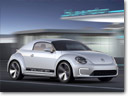
    Volkswagen-E-Bugster-concept-THUMB2012 Volkswagen E-Bugster Concept is the successor of the emblematic Beetle and it will be exhibited for the first time in Asia during Auto China in Beijing. There it will show how sportiness can also be transferred to a Beetle with pure electric drive.

    The Concept vehicle is a two-seat Beetle speedster, 85 kW in power, and able to accelerate from 0 to 100 km/h in 10.8 seconds. The surprise here is that it is able to produce zero emissions.

    To go further into details, the central electric module of this Volkswagen has an innovative design. It weighs just 80 kg. The electric motor produces energy which is stored in a lithium-ion battery whose modules are housed in a space-saving location behind the front seats.

    The battery has an energy capacity of 28.3 kWh. In kilometers this means that the vehicle is able to cover the range of at least 180 km in the urban world.

    In addition, Volkswagen has included its special quick charging function, thank to which the battery can be ‘refuelled’ within 35 minutes at suitable charging stations. Of course, this battery can be charged at the convenience of the home environment through a conventional electric outlet.

    The interface for the charge cable is located behind the normal ‘fuel door’ near the C-pillar. Due to the new Combined Charging System it is possible now for the E-Bugster to be ‘filled up’ flexibly via one interface using any available charging modalities, such as single-phase charging with AC current or ultra-fast DC charging at charging stations (quick charge).

    Exactly how much energy the driver is requesting with the ‘electric pedal’ can be observed in a power display. In addition, there are also featured instruments which include a driving range indicator and a display showing the current charge state of the battery.

    Furthermore, there is also an instrument in the new Bugster, which shows the intensity of battery regeneration. What this means in short is that the regeneration actually is the recovery of braking energy. When the driver’s foot leaves the accelerator pedal and/or brakes, kinetic energy is transformed into electricity, which in turn is collected in the battery.

    This serves as a means to increase the driving range of the E-Bugster.

    2012 Volkswagen E-Bugster Concept
    2012 Volkswagen E-Bugster Concept

    Furthermore, the 2012 Volkswagen E-Bugster is in fact a sports car. This is due to its height of less than 1,400 mm, which is about 90 mm less than that of the hard top Beetle. In details, the E-Bugster’s width (1,838 mm) grew by 30 mm, while its length (4,278) remained the same as that of the production car.

    Another highlight here is that the E-Bugster has unique dynamic styling, due to a lot of new styling elements included in the model.

    Looked from the front, it is the swept-back and wide windscreen that catches the eye. The E-Bugster’s glass extends to a point above the A-pillars.

    In addition it includes LED headlights, highly customized, daytime running lights to the left and right of the central air intake as bands of LED lights in a C-shape. All these styling elements can be seen again in a transformed form as reflectors in the rear bumper.

    The rear windscreen of the E-Bugster is extremely wide as well.

    On the other hand a side view of the Bugster gives the observer the image of swept-back windows and a low roof. In addition, the designers lengthened the chrome strip of the lower window border towards the rear and it now runs once around the car, from A-pillar to A-pillar.

    Moreover, this electrified Volkswagen runs on 20-inch ‘Twister’ wheels, which are equipped with 235/35 R 20 tyres.

    What is left is of course the interior, which is spectacular. First of all it includes a combination of high-tech equipment. Secondly the dynamic performance reflected through the sport seats and a continuous centre tunnel in body colour.

    The door handles and the belt guides are made of aluminium, and in addition to this the lightweight construction styling of the steering wheel also creates a direct connection between the exterior and interior.

    Through the Start button, the driver not only activates the drive system but also puts a light show into motion. What happens is basically this: first, the interior is bathed in a white light, which eventually is substituted with blue light.

    Next, it begins as a light pulse in the instrument cluster, from which the light emanates as a thin line of light. The latter is just one millimetre wide and courses into the door window sills and around the air nozzles.

    Source: Volkswagen

  • History on Wheels: Volkswagen Beetle

    vwb1938 original THUMBCan you believe that at first the now so popular Volkswagen Beetle was firstly intended to be a mass-production car, which can be afforded by an average person? Well, the beginning of the story of the famous car started just like that in pre Second World War period. The history of the emblematic car began in 1934, when Hitler himself, announced his vision for a “peoples car”. To be more precise the literal meaning of Volkswagen is “peoples car”, this is how the brand actually got its name. The most famous car designer at that time – Ferdinand Porsche – was entrusted to construct the vehicle. However, Hitler insisted on his own vision of the car, which must carry two adults and three children and have a low consumption of gasoline. However, the most prominent factor had to be the price – 1000 Reichmarks, which for Ferdinand Porsche seemed to be unreasonably low.

    The first prototypes called “Type 60” came out in the 1935, and included one saloon model and one convertible. These vehicles were made from alluminium mounted on wooden frameworks. All this represented the body. A year later the bodies were mounted on steel floor panels. The top speed of the car was estimated around 105 km/h. As expected, this provoked a huge interest among Germans, and everyone wanted to buy a car. Hence, this led to the construction of factory in 1938. Nowadays this same factory is the biggest factory in the world. The name for the future Beelte was chosen by Hitler himself, and meant literally “Strength through Joy Car” – KDF Wagen (or Kraft Durch Freude Wagen). However, as we all are familiar, in 1939 the Second World War began, and hence the production changed its purpose. Now it was for military vehicles.

    1938 Volkswagen Beetle Original
    1938 Volkswagen Beetle Original

    The war eventually ended in 1945, but the production of the Volkswagen continued. However, it was much slower than the pre-war. Cars were put together with the last materials left from the bombardment and stored in the basement. In contrast just a year later, the production of the vehicles was 1000 a month. It is almost unbelievable that the numbers of the manufactured cars went to 19 000 in 1948, and the astonishing 46.000 in the next year. In this year the range of the produced Volkswages was extended. It now featured two different convertibles, one with two seats and one with four.

    The 1000th Volkswagen Beetle built in 1946 coming from Assembly Line
    The 1000th Volkswagen Beetle built in 1946 coming from Assembly Line

    The 50’s was a prominent decade for the famous vehicle, where the tradition was established. Moreover there were so many additional changes added, which improved the performance of the car. One example is that there were included hydraulic brakes. Another good instance is the 15×5 inch tires, or the taillight of each rear fender. However, probably one of the most important changes in the design that has been made during the 50’s the single oval rear window which took the place of the two-piece one, and thus improving the visibility. In this decade the engine grew to a full 1.2 liters one. Interesting information to be shared is that during 1955 and 1956 there was a Beetle Deluxe, which was the only model of the vehicle exported to the U.S. Although there were a lot of modifications made further throughout these ten years, the Volkswagen remained a slow car, which was considered a huge problem. In the 1956 for example the car acceleration from 0 to 50 km/h was made in 7.5 second, the top speed was just 110 km/h. Nonetheless, people bought the car with eagerness. At the end of the year of 1959 there were in total 575 407 cars sold. Furthermore, 120 442 Beetles of these were sold only in the U.S.

    The great success achieved in the 50’s is what made the Volkswagen Beetle and Icon in the next decade. The elements of the new 60’s Beetle were even more enhanced: new steering wheel, better seats design, and plastic headliner. Moreover the fuel tank was redesigned to make more space for the luggage. More importantly, during the first years of the decade there was included a conventional fuel gauge and bigger taillights. In the mid of the decade there was included a new powerful motor and by the end of the 60’s there’s a new 1.5-liter engine, making 53 HP (39 kW). However the car was still not fast enough, although the acceleration form 0 to 50 km/h went to 5.9 seconds. A huge innovation in technical terms was the introduction of the new optional Automatic Stick Shift semiautomatic transmission in 1968. It allowed the driver not to press the clutch pedal while shifting the gear.

    However, in the 1970’s the picture weren’t that much successful as was the previous decade. There were several reasons for that, but probably most significant is the presence of other competitor companies like Renault and Toyota on the market. So during the 70’s the fame of the Beetle slowly began fading away. Of course there were a lot of innovations included in the car during these years. In the beginning of it the engine grew to 1.6 liter and now produced 60 HP (44 kW). But again the acceleration was literally disappointing. In the ext years, the Beetle got another significant change that has to be marked – this time in suspension. It adopted MacPherson strut front suspension. This was the beginning of the model, called “Super Beetle”. Of course during those years the car underwent a lot of modifications in order to keep with the trend. Unfortunately, the start of the end of an era was marked with the closure of the VW’s plant in New Zeland in the beginning of the 70’s. Another important factor for the waning fame is the start of the production of the replacement of the Beetle, which was named Volkswagen Golf. This led to more factories which didn’t produce more Beetles and slowly it’s popularity due to lack of innovations and improvements of technology began fading away.

    1970 Volkswagen Beetle
    1970 Volkswagen Beetle

    In the eighties the production of the iconic vehicles continued, however strongly narrowed to only one plant on Mexico. In addition this plant stopped exporting vehicles for Europe and it was used mainly as a taxicab in Mexico. This plant continued producing Beetles till the first years of the 90’s too. And more interestingly it even produced the 21st million Beetle. However the end was near and the plant ceased working. In the end of the 90’s the designers from Volkswagen decided to revitalize the iconic car. Thus in 1998 was produced (again in the plant in Mexico) a more stylish variant of the vehicle. It now produced the 115 HP (84 kW), had 2.0 liter engine, five-speed manual or four-speed automatic transmissions, and independent suspension. At the end of the 1999 the Beetle included ABS brakes, 150 HP (111 kW) turbocharged 1.8 liter engine.

    The beginning of the new Millennium was successful too. In the 2002, there was made a sporty model, called Beetle Turbo S, with venerable 1.8T turbocharged engine, which made the total 180 HP (133 kW) at 5,500 rpm and 173 pound-feet of torque from 1,950 rpm to 5,000 rpm. Due to these numbers in the model was included for the first time a six-speed manual transmission. However there was still something missing, and this time it was something which had to remind the customers for the original Beetle. In 2003 Volkswagen launched a brand new redesigned Beetle Cabriolet with 2.0-liter and 1.8T engines. Since then the brand continued producing the emblematic vehicle further enhanced and improved. In 2006 the brand revealed its “new” Beetle (including a convertible model) which had a subtle but stylish new look that fashionably updates. Yet, it maintained the core emotional appeal of the iconic Beetle design. It got the 2.5 liter, five-cylinder engine which creates 150 HP (84 kW). Another significant technical update here was the standard traction control with Electronic Stabilization Program (ESP).

    Now, in 2012, we are about to see the coming of two Beetle versions. The first one is, to say so, a regular one, with improved design, aerodynamics, modern interior and appealing exterior. The second one, in my opinion, is a pure development of the iconic car. Moreover it matches the “demands of the times” and is purely … electric! It is named Volkswagen E-Bugster, and although it is still in a concept mode, it is electrifying! This concept vehicle was revealed at the 2012 North American International Auto Show in Detroit. The new two-seated E-Bugster continues Beetle’s sporty theme, but is powered by an electric motor which provides 85 kWh of power.

    2012 Volkswagen Beetle
    2012 Volkswagen Beetle
    2012 Volkswagen E-Bugster Concept
    2012 Volkswagen E-Bugster Concept

    To sum up, the Volkswagen Beetle has almost 80 years old history and more importantly – it continues it nowadays successfully. Although it remained mostly unpopular with its original name, which is Volkswagen Type 1, the Beetle remains the longest-running and most-manufactured car of a single design platform. In the world all-in-all there are over 21 million manufactured models of the emblematic Volkswagen.