Tag: Dynamic Stability Control

  • Mazda MX-5 Venture Edition

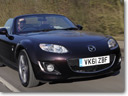
    Mazda-CX-5-Venture-thumbWe all know the Mazda MX-5, right? It’s that front-engined, RWD, simple, fun handling roadster that has been around for years. The latest attempt of the Mazda company to refresh it comes in the form of the MX-5 “Venture Edition” with new interior trims and exterior finishes and more technology and luxury equipment.

    The new Venture picks up where the SE and Sport Tech MX-5 end. You can either go for the 1.8 MZR Soft-top (SE) or the 2.0 MZR Roadster Coupe (Sport Tech). Exclusive highlights from the outside include light gun metal 17-inch alloy wheels, front fog lights and a chrome front grille. But we don’t really have to notice these things to know it is a Venture edition. There are badges for that. Three body colors will be – the popular Metropolitan Grey Mica and two exclusive Radiant Ebony Mica and Crystal White finishes.

    Mazda CX-5 Venture Edition (2012)
    Mazda CX-5 Venture Edition (2012)

    Inside a leather feast unfolds itself as you enter. The steering wheel, seats and the leather lever are all wrapped in Havana Brown leather. A matching door trim on the side and piano black dashboard accents at the front appease you. Technology includes climate control air-conditioning, cruise control, Dynamic Stability Control, TCS and airbags, lots of them. Also, for the first time ever on an MX-5, a Satellite navigation. And it is not an antique one as well. It has a 5.8-inch touch screen monitor, 4GB SD card based map (45 countries), live services, iPod and Bluetooth® connectivity.

    Most importantly it still remains a proper roadster with a perfectly balanced handling and a 1.8 MZR, 126 ps (SE) engine or a 2.0 MZR, 160 ps (Sport Tech) one. Manual transmissions come with either five or six speeds respectively. Going up to 60 mph will take you 9.9 seconds in the 1.8 soft-top, while for that same speed the time mark of the 2.0 Roadster Coupe is 7.9. Fun however, doesn’t come only in a straight line. The Mazda is fitted with a Limited Slip Differential for that extra sideways lunatism.

    Source: Mazda

  • BMW – Dynamic Stability Control

    The DSC (Dynamic Stability Control) is BMW’s electronic stability control system. It controls the suspension with the help of three other single programs – ABS (Anti-lock Brake System), ASC + T (Automatic Stability Control + Traction) and CBC (Cornering Break Control).

    The system was firstly introduced back in 1997 offered on BMW 740i/L and 750i/L. Nowadays, all BMWs come with DSC III as standard including DTC (Dynamic Traction Control). The DTC allows more wheel slip meaning a more dynamic driving style with higher wheel traction including DSC controlling stability. In other words, the DTC will allow you to drive more aggressively without suiciding yourself.

    The DSC system is very complex and interesting. It constantly checks vehicle speed, steering angle, wheel rotation, lateral and transverse acceleration, brake pressure and yaw to register imminent instability when cornering, especially on slippery conditions like snow and rain. When instability moment is registered, the DSC intervenes via the engine management system. It reduces drive torque and activates each wheel brake individually to keep the car stable. Everything this happens within milliseconds, so do not think you don’t need this system.

    So, the DSC uses ASC+T to cut the engine power and, if this is insufficient to maintain traction, it also uses ABS to apply braking power wherever it is needed.

    httpv://www.youtube.com/watch?v=ncE-Vk7egRo

    The DSC uses a lot of sensors to work properly. First, it monitors the steering angle sensor to detect the driver’s chosen path. After that it uses lateral- acceleration to define the forces, which must be transmitted to the road by the tires. The rate-of-turn sensor defines the car’s degree of rotary movement and the brake-pressure sensor define the longitudinal forces acting between tires and road surface under braking.

    If something went wrong while driving and the car begin to oversteer or to understeer, the DSC can counter the situation by applying brakes. All electronic and hydraulic systems are very rapid and precise, so the driver can hardly feel them.

    • While ASC + T analyzes the longitudinal forces occurring in straight-ahead operation, DSC additionally registers and analyses lateral dynamic forces.
    • When cornering at high speeds, DSC counters unstable vehicle states such as oversteering or understeering
    • The DSC feature can provide maximum stability when cornering.
    • With DSC there is a significant reduction in the risk of skidding.

    The DTC (Dynamic Traction Control) is a sub-function of the DSC system. Besides offering sports-style driving, it provides a small amount of wheel spin improving traction, especially on deep snow, slush or loose terrain. In some occasions more slip generates better better traction and more thrust.

    The DTC alloys sports-style driving and even permits controlled drifts. Still, the driver retains complete control over the vehicle in every situation and the Dynamic Stability Control’s stabilising measures remain active even when the DTC is activated.

    When you start the car and you are in normal driving mode, the DSC is active. One short push on the DSC button: the DTC is enabled and DSC restricted. One long push on the DSC button: DSC and DTC off.

    So, we strongly do not recommend turning the Dynamic Traction Control off, because it is very dangerous.

    BMW DSC button E46
    BMW DSC button E46
  • 2011 BMW X3 – The leader in the premium sports activity market

    The new small SAV from BMW is ready to raise the bar in the premium sports activity market this year when the model goes on sale in the UK. X3 will be the lowest-emission four-wheel drive model in its segment. Furthermore, it is the first to have start-stop with auto transmission, unparalleled agility, significantly upgraded cabin and a raft of sector-first technology.

    Some of the features of 2011 BMW X3 are a class-leading diesel engine, numerous chassis configurations courtesy of Variable Damper Control, as well as UK specific equipment packages and innovations such as Head-up Display and online connectivity, thanks to ConnectedDrive. (more…)

  • 2011 MINI Countryman combines versatility, comfort and exclusiveness

    2011 MINI Countryman takes the driving pleasure into a new dimension. This is the first MINI with four doors and big tailgate while the a versatile interior offers space for up to five people. The body length is more than 4 metres so there is plenty of inside space. Furthermore, the seating position is raised and the ride comfort is optimised.

    There are three petrol and two diesel engines in the range. The puniest petrol variant is in MINI One Countryman developing 98hp. The next is MINI Cooper Countryman with 122 hp and the top-of-range 184 hp MINI Cooper S Countryman, whose 1.6-litre four-cylinder engine is the most efficient unit in its displacement class. (more…)

  • 2010 Mazda MX5 Miyako limited edition specially for the UK

    Mazda released a special limited edition of MX5 called Miyako. The new model is specially designed to celebrate 20th Anniversary of the world’s best-selling roadster.

    Mazda MX5 Miyako will be put on sale from 1 July and available in two versions – the 1.8i Miyako soft-top priced at £18 385 and the more powerful 2.0i Miyako roadster coupe with the world’s fastest folding powered roof (up or down in 12 seconds), priced at £20 885.

    Inside, the new Miyako features black leather trim with a red underlay and stitching, special badging, floor mats and climate control air-conditioning. (more…)

  • MINI Countryman’s price details revealed

    MINI releases the price table for its first crossover, the MINI Countryman. As we are getting more and more impatient to see its world debut at Geneva Motor Show in Switzerland, MINI is presenting the available model variations for the new Countryman compact crossover. (more…)