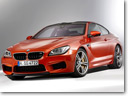
 The latest from the M division comes in the form of an M6 – Coupe and Convertible. It has retained its characteristic body line and still is the ultimate in gran touring thanks to its V8 M TwinPower Turbo engine and clever design. BMW‘s EfficientDynamics on the other hand keep it frugal and refined.
The profile is familiar but there are bodily innovations – a new front apron has been introduced with massive, honeycombed air-intake patches. No matter how massive however, they are unable to steal away the headlamp department which features the characteristic BMW Corona rings that make use of the latest Adaptive LED headlight technology. A 30 mm increase of the front track has resulted in a noticeable swelling of the wheel arches which are as ever complemented by the indicator and M badge housing gills behind them. At the back we have quad tail pipes separated into two pairs, flanking the clever diffuser. The M6 sits on 19-inch alloy wheels in a star-spoke (seven double spokes) design that come in two finishes. Alternatively, as an option one can go with the 20-inch ones that have five double spokes for the sake of lighness. As always, lightness for the Coupe is also guaranteed by the carbon-fibre reinforced plastic roof panel which lowers the center of gravity significantly with improved agility and handling as an end result. In the mean time, the Convertible M6 gets the standard 6 Series Convertible retractable roof with its independent retractable rear window. The party piece is the fact that you can operate it while in motion of up to 25 mph.


Inside, the M6 is a blend of luxury and sportiness – Merino leather everywhere while an instrument fascia featuring a Black Panel technology, dials with red needles and white backgrounds adorn the dashboard. The windscreen is also affected as a HUD display provides speed readout and speed limit identification, gear and rev counter and shift lights to the driver. It’s not all flash and glam though. The new M6 has more space inside and a luggage capacity of 460 litres (300-350 litres for the M6 Convertible). The M Sport seats are more complicated than a smartphone with their electric pneumatic adjustments and the manually adjustable under thigh support.
The power plant for the new M’s is the same one found in the M5 – a mighty 560 hp V8 M TwinPower Turbo 4.4 petrol unit. That’s 53 more hp than the V10 predecessor. Put your foot down behind one of these V8‘s and you’ll be greeted by a maximum torque of 680Nm as early as 1500 rpm and will be escorted by it up until 5,750rpm. That is a lot of power at your disposal ready to thrust you back into your seat when pressed. Deep down in the confounds of the engine one would find the reason for all of that grunt – twin turbochargers built in to the twin scroll principle and direct fuel injection plus a Valvetronic variable valve timing and Double VANOS continuously variable camshaft control – that translates into 0-62mph sprint of just 4.2 seconds for the M6 Coupé, with the M6 Convertible following at 4.3 seconds. The top speed limiter starts screaming at the 155 mph mark. It’s not all muscle and grease though. Thanks to BMW’s EfficientDynamics technology, the M6 has a Stop/Start function, Brake Energy Regeneration and Active Aerodynamics – all of which help reduce consumption up to 30% in comparison to previous models: The M6 Coupé has a combined fuel consumption of 28.5mpg (Convertible 27.4mpg) with CO2 emissions of 232g/km (Convertible 239g/km).
As standard, all that power coming from the engine is digested trough a seven-speed Double Clutch Transmission (M DCT) with DRIVELOGIC. It is a uniquely complex and high-tech gearbox that has three modes of shifting (thanks to the logic thing) so that the driver has the freedom to chose a style from sportiness to comfort. It also allows manual shifting trough the paddles behind the wheel or the gearstick.


Surely, with that kind of power, one needs some stability feedback from the chassis. That is why M engineers have fiddled in that area as well – The rear axle subframe has been bolted directly to the body while the front axle kinematics have been redesigned with M-specific settings, and a number of 6 Series suspension components replaced with forged aluminum items. The shock absorbers are electro-hydraulically operated trough the car’s Variable Damper Control (VDC) again with three settings. Driver aids come in many abbreviations such as DSC, ABS, CBC and DBC but thankfully all can be overridden with the very important M Dynamic Mode (MDM) which allows you to do what one must do with an M car – wheel spinning, oversteer and other tire-destructive activities. For the braking power, the M6 comes as standard with 400mm front discs and 396mm rear discs clamped by six-piston calipers (at the front at least). Novice or trackday drivers can opt for the Ceramic Brakes which are more heat resistant and counter fading after much abuse.
It all sounds really wonderful but will it be a better value from the M5? There is no answer to that question as both cars have target groups: The M6 is for the hardcore performance bachelors while the M5 is for the hardcore performance family men.
Source: BMW

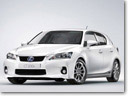 Lexus CT 200h is priced for USA and it will soon go on sale on the North American market. The hybrid’s price starts at $29 120 and goes up, depending on the optional extras, to $30 900. However, the price doesn’t include the delivery charges.
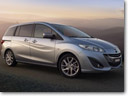 2012 Mazda5 is priced for the USA and it will go on sale in January next year. The vehicle will feature Dynamic Stability Control (DSC), traction control, anti-lock brakes (ABS), tire-pressure monitoring, and dual front, front-seat and side curtain airbags. The 2012 Mazda5 will be equipped with 16-inch alloy wheels, 6-disc CD changer and Sirius satellite radio, a moonroof and xenon high-intensity discharge (HID) headlights. The base version is priced at 19 990 USD.
 2011 MINI Countryman takes the driving pleasure into a new dimension. This is the first MINI with four doors and big tailgate while the a versatile interior offers space for up to five people. The body length is more than 4 metres so there is plenty of inside space. Furthermore, the seating position is raised and the ride comfort is optimised.
 Mazda released a special limited edition of MX5 called Miyako. The new model is specially designed to celebrate 20th Anniversary of the world’s best-selling roadster.


 When the expanded 26-strong line-up of 2009 new Mazda6 models goes on sale in January, prices will start at just £14,891 (OTR). Mazda is taking the opportunity presented by the arrival of its all-new MZR-CD 2.2-litre turbo diesel engine, with a choice of three power outputs, to also introduce some specification upgrades and one additional diesel model – offering both the low power (125ps) and mid power (163ps) engines in the TS hatchback.