Tag: Daytona

  • Dodge Charger Daytona SRT Concept

    Dodge is taking a giant step forward on the performance brand’s road to an electrified future, revealing the Dodge Charger Daytona SRT, a perception-shattering concept that reimagines what a battery-electric vehicle (BEV) can be. The Dodge Charger Daytona SRT Concept offers a glimpse at the brand’s electric future through a vehicle that drives like a Dodge, looks like a Dodge and sounds like Dodge.

    The two-door Dodge Charger Daytona SRT Concept was unveiled today at M1 Concourse in Pontiac, Michigan, during the third day of the three-day Dodge Speed Week event series, which featured announcements and reveals of Dodge performance products.

    The Dodge Charger Daytona SRT Concept muscles aside the boring BEV paradigm and replaces it with an electrified vehicle unlike any on the road today. A new propulsion system drives the Charger Daytona SRT Concept with performance that exceeds the Dodge brand’s famed SRT Hellcat engine, accompanied by an industry-first BEV exhaust sound.

    The concept’s modern exterior styling incorporates subtle Dodge heritage cues while also exceeding aerodynamic targets. Interior design elements connect to create a driver-centric, immersive experience through sounds, displays and lighting features that change inside and out at the push of a button.

    Core to the Dodge Charger Daytona SRT Concept are three game-changing, patent-pending features that will rewrite the rules of the BEV segment:

    • R-Wing: A unique aerodynamic pass-through design feature that connects the concept with its iconic Dodge Daytona namesake
    • Fratzonic Chambered Exhaust: Industry-first BEV exhaust, can reach 126 dB, making it as loud as a Hellcat-powered Dodge
    • eRupt: Multi-speed transmission with an electro-mechanical shifting experience that’s pure Dodge

    “The Dodge Charger Daytona SRT Concept exists because performance made us do it,” said Tim Kuniskis, Dodge brand chief executive officer – Stellantis. “Dodge is about muscle, attitude and performance, and the brand carries that chip on its shoulder and into the BEV segment through a concept loaded with patents, innovations, and pertformance features that embody the electrified muscle of tomorrow. The Charger Daytona SRT Concept can do more than run the car show circuit; it can run a blazing quarter-mile. And when it comes to product cycles, it outruns Darwin. Charger Daytona does more than define where Dodge is headed, it will redefine American muscle in the process.

    “One day ago, the brand’s first-ever electrified performance vehicle was unveiled, the all-new 2023 Dodge Hornet. Today, we revealed a peek at our eMuscle future with the Dodge Charger Daytona SRT Concept. When we said it was going to be an electric summer for Dodge, we meant it.”

    Brotherhood, Meet Banshee

    Dodge has built a unique reputation as America’s muscle car brand. In the race to be faster, quicker and more powerful, Dodge is turning the page to a new chapter. The brand’s first-ever electric car isn’t called the Dodge Charger Daytona SRT Concept by coincidence — like the famed Charger Daytona model that was the first vehicle to break 200 mph on a NASCAR track in 1970, the Charger Daytona SRT Concept packs a performance punch.

    It does so courtesy of a new propulsion system that joins high-horsepower household names such as HEMI®, Hellcat and Redeye. There’s a new pinnacle of performance in the Brotherhood of Muscle: Banshee.

    The 800V Banshee propulsion system powers the Dodge Charger Daytona SRT Concept car and screams performance, making Dodge’s first electric vehicle faster than a Hellcat in all key performance measures. The standard all-wheel-drive system is key to pushing beyond Hellcat performance while also improving all-weather capability.

    eRupt Transmission

    Unlike typical BEVs, the Dodge brand’s eRupt multi-speed transmission with electro-mechanical shifting delivers distinctive shift points, throwing shoulders into seatbacks in true Dodge style. The Charger Daytona SRT Concept also boasts a PowerShot push-to-pass feature. Activated by the push of a button on the steering wheel, PowerShot delivers an adrenaline jolt of increased horsepower for a quick burst of acceleration.

    Fratzonic Chambered Exhaust

    While most BEVs embrace their virtually silent electric motors, that just wouldn’t do for Dodge. The Charger Daytona SRT Concept voices a 126 dB roar that equals the SRT Hellcat, generated through a new, patent-pending Fratzonic Chambered Exhaust system. Yes, Dodge added an exhaust to an electric vehicle.

    The industry-first Fratzonic Chambered Exhaust pushes its one-of-a-kind performance sound through an amplifier and tuning chamber located at the rear of the vehicle. The Fratzonic Chambered Exhaust represents the next generation of tactile, bone-shaking, muscle attitude, creating a visceral “Dark Matter” sound profile experience in concert with the eRupt transmission.

    Dodge Design, First and Foremost

    The Dodge Charger Daytona SRT Concept features inspired design that takes on the challenge of revolutionizing the look of a BEV while offering subtle nods to the brand’s muscle car past.

    That design principle begins to unfold up front, where the Charger Daytona SRT Concept’s patent-pending R-Wing redefines the typical Dodge front end, maintaining the characteristically blunt Dodge profile while developing a more aerodynamic vehicle.

    The R-Wing, an homage to the original Charger Daytona design and to a key figure behind development of the original vehicle, allows air to flow through the front opening, enhancing downforce. Incorporated into this functional performance hood, the front R-Wing holds true to the brand’s dramatic exterior themes while delivering an aerodynamically improved pass-through design. Carbon-fiber intakes tucked into both sides of the front and rear lower fascias provide an air curtain to assist in aerodynamic performance.

    The Charger Daytona SRT Concept combines modern looks with a long, wide and confident road presence. The front grille stands out with cross-car illuminated lighting centered by a white illuminated Fratzog badge, a symbol teased last year by the Dodge brand. The three-pointed Fratzog badge, originally featured on Dodge muscle cars from 1962 through 1976, was previously used without any meaning or context — until now. The return of the Fratzog logo represents the electrified future of Dodge and signifies the brand’s unwavering commitment to its performance heritage, but with new technology capable of pushing limits well beyond the cars of today.

    Simple, vertical details on the front grille add texture while calling back to the brand’s heritage, specifically the iconic 1968 Dodge Charger. The concept distills performance to its simplest form, enhanced by a typically playful Dodge exterior color name, Greys of Thunder, that gives a high-gloss graphite feel with deep textures. The concept’s “waterline” tracks around the sides and gives a planted look while emphasizing the upper portion, keeping the visual weight up high. Subtle, muscular shaping of the wheel fenders accent the body styling.

    The vehicle avoids excess decoration — headlights almost disappear, hidden underneath the R-Wing and integrated seamlessly into the aerodynamic surface providing just the functional elements needed for forward lighting. Both the front and rear lighting feature a full width design centered by a 3D illuminated Fratzog badge. The exterior lighting elements are truly unique – even in the dark, you’ll know the Charger Daytona SRT Concept’s silhouette. Flush door handles continue the minimalist design. Brushed aluminum “screaming” Banshee fender badges announce the new propulsion system that drives the concept.

    Painted-pocket 21-inch wheels with diamond-cut faces continue the aerodynamic efficiencies with a turbine-like design, and a red Fratzog logo embellishes the wheel center locks. Grey six-piston brakes provide the stopping power.

    A new hatchback design is highly functional, giving the concept a dual personality: a beast at the track that can still meet every day needs. The design, along with rear seats that fold flat, offer unexpected utility and storage capacity from a muscle car.

    Connected, Driver-centric Interior

    The Dodge Charger Daytona SRT Concept’s interior is modern, lightweight and athletic, providing a driver-centric cockpit with all essentials cohesively packaged.

    The 12.3-inch center screen, the largest featured in a Dodge vehicle, angles nearly ten degrees towards the driver, and the 16-inch instrument cluster is curved, creating a cocooned, driver-focused feel. An 8-by-3-inch Head-up Display (HUD) puts additional vehicle information where the driver needs it. The slim, instrument panel (IP) and mid-bolster in Ultraviolet color with blue and silver accent stitching feature a “waterline” that extends cross car. The upper IP is a step higher, an elevation change that creates a sculptural surface floating above the cluster. The Ultraviolet color also touches multiple interior surfaces, such as the console, doors and seats, creating a halo that works with the Attitude Adjustment Lighting™ to enhance shadows and highlights.

    A parametric texture unites the interior and provides a connection to the exterior by continuing the inspiration of the 1968 Charger grille detail on the inside. The parametric pattern adds fluidity and sculpture, spanning from the IP to door appliques, beneath the console and continuing to the rear armrests and rear console. The dynamic interior texture has a three-dimensional quality that bounces light and is reactive to the environment, with lines that radiate as they move rearward.Ambient Attitude Adjustment Lighting™ illuminates the texture from below, playing with depth and dimension.

    Circuit-like graphics originate on the carbon fiber floor and are strategically placed to surround occupants, flowing under the seats, moving to the center console and IP, and coming back to the driver, a subtle detail that acts as a circuit board, connecting one to another. A unique lightning bolt shape on the accelerator pedal hints at the concept’s electrified powertrain, as does the dual Blue Plasma and Silver stitching that surrounds the entire interior. Carbon fiber door sills feature illuminated white Daytona lettering, with lighted Daytona lettering also found at the top right of the mid-bezel.

    Doors and center console follow the sculptural design theme, including only the needed elements. A pass-through area under the console creates a much lighter feel, and clever center console touches include a jet-fighter inspired cap that flips up when engaging the start button. The unique pistol-grip shifter is inspired by the past but with a modern execution, functioning as a mechanical precision piece that delivers an effortless shift experience when squeezing the pistol grip’s trigger.

    A new steering wheel design offers a thinner feel, with a flat top and bottom. The center spoke of the steering wheel is not connected to the rim, giving the steering wheel a floating feel. Paddle shifters are mounted on the steering wheel, with the PowerShot button on the right and drive mode controls on the left. Like the doors, the steering wheel features capacitive touch controls. An illuminated red SRT logo lights up the steering wheel center.

    Dodge Charger Daytona SRT Concept seats are lightweight, race-inspired and slim in design, with an insert that features an abstract, perforated pattern of the Fratzog logo. The unique pattern fades out as it travels down the seat and reappears as it flows toward the center of the seatbacks. The upper seatbacks feature openings and seat bolsters that provide an airy, race-oriented feel, while holding occupants.

    The panoramic glass roof gives an open-air feel to the Charger Daytona SRT Concept, helping to include rear passengers in the vehicle experience. The parametric interior texture extends to the headliner surrounding and accentuating the glass area. The carbon fiber “tub” floor and hatch are race-inspired lightweight features, and the large cargo area along with fold-flat rear seats provides more storage space than any previous Dodge muscle car.

    Immersive, Electrified User Experience

    The Charger Daytona SRT Concept’s cockpit immerses the driver’s sensory experience through performance sounds, lighting features and vehicle displays.

    A simple one-button press on the steering wheel lets the driver pick from Auto, Sport, Track and Drag modes, instantly changing the driving dynamics, instrument cluster information, HUD content, performance sound and interior lighting features of the vehicle.
  • Acura ARX-06 Racecar

    Acura Motorsports today released the first official images and details for the all-new, electrified Acura ARX-06 prototype sports car, which will make its competition debut next January at the Rolex 24 at Daytona.

    The latest in a line of successful Acura endurance racing prototypes, the ARX-06 features Acura-specific bodywork and aerodynamics based around an all-new ORECA LMDh chassis which utilizes an electrified hybrid power unit featuring an equally new, bespoke twin-turbocharged 2.4 liter V6 internal combustion engine designed, developed and manufactured by Honda Performance Development [HPD] the racing arm for Acura Motorsports in North America.

    The public unveiling will take place Friday, August 19, at The Quail, a Motorsports Gathering, in Carmel, California.

    “Precision Crafted Performance is at the heart of everything Acura does,” said Jon Ikeda, vice president and Acura brand officer.  “If you’re a performance brand, you have to go racing. It’s that simple.  Both the existing ARX-05 prototype and our production-based NSX GT3 have proven to be race- and championship-winning designs on tracks all across North America.  Now, with the introduction of the new, electrified Acura ARX-06, we look forward to facing off against other premium automotive brands from around the world – and continuing our winning ways.”

    “HPD has 30 years of race-winning and championship-winning history,” said David Salters, HPD President and Technical Director.  “Not only in endurance sports car racing, but in developing championship-winning Honda Civic-based racing cars, the powertrain for the Baja Ridgeline race truck, Formula Regional Americas and Formula 4 powertrains with the Type R engine, and of course the Indy 500 and the IndyCar Series.

    “We are HPD.  We race, we develop our engineers and technology through racing.  We have an amazing and unique racing legacy, both past and present. It’s what we do as Acura’s – and Honda’s – North American racing organization. We are looking forward to the challenge of racing Porsche, BMW and GM in IMSA’s pinnacle GTP championship.  We are very cognizant this is a big step for us.  We have a lot to learn, but that is why race.”

    “The new Acura ARX-06 has elements of our Indy-winning technology, Honda Formula One technology and Rolex 24-winning technology in it.  This was achieved using HPD’s world-class simulation, design, development and manufacturing technologies; that our own engineers have developed, tested and validated.  We are very proud of that.  Now the challenge and hard work really starts, including grueling 24 hour simulations, and learning how to maximize all aspects of performance.”

    Powertrain

    The Acura AR24e power unit was developed by Honda Performance Development to bring electrification to the Precision Crafted Performance of Acura’s endurance sports car racing program.  The complete hybrid power unit is based around the Acura AR24e internal combustion engine (ICE), an all-new bespoke 2.4-lliter, twin-turbocharged direct injection racing V6 that was designed, developed and manufactured by HPD.

    At 2.4 liters, this is the smallest displacement ICE conceived by HPD for endurance racing, yet still meets the performance target of 500 kW as measured at the rear axle by torque meters.  It features a 90-degree V-angle to reduce its center of gravity and polar moment of inertia. In addition, the combustion chamber has been designed to run on sustainable low-carbon fuel.

    The hybrid power plant includes an IMSA-specified electric Bosch Motor Generator Unit (MGU) and Williams Advanced Engineering battery pack.  The MGU is contained in a common transmission casing and gearbox internals provided by Xtrac.  The battery, within the chassis survival cell, is built by Williams Advanced Engineering. The HPD Electrical Group completed both hardware and software development to best match the spec MGU and battery pack to the Acura ICE.

    “We’ve taken the challenge presented by this new rule package from IMSA, and developed what we believe is a very competitive solution,” said Pierre Descamps, who led HPD’s powertrain design team for the ARX-06.  “We’ve gone in a new direction for HPD in the design of the ICE.  It is still a V6, which of course for Honda is well-known, but we have incorporated several new elements which we believe will make best use of the electric MGU and battery pack. Our new engine will rev to the maximum 10,000 rpm set by the rules, so it also makes a wonderful sound!”

    Chassis

    Both IMSA in North America and FIA World Endurance Championship rules require manufacturers to use one of four approved prototype chassis, fitted with IMSA-homologated, manufacturer-designed and branded bodywork and engines.

    In the case of the ARX-06, HPD and Acura have elected to continue their successful relationship with ORECA [ORganisation Exploitation Compétition Automobiles].  Since moving into chassis design and construction in 2007, ORECA has produced a series of winning sports prototypes, including the Acura ARX-05.

    “We’re extremely pleased with our relationship with ORECA,” said Mark Crawford, HPD Large Project Leader for the ARX-06.  They’ve been great partners throughout both our ARX-05 DPi program and now with the ARX-06.  The GTP [Grand Touring Prototype] project has brought with it a new set of challenges and, while you certainly can see the Acura ‘family resemblance’ to our previous collaboration, the ARX-06 is an entirely new design.”

    HPD’s Vehicle Performance Group worked closely with the ORECA design team and engineers to simulate chassis layout geometries and lap time optimization studies.  They also “coded” the new car into HPD’s static and dynamic Driver in the Loop simulators to begin development of the car’s vehicle dynamics and vehicle dynamic control systems.

    Critical to the projects was a clean sheet hybrid powertrain control system, brake-by-wire and vehicle dynamics control system – all written in-house at HPD.  This control system architecture was implemented on a Formula 1-spec ECU hardware platform.  HPD also utilizes its custom, in-house developed ultra-high speed data logging system.

    Salters praised the ORECA-HPD relationship during the development process.  “I would like to note the stand-out collaboration between the ORECA and HPD engineering groups. Working with the extremely talented ORECA engineers on chassis and aero design and powertrain installation has been a real pleasure. Both groups have put their heart and soul into this intense project and sophisticated race car,” he said.

    Bodywork and Aerodynamics

    Exterior styling of the Acura ARX-06 was led by the Acura Design Studio in Los Angeles, California, in conjunction with HPD and chassis-supplier ORECA, one of the chassis suppliers approved for prototype competition in both the IMSA WeatherTech SportsCar Championship and the World Endurance Championship.

    HPD’s aerodynamics engineers and in-house CFD aero engineers worked with the Acura styling studio and chassis builder ORECA to help develop the styling and maximize the aerodynamic performance envelope of the ARX-06, while keeping it within the homologation boxes as specified by IMSA and the FIA.

    “The process we used in creating the exterior design for the Acura ARX-06 is exactly the same as how we create a new Acura passenger vehicle,” said Dave Marek, Acura Executive Creative Director.

    “As part of our Precision Crafted Performance Brand Promise, we treated it as an integral part of our lineup.  The same world-class stylists that lead Acura production car design created initial sketches, then pared those down to several potential designs. Next, we created a scale model, did aero and wind tunnel model testing, and brought HPD and our partner teams in for their feedback,” Marek recounted. “The design continued to be refined throughout the testing and evaluation process, until we came up with a final treatment that met our performance goals while maintaining all-important Acura styling cues. It’s been an exciting process.”

    Driver and team input was also sought throughout the design process. One effective change was a revision to the placement of the rearview mirrors – a seemingly minor adjustment that in fact has a large effect on vehicle aerodynamics. Using VR headsets, the drivers were able to sit in the car virtually and recommend a much lower placement for the side mirrors, improving both the aero efficiency of the ARX-06 and visibility for the drivers.

    Partner Teams

    Acura will continue its partnerships with the proven, race- and championship-winning Wayne Taylor Racing and Meyer Shank Racing organizations to campaign a pair of hybrid-powered Acura ARX-06 entries in the featured GTP category of the 2023 IMSA WeatherTech SportsCar Championship, North America’s premier endurance sports car racing championship.

    In addition to sweeping all three major IMSA prototype titles in both 2019 and 2020 – for Manufacturers’, Drivers’ and Teams – Acura has won the Rolex 24 at Daytona in both 2021 and ’22, including a 1-2 finish for the manufacturer at this year’s twice-around-the-clock endurance classic.  Additional podiums at Sebring, Watkins Glen and the Petit Le Mans in 2021 resulted in a sweep of IMSA Michelin Endurance Cup titles for Acura and partner Wayne Taylor Racing.

    This season, Wayne Taylor Racing has recorded four wins and a second to rank lead the IMSA Drivers’ and Teams’ championships heading into the final race of the season at Road Atlanta in October.  Meanwhile, Meyer Shank Racing started off 2022 with a second consecutive Acura victory in the Rolex 24 at Daytona and five second-place finishes in eight races to rank second in both the drivers’ and teams’ standings.

    These results have unofficially clinched the 2022 IMSA Manufacturers’ Championship for Acura; while the Drivers’ and Teams’ titles will go to either Meyer Shank Racing or Wayne Taylor Racing.

    Acura ARX-06 Development Timeline 

    “We started with the rule book, a challenging spirit and an open mind,” said Salters. “Then our engineers got to work, utilizing all of the vehicle performance, powertrain simulation and development tools we have at HPD to address the critical areas for performance, including weight, power, packaging, center of gravity, etc.”  Here is a timeline of the development process for the Acura ARX-06:

    • The HPD Vehicle Performance Group used simulation tools to determine the overall vehicle envelope and key requirements that would need to be met to maximize performance.  Efficiency, power, weight distribution, aero balance, center of gravity, tire energy, hybrid management and chassis stiffness were some of the parameters included in determining the core architecture guidelines.
    • This process determined the key architecture for the Internal Combustion Engine [ICE], displacement, fuel injection and turbocharging strategy, and the intercooler layout.
    • The Design Group then schemed different concepts and weight aspects over a three-week evaluation period.
    • The Acura ARX-06 concept was then finalized in a single meeting of HPD technical leaders, who then signed off on the project.
    • Prototype parts were designed and produced for testing in HPD’s in-house single cylinder research engine. These parts were manufactured within 4 weeks.
    • The HPD Development Group tested these concepts, analyzing performance, efficiency, combustion characteristics, heat rejection etc.  Results were analyzed and compared to the initial simulations – the simulation results were spot-on and validated.
    • Simulation work also was carried out for a novel intercooler packaging and anti-tune induction concept to reach the performance targets while allowing the downsized engine to meet the 500Kw rules target without damaging combustion “events”.
    • Next, parts were designed and built for the V6 internal combustion engine, including machined from billet sump, block, front cover and ancillary parts made using in-house agile manufacturing techniques.  Five months after the initial simulation and concept study, the Acura V6 ICE ran on the dyno and met all performance targets.
    • The complete control system – written jointly by HPD’s Electrical Control Systems group, Vehicle Performance and Performance Application groups – was prototyped in HPD’s Hardware-In-the-Loop and Driver-In-the-Loop simulator systems.
    • The control system was then taken to the state-of-the art transient dyno facility at HPD where engineers tested the complete hybrid powertrain – ICE-Hybrid MGU-Gearbox. This system simulates key aspects of the cars during track running and the durability cycle, including running complete “laps” of a circuit, including 12- and 24-hour endurance runs with shifting, acceleration and braking all reproduced on the dyno.
    • The Aerodynamic Group at HPD made use of its in-house CFD capability during the design phase to optimize aerodynamic and cooling performance.  The group worked closely with ORECA on the overall aerodynamic concept of the ARX-06.  This has been recently validated in a full-scale wind tunnel test.  HPD aerodynamists, using advanced simulation techniques, are working with IMSA to ensure the safety of the racing car, and that it satisfies stringent flip-over criteria for high speed prototype sportscars.

    Acura ARX-06 Details

    • Will compete in the 2023 IMSA WeatherTech SportsCar Championship
    • Carbon fiber monocoque chassis manufactured by ORECA
    • Acura-specific bodywork, aerodynamics and cooling systems
    • Double wishbone, pushrod suspension front and rear, Penske dampers
    • FIA-specified roll cage structure, carbon fiber driver’s seat shell, six-point safety harness, fresh air intake system, on-board fire suppression system
    • Bespoke Acura 2.4-liter, twin-turbocharged, direct injected V6 internal combustion engine designed, developed and manufactured by HPD, mated to IMSA-specified electric Bosch Motor Generator Unit (MGU) and Williams Advanced Engineering battery pack
    • IMSA-specified XTrac six-speed, sequential, paddle-operated transmission, rear-wheel drive
    • Chassis dimensions:  5100mm length x 2000mm width x 1060mm height (above reference plane); 3148mm wheelbase
  • Ford GT Heritage Edition

    2021-Ford-GT-Heritage-Edition1

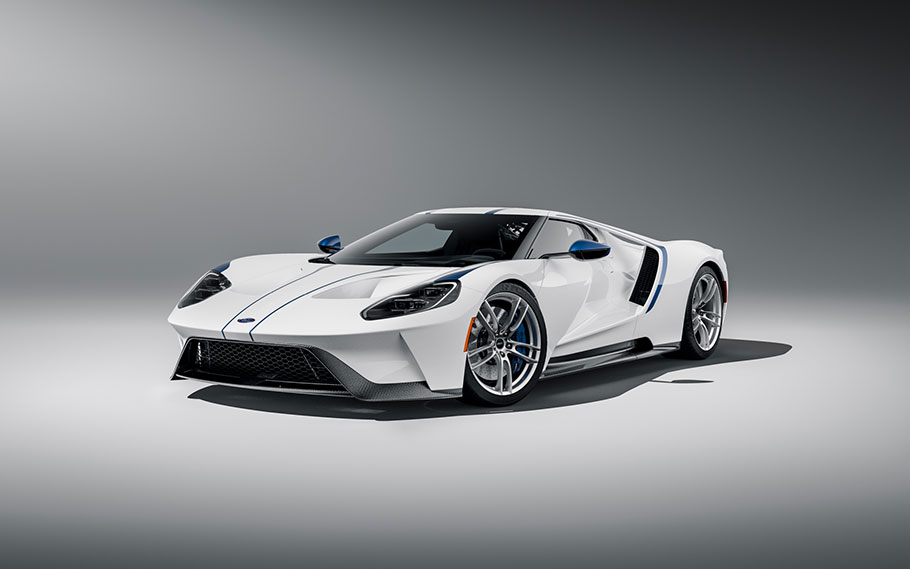
    The Ford GT is America’s only Le Mans-winning supercar, and taking this pinnacle of Ford Performance even further for 2021, Ford is revealing two new enhancements today – the first-ever Heritage Edition inspired by the original model’s first endurance win at the 1966 Daytona 24 Hour Continental race, plus an all-new Studio Collection package offers even more exclusivity and design enhancements.

    “For this Heritage Edition, the Ford Performance team went deeper into the Ford GT’s race history and crafted a limited-edition model that stylistically honors the 55th anniversary of the Daytona 24 Hour endurance race that would eventually lead to our successes at Le Mans,” said Mike Severson, Ford GT program manager. “Plus, for customers who want to highlight the carbon-fiber body and functional cooling ducts that help deliver Le Mans-winning performance, the Ford GT Studio Collection offers another new way GT fans can personalize their supercars.”

    The announcement of two new variants of the Ford GT were the highlights at the conclusion of 2020 Petersen Car Week, which started airing Wednesday on the museum’s YouTube channel. The virtual event featured 25 hours of original content from manufacturers and enthusiasts, along with automotive lifestyle and auction house activities.

    First-ever Daytona-inspired Ford GT Heritage Edition
    The latest Heritage Edition to join the storied Ford GT supercar family is a tribute to the winner of the 1966 Daytona 24 Hour Continental, where Ford achieved its first 24-hour endurance win, which is captured in the 2019 film “Ford v Ferrari” – or “Le Mans ’66,” as it is known in Europe.

    Co-drivers Ken Miles and Lloyd Ruby led a 1-2-3-5 Ford domination at Daytona, kicking off a magical season for the Ford GT40 MK II, with additional 1-2-3 wins at Sebring and Le Mans. This Heritage Edition is the first to feature a livery famous for a race other than Le Mans.

    “Miles and Ruby led nearly every lap of the 24-hour race and outpaced the competition by 30 miles,” said Severson. “The win was the first time anyone had threatened Ferrari’s dominance in sports car racing and represented a turning point in the Ford GT race program.”

    Inspired by the bold white, black, and red exterior of the 1966 endurance-winning Ford GT40 MK II race car, the new 2021 Ford GT Heritage Edition features Frozen White exterior paint with exposed carbon fiber hood adding stark contrast. Asymmetrical Race Red accents on the front fascia and roof edge, driver’s side door, and underneath the rear wing add distinct visuals, while exposed carbon fiber shapes the signature 98 roundel graphics and speak to the supercar’s lightweight body. Unique Ford graphics on the lower rear-quarter panels plus one-piece Heritage Gold 20-inch forged-aluminum wheels paired with red lacquered Brembo monoblock brake calipers complete this new exterior livery.

    Inside, the lightweight driver-centric interior features unique appointments including black Alcantara® suede wrapping the instrument panel, headliner, and steering wheel rim, while anodized red paddle shifters and red Alcantara suede performance seats add dramatic contrast to the interior.

    For customers looking for an even bolder look, an optional Heritage Upgrade Package includes 20-inch exposed carbon fiber wheels with a unique gloss red-painted inner accent barrel, while monoblock brake calipers are lacquered in black and detailed with Brembo lettering in red.

    Inside, ghosted 98 roundels provide subtle contrast on both driver and passenger carbon fiber door panels of this package.

    All-new Ford GT Studio Collection graphics package
    Ford Performance also pulled the wraps off an exclusive series new to the supercar lineup, the Ford GT Studio Collection. This all-new graphics package with customizable colors highlights key styling elements, including the functional cooling ducts that help the 2021 Ford GT deliver all 660 horsepower during the most strenuous, high-temperature sessions at the track.

    Its unique exterior graphics package was born of a design collaboration between Ford Performance and Ford GT manufacturer, Multimatic. It reflects the input of Garen Nicoghosian, Multimatic design head, who has worked on the Ford GT program since its genesis.

    “The combination of the stripes and accents invokes the emotion of speed and draws your eye to some of the most prominent features of the GT,” said Nicoghosian. “The fuselage, buttresses, and signature features on the headlights provide visual anchors for the graphics, guiding your eye across the vehicle.”

    Only 40 cars are slated to receive the Studio Collection package across the 2021 and 2022 model years. The body and graphics can be customized with seven standard colors or further personalized with an extended palette offering endless color combinations for even greater exclusivity.

    Deliveries of the 2021 model year Ford GT begin in early 2021, with Ford GT production wrapping up in 2022.

  • Shelby Cobra Daytona Anniversary Edition with Premiere in August [VIDEO]

    Shelby American 50th Anniversary Cobra Daytona Coupe SeriesShelby Cobra Daytona Coupe Series is going to be produced in order to celebrate the 50th anniversary of Shelby’s FIA World Championship. The limited edition series is a continuation of Shelby Cobra Daytona Coupes. They will be produced in only 50 examples. To build them the experts will use either aluminum or fiberglass. Both will make an official world premiere in California this August.

    Looking Back to Historic Events

    The Cobra Daytona Coupe was responsible for the victory in the FIA Sports Car Championship on July 4, 1965. This is when the small Shelby American team fielded six sleek Cobra Coupes against the Ferrari force. At the same time, this win was as joyous as it is sad now, because this is still the only single time that the team got the crown.

    SEE ALSO: Ford Unleashes Shelby GT350R-C Racecar at Watkins Glen

    Back in 1965 there were only six Cobra Daytonas built. This also makes the vehicles one of the most wanted racecars globally. You can imagine how much each costs nowadays (probably millions of dollars), but most importantly, to own one is literally impossible.

    Reviving the Spirit

    The chance of owning such historic vehicle is almost zero percent. But to own the new version is not that impossible, you just have to hurry up and be among the first who will have the chance to order one of the 50 specially badged anniversary Shelby Cobra Daytona Coupes.

    As a matter of fact, this is the first time that the company offers an aluminum continuation of the famous coupe. Each aluminum Daytona Coupe has safety and performance enhancements, but still keeps the original blueprints and measurements. There is a wide choice of exterior colors, but every single model will come with black leather interior, special badging, modern disc brakes and a stronger frame.

    Pricing & Places You Can See the Shelby Cobra Daytona

    The fiberglass and aluminum versions of the Shelby Cobra Daytona Coupe will be revealed at Gordon McCall’s Motorworks Revival on August 12. Then they will be on display at Rolex Motorsports Reunion inside Mazda Raceway at Laguna Seca.

    An aluminum variant will be available for the sights of the visitors at Goodwood Revival in the United Kingdom as well.

    How about the pricing? The aluminum Shelby Daytona Coupe without the drivetrain costs $349,995 USD, while the fiberglass variant is priced at $179,995 USD (without the drivetrain). Shelby American is currently taking orders.

    httpv://youtu.be/buWIbGEd-lc

    Video Source: YouTube via Gumbal

    Source: Shelby American 

  • 2014 Chevrolet SS Revealed At Daytona!

    2014 Chevrolet SS is finally revealed after being teased a few days ago. This is Chevrolet‘s first V-8, rear-wheel-drive performance sedan since 1996, and it is created in order to offer performance on the street and on the track.

    The model has just debuted at the Daytona International Speedway, showing off its proven, race-tested, global rear-wheel drive architecture. The Chevrolet SS is equipped with the LS3 Chevrolet V-8, which genrates 415 horsepower (305 kW) and 415 lb-ft (562 Nm) of torque.

    The unit is mated to a six-speed automatic transmission, which can be shifted manually using TAPshift paddles mounted on the steering wheel. More importantly, this Chevrolet model delivers acceleration time of 5 seconds for the sprint from 0 to 100 km/h.

    In addition, is equipped with a a sport-tuned chassis, including MacPherson strut front and multilink independent rear suspension geometry, electronic power steering system, optimized for sport driving, standard Brembo brakes, with ventilated, 355-mm rotors and two-piece, four-piston front calipers, Forged aluminum wheels, wrapped in ultra-high-performance Bridgestone tires: 19 x 8.5 inch wheels with 245/40ZR19 tires in front; 19 x 9.0 inch wheels with 275/35ZR19 tires in the rear.

    To go further into details, the staggered front and rear wheels are pushed out to the corners. Hence, they improve the sporting, muscular presence of the SS. Up front, the aluminum hood includes a subtle “power bulge” hinting at the power of the engine underneath.

    On the other hand, at the rear, the tapered, tear-drop shape delivers enhanced aerodynamic performance. Some of the highlights here include jewel-like chrome accents, standard high-intensity discharge headlamps and light-emitting diode daytime running lights.

    How about the interior: it is spacious enough and comfortably accommodates five adults, with 42 inches of front legroom, and 39 inches of rear legroom. The seats are wrapped in leather as a standard. The SS emblem can be seen on the soft-touch instrument panel which also includes two types of chrome finishes – a satin gloss and bright chrome. At night, the interior is illuminated by ice blue ambient lighting.

    A wide range of technology features is included in the Chevrolet SS: Color, in-dashboard touch screen that supports Chevrolet MyLink and the next- generation navigation system; Bose® Nine-speaker premium sound system; Color heads-up display; Push-button start; StabiliTrak Electronic Stability Control; Forward Collision Alert; Lane Departure Warning; Side Blind Zone Alert; Rear-vision camera Rear Cross Traffic Alert.

    Even more, in the SS is also included for the first time the Automatic Parking Assist, which provides hands-free parking help. This parking assistant utilizes ultrasonic sensing system in order to detect the width and depth of either parallel or reverse right-angle parking spaces.

    2014 Chevrolet SS will be available at dealerships in the fourth quarter of 2013.

    Source: Chevrolet

  • Audi R8 Grand-AM debut at Daytona 24h

    Audi-at-Daytona-24-Hours-thumbDouble the excitement as Audi will be making a debut of the R8 GRAND-AM customer sport race car on the 50th running of the Daytona 24 Hours. Two teams, APR Motorsport and Oryx Racing will have the privilege to race their own LMP Audis in the GT class of the endurance race which kicks off on the 26th of January.

    “We are proud to be part of the action for the first time at the event’s special anniversary,” said Werner Frowein, Managing Director of Quattro GmbH, which has developed the Audi R8 GRAND-AM. After the debut, the R8 is set to take part in the other 12 challenges of the GRAND-AM series. Let us remind ourselves that back in 2008, Audi was represented in the United States for a whole season with a factory commitment featuring the Audi R10 TDI LMP1 sports car and proceeded to win the title in the American Le Mans Series (ALMS). Now the APR Motorsport and Oryx Racing customer teams are going to take part of their own commitment.

    APR has a reputation of playing with Audis as it is known as one of the most active tuners of the car make. They are based in Opelika, Alabama and headed by Jeff Mishtawy. Hopes fall on a lineup of 5 drivers: The Americans Ian Baas and Dr. Jim Norman, Nelson Canache from Venezuela, Dion von Moltke plus the legendary (former now) Audi factory driver Emanuele Pirro from Italy. The other team, Oryx Racing, is headed by  Humaid Al Masaood (UAE) as he also plays the role of a driver. Hist two other team mates are  Saeed Al Mehairi and Steven Kane (UK)

    “We’re entering a new car in a series that’s new to us. It was important to us to be involved in the project right from the beginning and help continue to develop this fascinating customer racing car from Audi to become as competitive as possible.” comments an enthusiastic Al Masaood. Despite the fact that the team is from UAE, they also have a base in the US, West College Corner near Indianapolis.

    The “Rolex 24 at Daytona” ranks as one of the finest international motorsport events. Attenders are in for a treat as a champions party with numerous racing legends, an exhibition of historic overall-winning cars, a carnival complete with a Ferris Wheel, a 5-kilometre run on the track for all sports enthusiasts on Saturday before the race, autograph sessions and pit walks are just some of the attractions featured on the last weekend of January. The GRAND-AM Audi will be competing against approximately 30 more contenders which fall into the category of GT LMP1 vehicles. After a qualifying session on Thursday the race will start on Saturday (January 28) and end on Sunday (January 29) at 15:30, local time (21:30 Central European time).

    Audi R8 GRAND-AM (2012)
    Audi R8 GRAND-AM (2012)
    Audi R8 GRAND-AM (2012)
    Audi R8 GRAND-AM (2012)
    Audi R8 GRAND-AM (2012)
    Audi R8 GRAND-AM (2012)

    Source: Audi