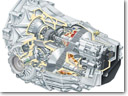
 Today we have a new type of transmission to consider and it is called a continuously variable transmission (CVT). A CVT is a type of automatic transmission but it operates very differently than older automatics. CVTs provide more useable power, better fuel economy and smoother driving than traditional automatic transmissions. CVTs have been around for years in motorized applications such as snowmobiles and off-road recreational vehicles, but just started to be used in regular automobiles a decade or so ago.Conventional automatic transmissions use sets of gears inside that provide different ratios or speeds. Control units sense speeds and shift a transmission’s gears automatically to provide the most appropriate ratio for a given driving situation: lowest gears for low speeds, middle gears for acceleration and passing, and higher gears for efficient cruising. This is visually indicated in most vehicles with a selector display (P-R-N-D-L).A CVT replaces the complex gears sets common in standard transmissions with two variable-diameter pulleys, each shaped like a pair of opposing cones, with a metal belt running between them. One pulley is connected to the engine, the other to the drive wheels. The way it works is that during operation the pulleys move in and out such that a drive belt between moves higher on one pulley, lower on the other. You can picture this roughly as the way a 10-speed bike works, by routing the chain over smaller or larger gears to change the gear ratios.The controls for a CVT-based car are the same as an automatic-based car: Two pedals (gas and brake) and a P-R-N-D-L-style shift pattern. When driving a car with a CVT, you won’t hear or feel the transmission shift, though. It simply raises and lowers the engine speed as needed, calling up higher engine speeds (or RPMs) for better acceleration and lower RPMs for better fuel economy while cruising. Many people find that driving a CVT-based automobile is a little disconcerting because of the sound it makes. When you push hard on the accelerator, the engine races a bit as it would with a slipping clutch or a failing automatic transmission. This is normal, the CVT is simply adjusting itself to provide optimal power for acceleration.Engines do not develop constant power at all speeds; they have specific speeds where either torque, horsepower or fuel efficiency are at their optimum levels. Because a CVT can theoretically adjust to any gear ratio, engineers can program it to give maximum performance during all these situations. For example, when power is needed, or maximum fuel-economy is desired, a CVT can adjust to those conditions more accurately than a standard automatic transmission.The CVT’s biggest problem has been user acceptance. Because the CVT allows the engine to rotate at any speed, the noises coming from under the hood can sound odd to ears accustomed to conventional automatic transmissions. The gradual changes in engine note sound like something is “slipping”– signs of trouble with a conventional transmission, but perfectly normal for a CVT. Automakers have gone to great lengths to make the CVT feel more like a conventional transmission.Because early automotive CVTs were limited as to how much horsepower they could handle, there has been some concern about the long-term reliability of the CVT. This has not proven to be a problem, though. Advanced technology has made the CVT quite robust and reliable. Nissan has more than a million CVTs in service around the world and says their long-term reliability is comparable to conventional transmissions.The future of the CVT remains to be seen. In spite of the obvious efficiencies of CVTs, customers can be fickle and may prefer and older technology. We will likely see how CVT transmissions fare over the next few years or so.
Tag: Continuously Variable Transmission
-
All About Continuously Variable Transmissions
-
CVTs – The Perfect Transmission?
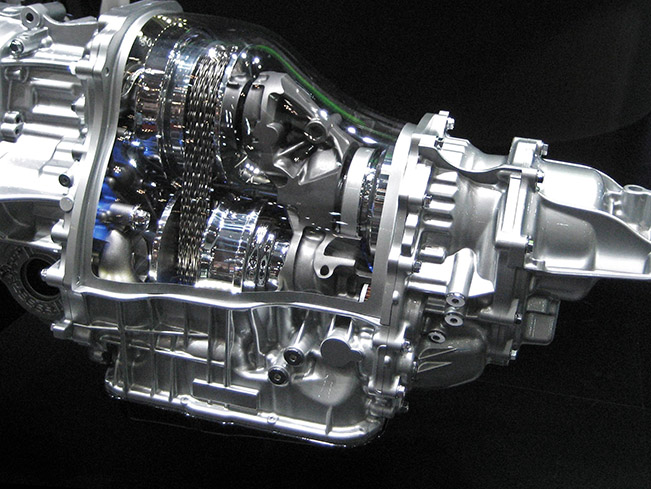
A continuously variable transmission (CVT) is a type of automatic transmission but operates very differently than older fluid-based automatics. CVTs are mechanically-based transmissions and provide more useable power, better fuel economy and smoother driving than traditional automatics. It should be noted that CVTs have been around for years in other motorized applications. Vehicles such as snowmobiles and some off-road recreational vehicles have utilized CVTs for decades. Only just recently has the technology seen mainstream automotive use.How they work
Conventional automatic transmissions have sets of gears inside their housings that provide different gear ratios or speeds. Control units sense a vehicle’s speed and other parameters and use that information to shift the transmission’s gears. The user just puts the transmission in the appropriate mode with the gear selector switch (P-R-N-D-L). A CVT uses a similar selector switch but replaces the complex gears sets common in automatic transmissions with two simple variable-diameter pulleys, each shaped like a pair of opposing cones, with a metal belt running between them. The way it works is that during operation the pulleys move in and out such that a drive belt between moves higher on one pulley, lower on the other and this provides a numerical gear reduction. You can picture this roughly as the way a 10-speed bike works, by routing the chain over smaller or larger gears to change the gear ratios. The gearing effect with a CVT is essentially “continuous”, hence the nomenclature.
What they are like to drive
The controls for a CVT-based car are the same as an automatic-based car: Two pedals (gas and brake) and a P-R-N-D-L-style shift pattern. When driving a car with a CVT, you won’t hear or feel the transmission shift, though. It simply raises and lowers the engine speed as needed, calling up higher engine speeds (or RPMs) for better acceleration and lower RPMs for better fuel economy while cruising. Some people find that driving a CVT-based automobile is a little disconcerting because they sound different when being driven.
Advantages of CVTs
Internal combustion engines do not develop constant power at all speeds; they have specific speeds where either torque, horsepower, or fuel efficiency are at their optimum levels. Because a CVT can theoretically adjust to any gear ratio, engineers can program them to give maximum performance in all these situations.
Disadvantages of CVTs
The CVT’s biggest problem has been user acceptance. Because the CVT allows the engine to rotate at any speed, the noises coming from under the hood can sound odd to ears accustomed to conventional automatic transmissions. Automakers have gone to great lengths to make the CVT feel more like a conventional transmission. For example, many CVTs are now programmed to simulate the “kick-down” feel of a regular automatic when the pedal is floored.
Reliability of CVTs
Because early automotive CVTs were limited as to how much horsepower they could handle, there has been some concern about the long-term reliability of the CVT. This has not proven to be a problem, though. Advanced technology has made the CVT quite robust and reliable. Nissan has more than a million CVTs in service around the world and says their long-term reliability is comparable to conventional transmissions.
The future of the CVT remains to be seen. In spite of the obvious efficiencies of CVTs, customers can be fickle and may prefer and older technology. Give it a few more years and we should know how user acceptance plays a role in the adoption in CVT technology.
Source: Team Nissan North
-
2013 Honda Accord Coupe Concept – NAIAS
 Honda has revealed the Accord Coupe Concept today at the North American International Auto Show. The new ninth-generation 2013 model is set to go on-sale this fall. It boasts cutting edge technologies combined with bold design and nice powerful engines.
“Marking the 30th anniversary of U.S. production, this new ninth-generation Accord will raise the bar again through a tour de force of new Honda powertrain and safety technologies, geared to ensure that Honda and the Accord continue to lead in fuel economy, safety and fun-to-drive performance,” commented John Mendel, executive vice president of sales for American Honda.
The engine range includes a new 2.4 liter Earth Dreams with 184PS (135 kW) and 240Nm (177 lb-ft). It is coupled with a 6-speed manual or a new Continuously Variable Transmission (CVT). There is also a hybrid model with a 163PS (120 kW) electric motor and a 2.0-liter four-cylinder Atkinson-cycle engine. Last, but not least, Accord can be power by a mighty 3.5-liter V6 with 314PS (231 kW) and 359Nm (265 lb-ft). It can be connected to a 6-speed manual or a new 6-speed automatic.
The new Accord will be available with Honda’s first application of Lane Departure Warning (LDW) and Forward Collision Warning (FCW) technology. Both systems use a camera mounted behind the windshield to alert drivers if the car is moving out of its lane or to warn drivers of a potential collision in front of them.
The standard equipment is amazing, but the most interesting features are the Bluetooth 3 HandsFreeLink phone interface, a full-color intelligent Multi-Information Display (i-MID) and an SMS text messaging function. Another standard feature and first for the Accord is the introduction of a Pandora Internet Radio interface4, compatible with the Apple iPhone, which works with the vehicle’s audio controls and i-MID.

2013 Honda Accord Coupe Concept 


Source: Honda
-
2011 Jeep Compass UK
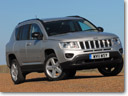 2011 Jeep Compass will hit the UK market on 15 April. It is priced at £16 995 for the entry version, but the price can go up to £23 995 for the top-of-range model.
Compass will be offered in either two or four-wheel drive version. This is the first SUV from the company, which will be available in two-wheel drive and it is specially aimed to the hatchback owners who want to trade up. These buyers don’t need four-wheel drive, but want the styling, image and practicality of a Sports Utility Vehicle (SUV). However, the 4×4 version will please the off-roaders with its improved quality of the interior and exterior inspired by Grand Cherokee.
There will be four trim levels, with 4×4 Limited and 70th Anniversary versions on sale this month. The entry-level Sport and Sport+ versions will join the range in August.
The engine range includes two petrol and one diesel. These have four power outputs and offer significantly improved performance and economy over the engines they replace.
The Limited and 70th Anniversary models will feature a chrome exhaust tailpipe and sit on new 18” alloys. The Sport and Sport+ come with smaller 17 inchers as standard.
2011 Compass comes with cruise control along with backlit switches for the door handles and locks, power mirrors and windows as standard. The safety is granted by active front headrests, and next-generation multi-stage front airbags with side curtain front and rear airbags as standard.
The automatic climate control is also standard, except the Sport which features manual air-conditioning. Front seat passengers sit in sumptuously padded bucket seats, covered in leather with accent stitching in the Limited and 70th Anniversary models, premium cloth in other versions. A six-way power adjustable driver’s seat and heated front seats are standard in the Limited and 70th Anniversary.
Sport and Sport+ models include a Media Centre CD player and MP3 compatibility, while the Limited and 70th Anniversary add a six CD system. All models have four speakers and an audio jack for connecting MP3 players. Owners of Sport+ models and above have a USB socket and can connect their mobile phones and use them handsfree with Uconnect Bluetooth.
The SAT NAV is available as an option on Limited and 70th Anniversary versions. It includes a 30GB HDD and a 6.5” touch screen.
The new 2.2-litre CRD turbo diesel engine has either 134BHP or 161BHP and 320Nm available from just 1400RPM.
The petrol engines are either 2.0 or 2.4-litres. Both feature dual Variable Valve Timing on the twin overhead camshafts. They deliver more power and offer better fuel economy and smoother, quieter operation.
The gearboxes are 5-speed manual for 2.0 litre petrol, 6-speed manual for the 2.2 diesel and the 2.4 litre petrol is available with the CVT2 Continuously Variable Transmission.
Jeep vehicles were first produced in 1941 and they become legendary with their capability.
2011 Jeep Compass is not an exception!


Source: Jeep
-
Nissan Rogue Krōm Edition hits the market in December 2009
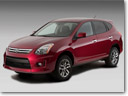 The new Krom edition of Nissan Rogue will be available at dealerships across USA in December 2009. It features sporty styling, exclusive 17″ wheels and sport exhaust system. (more…)
-
2010 Suzuki Kizashi Sedan is released
 Kizashi Sedan is the newest creation from Suzuki. This premium sport sedan is targeted to people, who want luxury car at normal price. (more…)
-
The Next-Generation CVT by Nissan and JATCO
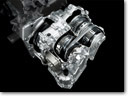 Nissan Motor Co., Ltd., a long-time leader in the development and application of CVT (Continuously Variable Transmission) technology, and its affiliate transmission supplier JATCO Ltd. today announced the joint development of a new generation of compact and lightweight CVTs. (more…)


