Tag: concept vehicle

  • BMW i8 Concept Spyder

    The exceptional BMW i8 Concept Spyder is an open-top two-seater, which can grab literally any heart! It has the entire necessary characteristic and in addition adds to them with sporting and emotional appearance.

    This concept is purposefully built in order to meet the changing needs of customers and transform the understanding of personal mobility. It is equipped with intelligent technologies and definitely has an innovative design, however what is more is that now embraces a philosophy which adopts significant degree by sustainability throughout the value chain.

    This is the third BMW i model, which is here to “inform” us what will be the future of cutting-edge and emotionally appealing mobility concepts. It is not only a mixture between sporting design with an open-top two-seater, but is also a combination of lightness, dynamic capability and efficiency with a very special aesthetic value.

    What is worth mentioning as well is that it is a blend of intelligent lightweight design and state-of-the-art hybrid technology. This results in exciting sports car performance and driving pleasure combined with exceptional fuel-consumption unmatchable in this segment before.

    BMW i8 Concept Spyder has the upward-swivelling, windowless doors and a range of purpose-oriented on-board equipment which features electric kickboards stowed under a transparent tailgate. The concept vehicle is built on the innovative LifeDrive architecture. The latter includes lightweight modular construction and the utilization of high-quality high-tech materials.

    BMW i8 Concept Spyder
    BMW i8 Concept Spyder

    Furthermore, the BMW i8 Concept Spyder is a plug-in hybrid powered by an eDrive drivetrain. This drivetrain combines the excellent performance of the electric motor and petrol combustion engine, while the lithium-ion battery supplies the motor with power that can be recharged in an extremely short space of time from any domestic power socket. In addition, the car has significantly reduced weight, low centre of gravity and is precisely balance. Everything is combined with a system output of up to 260 kW (354 hp).

    Like its Coupe sibling (2+2-seater BMW i8 Concept), the BMW i8 Concept Spyder blends intelligent lightweight design with the leading-edge drivetrain technology eDrive, which delivers extremely low fuel consumption and emissions.

    The concept got compact dimensions and specific exterior paintwork. Additionally, it has the upward-swivelling, windowless doors and a transparent glass panel at the rear. How about the interior: a revised material is used and a colour concept provides an extra dose of sportiness.

    Moreover BMW i8 Concept Spyder is built around the innovative modular LifeDrive architecture, which comprises of independent functional units. For instance, the carbon-fibre-reinforced plastic (CFRP) Life module gives the car an extremely lightweight passenger cell, while the Drive modules bring together all the car’s operational driving functions, such as the powertrain, chassis and safety structure. And thanks to the intelligent lightweight design and the use of innovative materials, the vehicle delivers great fuel-efficiency. In particular in the LifeDrive architecture the front and rear axle modules are connected by an “energy tunnel”, which houses the hybrid battery, this results in low centre of gravity and ideal balance.

    The BMW i8 Concept Spyder’s includes emotion-led design as well which vividly spotlights the car’s qualities, with lightness, dynamic capability and efficiency highlighted to particularly prominent effect. The key elements which contribute for this sporty dynamic stance are the large body panels, a hunkered-down stance and numerous aerodynamic elements such as contact surfaces, spoiler lips, AirCurtains and aeroflaps.

    What is more here is that the front end offers a revealing window into the open-top two-seater’s dynamic talent. In addition a spoiler lip on the windscreen frame guides the airflow over the heads of the passengers. Of course there is also featured a two-section folding roof.

    Observed from side, the Spyder has short front and rear overhangs and a low-slung silhouette. Additionally, the alluring lines and forms generate a strong forward-surging stance even before the car powers off the line.

    Compared to the front end, the rear also is positioned low to the road. Its headline feature is a transparent cover revealing the two folded electric kickboards accommodated below. A rear diffuser, three-dimensional air outlets and the U-shaped rear lights makes the BMW i8 Concept Spyder with extremely wide appearance and further emphasize its sportiness.

    Going further, the interior of the BMW i8 Concept Spyder is defined by three levels. Each one has various functions. The interlocking of surfaces and lines for instance, is also one of the stand-out features of the interior design. On the other hand, the outer layer also frames the supporting structure, while the inner “comfort” layer includes seat surfaces and stowage compartments. The third layer is represented by the cockpit, and brings together the instrument panel, steering column and steering wheel with the instrument cluster, central information display and control elements. Of course, the car has a low drivers’ seating position. Moreover, an 8.8-inch (22.4 cm) screen displays the driving information in three-dimensional, high-resolution quality.

    BMW i8 Concept Spyder Interior
    BMW i8 Concept Spyder Interior

    Furthermore, the Spyder’s interior is a mixture of plastic, carbon and leather, with theoff-white of the outer layer and the bold orange tone of the naturally tanned leather generating a sporting atmosphere.

    The BMW i8 Concept Spyder with eDrive means that it is a plug-in hybrid which combines two different power sources: electric motor and combustion engine. First, the electric motor produces 96 kW (131 hp) and it is on the front axle. It works in combination with a turbocharged three-cylinder petrol engine delivering 164 kW (223 hp) through the rear wheels. When combined, both units generate an aggregate system output of 260 kW (354 hp) and peak torque of 550 Nm.

    And if you wonder about the acceleration data, well – here’s some: the Spyder accelerates from 0 to 100 km/h (62 mph) in just five seconds. It has a electronically limited top speed of 250 km/h (155 mph). It’s performance in other words is exceptional. However, despite these numbers, the two-seater burns just three litres of petrol per 100 kilometres!

    Furthermore, the electric motor gets its energy from a lithium-ion battery which can be fully charged from a domestic power socket in less than two hours. The battery is located in the energy tunnel between the front and rear axle modules.

    With its battery fully charged, the BMW i8 Concept Spyder can go up to 30 kilometres (19 miles) only on electric power. And if it is required, a high-voltage alternator hooked up to the combustion engine generates additional power, which is then stored in the hybrid battery.

    Additionally, the concept vehicle has as wee the ability to send power through the front, rear or all four wheels at the same time. It has the intelligent control electronics, which ensure that the optimum drive configuration is available for the situation at hand. Next, the electronic systems ensure maximum energy recuperation under braking or when coasting.

    BMW i is equipped with new generation of driver assistance systems such as the camera-based proactive Collision Warning system, Parking Assistant and Traffic Jam Assistant. Remote functions accessed via a smartphone are also included, such as the Last Mile Navigation function and the Intermodal Route Planning function.

    Two large displays can be found inside the BMW i8 Concept Spyder. They make up the interface between the car, its passengers and the outside world. They are positioned next to the instrument cluster behind the steering wheel. What is innovative here is that all the screens display their information in 3D.

    On the other hand the instrument cluster displays important driving and it is positioned alongside the digital speedometer. For example, the efficiency display allows drivers to view how much energy they are currently using, and shows extra navigation details and information on the car’s range as well. If the driver switches to energy-saving ECO PRO mode, the display turns blue in colour to signal the shift in functional emphasis, and the ellipses now also vary in form. By the same token, moving into SPORT mode treats the driver to an emotional orange hue. As well as the changes in colour, the displays also provide information tailored to the driving mode selected and to assisting the driver as effectively as possible.

    BMW i8 Concept Spyder Specifications

    Length/Height/Width L 4480 mm, H 1208 mm, W 1922 mm
    Wheelbase 2650 mm
    No. of seats 2
    Kerb weightTop speed

    Acceleration

    1630 kg250 km/h (155 mph) electr. governed

    0-100 km/h (62 mph) 5 s 80-120 km/h (50-75 mph) 4.0 s

    System output TwinPower Turbo engineFuel consumption (EU cycle) 260 kW / 550 Nm 164 kW / 300 Nm3 l/100km / 94 mpg imp
    eDrive output electric motor electric range battery charge time 96 kW approx. 27-30 km (17 – 19 miles)standard: 1.45 h for 100% charge

    Source: BMW

  • 2012 Geneva Motor Show: EDAG Light Car – Sharing concept car

    2012-EDAG-Light-Car---Sharing-concept-car-THUMB2012 EDAG Light Car – Sharing concept car is thefirst vehicle to have been specifically designed to meet the needs of the growing car sharing sector. It is designed to include the maximum possible space inside, and also the exterior has resilient surfaces. It is electrically driven and in resonance with Light Car philosophy. In particular, the light is used as a means of communication to indicate the leasing status of the vehicle.


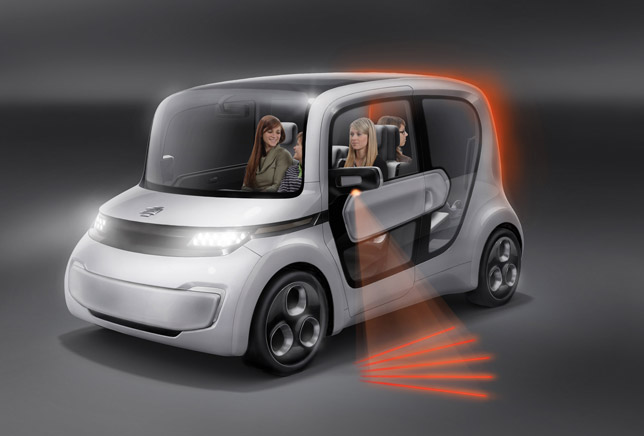
    For leasing purposes a car should be practical, robust and self-explanatory. Hence the exterior is of height of 1.90 meters, which makes it easy for the passengers to get in and out. In addition there is very convenient parking system, which is sensitive to spots around the bumper. As the name shows, the light plays crucial role and serves as a communication instrument. When the car is being charged or reserved, or available for hire, the LEDs integrated in the gel pads and “PLEXIGLAS ® LEDs” manufactured by Evonik Industries AG use three different colors to give a highly visible indication of the status. In addition, there is a laser, which when parking the car or opening the doors, projects a safety zone onto the asphalt, ensuring that passengers can get in and out in safety.

    2012 EDAG Light Car - Sharing concept
    2012 EDAG Light Car – Sharing concept

    Besides the two side doors with simple sliding windows, the “concept vehicle also has twin rear doors. The coupe features six folding seats arranged in two rows of three. A special emphasis has been put on an intuitive operating concept: aside from the accelerator, brake and steering wheel, the only other control is a lever to work the indicators. This means that there is just one display element, which only gives the important data (speed, charge, range, navigation).
    Furthermore EDAG Group is also exhibiting a networked mobility concept for booking the future share car fleet. In particular, the operators of future car will use GPS to locate their vehicles and communicate their locations to potential customers. Hence, it will be possible to inform the customer which cars are available, and then guide him to the nearest one by means of the navigation system in his smartphone. Of course, the booking will be made via Internet, and the customer can then access the vehicle through electronic “Bluetooth key”.

    In addition, the concept car features the so called “intelligent charger”: besides performing the actual charge process, the “intelligent charger” also sends vehicle information via the power supply system and decides itself when is the perfect time for charging. It does this by taking into account the availability of renewable energies and mobility behavior. More importantly, the operator receives all important information on the status of the vehicle online. The communication between car and user is even further enhanced with new services such as automated legitimation and the selection of individual tariffs or prices per minute. This interconnection brings about considerable added value for the entire mobility system. What it does in details, is that it gives the energy provider the chance to make use of energy storage and in this way reduce load fluctuations in the grid due to electric cars being connected. On the other hand it ensures that there is sufficient resource-saving energy to charge the share vehicles whenever necessary.


    Source: Edag

  • 2012 SEAT Toledo Concept

    2012-SEAT-Toledo-Concept-THUMBAt the 2012 Geneva Motor Show, SEAT brand will proudly present their new concept vehicle, named Toledo, which combines the proportions of a classic saloon car with a sporty, almost coupe-like design. This is a next-generation of the SEAT Toledo, which in addition is an extraordinary combination of emotion, excellent design quality and rational usability. It carries powerful and solid stance, clear surfaces and lines, and new headlamp form which is a signature feature of SEAT’s new design DNA. Furthermore the new 2012 SEAT Toledo Concept also offers spaciousness and usability within compact dimensions. Within its length of 4.48 metres, and wheelbase of 2.60 meters, the new Toledo delivers spaciousness for five people, a luggage compartment of more than 500 litres and large rear hatch and folding rear bench. These dimensions make the vehicle perfect for city driving as well as for long journeys and family transportation needs. Moreover, the luggage compartment is equally spaciously proportioned, with impressive volume. In addition, the new concept vehicle possesses a large rear hatch for optimum loading. Eventually, the folding rear seats facilitate an exceptionally long load length and give the Toledo a usability that is almost on par with that of an estate car.

    2012 SEAT Toledo Concept
    2012 SEAT Toledo Concept

    With the new 2012 SEAT Toledo Concept, SEAT Design is adding an extra portion of sophistication into the design language. At first sight, one can see that the vehicle got a fine figure with its stretched proportions, clean surfaces and sculpted edges. The grille is with honeycomb mesh and retains its trapezoidal form. However its look now is wider and lower. The same pattern is applied on the large air inlet beneath the bumper. One of the characteristic elements of the new SEAT design language is the pentagonal form of the broad front headlamps. The light units come with the chromed “wing” between main headlamp and daytime running light. The broad rear lights also received the same styling, thus contributing to the entire rears impression of quality and solidity. Observed from the side, the new Toledo Concept has taut and dynamic look. This impression is achieved, thank to the clean edge runs from the headlamps across the shoulders to the rear lights. In addition to that the area around the sills has a simple, sculptural feel. Nonetheless, the most important element here is the roofline, which carves an elegant arc all the way to the powerful breadth of the C-pillar, emerging seamlessly from the rear side panel.
    At last the interior of the 2012 SEAT Toledo Concept portrays the modern lines of the exterior and gives a feel for spaciousness. The cockpit delivers a feeling of ergonomic clarity, with the top of the dashboard seeming to float effortlessly above the air vents and trim elements. Furthermore, the light coloring of the interior comes with stitching of the leather seats and the leather cladding on the cockpit and doors. All this emphasizes the superb character of the new Toledo Concept.

    Source: SEAT

  • Nissan Hi-Cross Concept Teaser [VIDEO]

    Nissan-Hi-cross-Concept-ThumbNissan is the one of the biggest leaders in the production of crossovers all over the world. What we are going to see from the brand at this year’s Geneva Motor Show is something spectacular.

    There, we are promised to preview how Nissan explores new ideas and manifest them in reality. In addition, the brand is looking for an expansion in terms of award-winning range segment, and this is exactly where the attention will be put on the show in Geneva. A sneak peak of what is going to come and what we are going to see on 6th of March is the exclusively released video teaser of the new Nissan Hi-Cross Concept vehicle. The video is so creatively made that after watching it you’ll be “hungry” to know more about the upcoming concept car. Of course, any other details than these are scarcity at the moment so we have to wait till the show next week.

    Nissan Hi-Cross Concept
    Nissan Hi-Cross Concept

    So, let’s have a preview of the new Nissan Hi-Cross Concept:

    httpv://youtu.be/yA1IOFx5S8A

    Video Source: YouTube

    Source: Nissan

  • 2012 EDAG Light Car – Sharing concept car

    EDAG Light Car - Sharing concept ThumbThe engineering service provider EDAG is going to present a world debut of the outstanding Concept vehcile, called EDAG Light Car – Sharing at this years Geneva Auto Show. This is a concept car made especially to fit instantly to the booming leasing business. More importantly the car is electrically driven and has been constructed strictly for use as a leasing car. According to the manufacturers it answers all the needs of the customer: it is simple and easy to use as a local publuc transport. To be more precise, these requirenents, led to the non-featuring of storage surfaces nor fancy door trims in the new EDAG Light Car – Sharing Concept Car. And even more, to make it simpler, aside from the accelerator, brake and steering wheel, the only other control the customer will find is a lever to work the indicators. There is just one display element which gives basic information abut the speed, state of charge, range and navigation.

    Moreover, the car created by the EDAG is designed with two side doors and twin rear doors. However it keeps room for 6 passengers. Thank to the car’s height of 1.90 m the passangers can get in and out easily. Additionally, there are also folding seats included. They provide maximum transport capacity. The materials used in the interior are are easy to clean, and as they are modular-based,  so therefore also easy to exchange.

    2012 EDAG Light Car - Sharing concept
    2012 EDAG Light Car – Sharing concept

    There is also a unique technologies included in this leasing concept vehicle. For example, there shouldn’t be any worry about bumping the car when parking, bacause the sensitive spots are fitted with “Technogel” pads, and these can withstand minor collisions. Of course, light plays a prominent role as a communication instrument in this car: the LEDs integrated in the pads and “Plexiglass truLED” give a continual, visible indication of the status of the car. Furthermore, while parking the car or opening the doors, a laser integrated in the mirror starts projecting a safety zone onto the asphalt, ensuring that passengers can get in and out in safety. Another interesting and innovative feature is that the rear window can be marketed as advertising space by the fleet owner, but only when the car is not being driven. With this exceptional concept car – EDAG Light Car – Sharing, the EDAG Group shows extremely high competence and eagernessin finding new ideas and developing innovative vehicle concepts.

    Source: EDAG