Tag: CNG

  • Chevrolet Impala’s CNG tank can survive bullets

    2015-Chevy-tank_thumb2015-Chevy-tank_651

    There are many different fuels besides gasoline out there with each one of them having advantages and drawbacks. In the recent years, however, compressed natural gas (CNG) has become a popular type of fuel due to several advantages – it is cheap, it does not pollute the environment and it provides almost as much power as gasoline. The drawback? It’s the CNG tank as there may be leakages and other problems.

    This is not the case with the tank of the CNG-powered 2015 Chevrolet Impala. The car boasts a tank that is so safe and so strong it can survive bullets and fires that come from different directions. Chevrolet has achieved this level of endurance and safety by adding a large piece of cast aluminum that protects the tank valve and connection from certain side impacts and sheet metal plates on either side help protect it from loose objects in the trunk or rear seat. Chevrolet has also exposed the tank to pressures higher than 3,600 PSI, which is the normal value and then other extreme situations, exceeding US federal regulations and CNG industry guidelines. In addition to that the tank has undergone long-term structural integrity tests equivalent to 15,000 pressure cycles and hydrostatic burst tests of up to 8,100 PSI. This is what the tank also had to endure:

    • The industry-standard Bonfire Test confirms the CNG tank’s pressure relief valves are operational and help prevent the tank from rupturing in a fire. In addition to placing the tank about four inches above a steady 800-degree Fahrenheit fire, General Motors’ engineers added trunk, back seat and underbody fires to test the pressure relief valves’ ability to sense heat on all sides of the tank. And the tests were done at two different fuel levels.
    • In the Penetration Test, the tank is filled to its service pressure and is shot with a 7.62 mm armor piercing bullet. In order to pass the test, the bullet has to pass completely through one side of the tank without exiting out the other side. The goal is to have the tank maintain the bullet hole only as the weak structural point, without rupturing.
    • Front barrier, side impact and rear impact crash tests were conducted on the Bi-Fuel Impala. Some aftermarket CNG-conversion kit manufacturers conduct only a barrier test.

    The all-steel, trunk-mounted tank holds about 7.8 gallons of gas, enough for the driver to cover about 150 miles of driving after which the car automatically and seamlessly switches to gasoline. The Bi-fuel Impala, which is also a 2015 “Green Car of the Year” finalist, is the auto-industry’s only manufacturer-produced full size sedan in North America that runs both on CNG and gasoline. The CNG system is covered by a 5-year, 100,000-mile limited warranty, whichever comes first, and can be serviced at Chevy dealerships in both the USA and Canada.

    The CNG-powered 2015 Chevrolet Impala can be ordered now. The car will ship by the end of this year.

    Source: Chevrolet
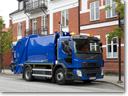
  • Volvo releases truck that runs on natural gas

    2015-Volvo-FE-CNG_thumb2015-Volvo-FE-CNG_651

    The Swedish auto maker Volvo has enhanced its truck range in Europe with the addition of a new version of the Volvo FE that runs entirely on compressed natural gas (CNG). The so-called Volvo FE CNG has been designed for activities that involve short driving cycles with repeated stops such as trash collection or local distribution. In addition to that the new Volvo FE CNG offers exceptional environmental cleanliness as natural gas has very low levels of harmful particles. If produced from biofuels, natural gas can have carbon dioxide emissions that are up to 70 per cent lower than those of a diesel-powered truck.

    “With the Volvo FE CNG we can now offer companies that drive predominantly in urban environments a truck with a far lower environmental impact. Many cities the world over are looking for alternatives to diesel-powered trucks. In the field of refuse handling, for example, renewable fuels are often a requirement for securing a contract,” says Christina Eriksson, Business Manager Alternative Drivelines at Volvo Trucks.

    The new Volvo FE CNG is powered by an all-new 9-liter Euro-6 engine featuring spark plug technology that produces 320 horsepower (235 kW) and 1356 Nm (1000 lb-ft) of torque. Thanks to its six-speed fully-automatic transmission, the truck retains the same excellent driveability and productivity as the conventional Volvo FE. The automatic transmission also gives faster driveline response.

    “Spark plug technology is particularly suitable for driving cycles where the truck covers short distances with a lot of start-stop traffic,” explains Christina Eriksson.

    “Methane gas is the fuel that will become a sustainable alternative to diesel in the long-term. Right now the focus is on working together with the various public authorities and private corporations to draw up the relevant rules and create the right conditions for positive development,” says Lars Mårtensson, Environmental Director at Volvo Trucks.

    The new Volvo FE CNG will become commercially available this month with series production commencing in early 2015. No word on pricing as of now.

    Source: Volvo

  • 2012 Opel Combo

    Opel has introduced the new generation Combo, which offers clever solutions in the compact van segment. It comes in a wide range of variants, is technically advanced, exceptionally economical and provides maximum utility.

    The panel van version now offers a choice of two wheelbases – 2 755 mm or 3 105 mm – giving an overall vehicle length of 4.39 and 4.74 meters respectively, as well as two roof heights, 1.85 m or 2.10 m. The new Opel Combo is also available as a versatile car-van, with five or seven seats and a paneled or glazed body.

    The short wheelbase model can hold 3 800 liters of luggage, while the extended variant can accommodate 4 600 liters.

    The engine range includes four diesels with 90 PS (66 kW) to 135 PS (99 kW / 133 hp), a 1.4-liter petrol with 95 PS (70 kW) and a CNG with 120 PS (88 kW). There is also a choice between three gearboxes – a 5-speed manual, a 5-speed automated manual or a 6-speed manual.

    2012 Opel Combo
    2012 Opel Combo

    Source: Opel

  • Speedriven Mercedes SL 600 CNG


    Mercedes SL 600 received a special tuning package from Chicago tuner Speedriven. The staggering thing about it is that the roadster will go on Natural Gas.

    2007 SL600 Mercedes-Benz roadster is powered by 5.5 liter twin-turbo V12 delivering 811PS (597 kW) and 1354Nm (1000 lb-ft). It does a 1/4 mile in just 10 seconds.

    However, the world record for the fastest CNG-powered car is still held by Hohenester Audi A4 tuned to 710 (522 kW), which hit 364.6 km/h (226.55 mph) in 2009.

    The goal of Speedriven is to hit 386 km/h (240 mph) with ther “green” roadster.

    “I admit it. I’m a horsepower addict. I love speed, I love power, and I love my Mercedes-Benz,” says Bernie Towns, the owner of the unique Mercedes.

    source: worldcarfans

  • Honda Civic GX CNG is announced for selling in Oklahoma

    CNG cars are becoming more and more popular in the USA, because of the lower emissions and extraordinary good fuel economy. Now Honda Civic GX running on compressed natural gas is available for selling in Oklahoma at the American Honda Motor Co., Inc. (more…)

  • Opel Adds New Turbo CNG Unit To Pro-Environmental Engine Range

    Higher output and torque with lower consumption and emissions
    Rüsselsheim. In 2009, Opel will introduce one new 1.6-liter turbo CNG engine (Compressed Natural Gas) with around 110 kW/150 hp and 210 Nm of torque. Developed by GM Powertrain in Turin, the new unit joins Opel’s current aspirated CNG engine, which has the same displacement and an output of 69 kW/94 hp. “Environmental awareness and driving fun are no longer mutually exclusive,” says Alain Visser, Chief Marketing Officer, GM Europe. “With this newly developed turbocharged CNG engine, we continue pursuing our strategy of turbocharging engines to increase efficiency – meaning lower consumption and emissions – without making any concessions in performance.” (more…)