Tag: Carbon

  • Limited Carbon Fiber Edition, Colossal Power: 2022 Toyota GR Supra

    2022-toyota-gr-supra-a91-cf

    The fifth generation GR Supra shook the automotive world when it arrived on the scene in 2019. It put pure driving fun above all else with a focus on performance specs and relentless track testing.

    For 2022, a special A91-Carbon Fiber (CF) Edition joins the lineup. Limited to just 600 vehicles, this special edition is the most exclusive Mark V Supra to date. It offers all the style, performance and technology that drivers expect, with an obsessive attention to detail that fits a racing legend. With the bold, sleek look of handmade carbon fiber accents and duckbill spoiler, this eye-grabbing new limited-run special edition is sure to sell fast.

    GR Supra is also available in 3.0, 3.0 Premium and 2.0 grades. Heated seats are now standard on the 3.0 grades and the 3.0 Premium adds a red leather trimmed interior option. Models equipped with Premium Audio package receive full-screen Apple Car Play.

    The Supra 3.0, 3.0 Premium and A91-CF Edition flex their muscles with a 382 horsepower turbocharged 3.0-liter inline-six that goes from zero to sixty in just 3.9 seconds. The 2.0 gives customers an intermediate model between the GR86 and the Supra 3.0, with a 2.0-liter inline four-cylinder turbocharged engine, launching the 2.0 to 60 mph in just 5 seconds.

    This latest generation keeps Supra finding ways to blend speed, power and style. Supra’s already-incredible features remain standard, including an aggressive eight-speed Z-F8 transmission with paddle shifters, Adaptive Variable Sport suspension and active rear sport differential, and front Brembo brakes with red calipers and emblazoned silver Toyota Supra logo come standard.

    Color always adds sizzle, and GR Supra serves it up in style. Absolute Zero, Nitro Yellow (special color), Nocturnal, Renaissance Red 2.0, Tungsten and Turbulence Gray are available for the 2.0 and 3.0’s exteriors. The 3.0 Premium adds Phantom to the mix. The A91-CF Edition is available in Absolute Zero, Nitro Yellow or Phantom. The 2.0 and 3.0 come with black Alcantara/leather on the interior, 3.0 Premium offers a choice of black or red leather and the A91-CF Edition comes with an exclusive mix of black and red Alcantara and leather.

    The 2022 GR Supra is available at Toyota dealerships now with a Manufacturer’s Suggested Retail Price (MSRP) starting at $43,290 (2.0 grade), prices subject to change; Delivery, Processing and Handling (DPG) are extra.

    Carbon Fiber For The Win

    The GR Supra A91-CF Edition features handmade carbon fiber on the front splitter with larger canards, while its carbon fiber rockers define the sides. Around back, the carbon fiber treatment continues, with a duckbill spoiler catching the air up top, and larger, lower canards doing so down below.

    This aero kit isn’t just for looks, its functional purpose improves downforce and stability during both everyday drives and hot laps around the local track. Additionally, unique 19-inch wheels sport a matte-black texture that complement A91-CF Edition’s available matte-gray Phantom paint color – Absolute Zero White and Nitro Yellow round-out the color choices.

    GR Supra A91-CF Edition brings an exclusive, refined interior as well, with a red-and-black theme throughout its Alcantara-and-leather-trimmed cabin. It includes red stitching details on standard 14-way power adjustable, heated sport seats, along with carbon fiber interior trim, leather wrapped 3-spoke steering wheel and sport pedals.

    Legendary Performance with Spec Variety

    It takes a relentless spirit to win at the 24 Hours of Le Mans race. Known as the “Grand Prix of Endurance and Efficiency,” just completing the race is an achievement. Toyota Gazoo Racing has taken the crown for the past three years.

    The same determination that fuels those wins goes into every GR Supra.

    For the 2021 model year, Toyota Gazoo Racing kept the pedal down and boosted output of the Supra’s turbocharged 3.0-liter inline-six from 335 to 382 hp, a 14% increase after just one year on the market. Torque rose from 365 lb.-ft. at 1,600-4,500 rpm to 368 lb.-ft. at 1,800-5,000 rpm.

    The Supra 3.0 chassis was also tweaked heading into its second year of production. Lightweight aluminum braces were added to increase lateral rigidity, along with front and rear bump stops and new damper tuning. Revised programming for the electric power steering (EPS), Adaptive Variable Suspension (AVS), Vehicle Stability Control (VSC) and Active Differential made the Supra more stable through quick transitions, such as compound turns.

    But making changes to Supra wasn’t enough for the GR team, in 2021 the Supra 2.0 was added to the lineup.

    The 2.0 gave customers an intermediate model between the GR86 and the Supra 3.0. With a 2.0-liter inline four-cylinder engine, this Supra 2.0 shares much of its technology with the 3.0-liter inline-six, including a twin-scroll turbo, direct fuel injection and continuously variable timing on both the intake and exhaust camshafts. The variable intake valve lift system adjusts intake valve timing and duration. The bottom line is 255 hp at 5,000-6,500 rpm and a stout 295 lb.-ft. peak torque at 1,550 to 4,400 rpm, launching the 2.0 to 60 mph in just 5 seconds.

    The Supra A91-CF Edition is one more way that the obsessive, gear heads on the GR Team keep things interesting. Additional changes across the Supra lineup for 2022 include standard heated seats in the 3.0 grade and a new red interior for the 3.0 Premium grade. All models with premium audio add full screen Apple Car Play® compatibility.

    2022 Toyota GR Supra A91-Carbon Fiber (CF) - Engine

    Complimentary 1-year NASA Membership

    Every 2022 GR Supra comes with a complimentary one-year membership to the National Auto Sport Association (NASA). As part of this membership, GR Supra owners will enjoy benefits like a free High Performance Driving Event (HPDE) and discounted admission to NASA-sanctioned events. The HPDE Program is NASA’s high-performance driving school on an enclosed road course. It’s designed for licensed drivers in streetcars like the GR Supra. It consists of an all-day course with classroom instruction, on-track driving and opportunities to connect with other sports car enthusiasts. Instructors are provided free-of-charge for all beginner drivers.

    Tech & Safety at Supra Speed

    Along with the rest of the Supra family, the GR Supra A91-CF edition delivers awesome entertainment and convenience with an 8.8-inch touchscreen with touchpad control, navigation, user friendly wireless Apple Car Play compatibility, AM/FM and SiriusXM® All Access 3-month trial. The 500W 12-speaker JBL® audio system is standard on the A91-CF and 3.0 Premium. A 4-speaker sound system comes standard on the 2.0; a 10-speaker sound system is standard on the 3.0.

    All GR Supras come equipped with a number of intelligent safety features, including a Pre-Collision System, with Pedestrian Detection, Lane Departure Warning with Steering Assist, Automatic High Beams and Speed Limit Information.

    Upgrade to the Safety & Technology Package on the 2022 2.0 and 3.0 grades, and get:

    • 12-speaker 500-watt JBL Audio System
    • Wireless Apple CarPlay® compatible with full screen capability (iOS only)
    • Dynamic Radar Cruise Control (Full speed)
    • Navigation
    • Blind Spot Monitor (BSM)
    • Rear Cross Traffic Alert (RCTA)
    • Speed Limit Information
    • Parking Sensors with Emergency Braking Function
    • Supra Connected Services trial includes Remote Services, Remote Maintenance, Automatic Emergency Call, Real Time Traffic Information, Stolen Vehicle Recovery and Map Updates

    The Driver’s Assist Package is another available option on the MY22 3.0 Premium and A91-CF Edition, it includes:

    • Dynamic Radar Cruise Control (Full speed)
    • Blind Spot Monitor (BSM)
    • Rear Cross Traffic Alert (RCTA)
    • Parking Sensors with Emergency Braking Function

    All GR Supra grades offer access to Toyota Connected Services featuring emergency calling, roadside assistance, remote control lock/ventilation, real time traffic information, map updates and Toyota Supra Online (Services available online; app available for iOS only), subscription required.

    2022 Toyota GR Supra A91-Carbon Fiber (CF) - Interior

    Maintenance and Warranty

    Toyota’s 36-month/36,000 mile basic new-vehicle warranty applies to all components other than normal wear and maintenance items. Additional 60-month warranties cover the powertrain and restraint systems for 60,000 miles and corrosion perforation with no mileage limitation. Accessories come with a 36-month/36,000 miles, whichever comes first.

    Standard ToyotaCare is also included, a no additional cost plan covering normal factory-scheduled maintenance for 2 years or 25,000 miles, whichever comes first, and 24-hour roadside assistance for two years with unlimited mileage.

    2022 Toyota GR Supra Pricing*

    Every GR Supra puts pure driving fun, performance specs and relentless track testing in the hands of driving enthusiasts everywhere.

    GR Supra 2.0 2.0L twin-scroll single turbo, DOHC 16-valve inline 4-cylinder $43,290
    GR Supra 3.0 3.0L twin-scroll single turbo, DOHC 24-valve inline 6-cylinder $51,640
    GR Supra 3.0 Premium 3.0L twin-scroll single turbo, DOHC 24-valve inline 6-cylinder $54,790
    GR Supra A-91 CF Edition 3.0L twin-scroll single turbo, DOHC 24-valve inline 6-cylinder $63,280

    * MSRP does not include Delivery Processing & Handling (DPH) Fee of $$1,025. DPH subject to change.

  • All-new Artura confirmed as McLaren’s next-generation high-performance hybrid supercar

    McLaren Hybrid1

    McLaren Automotive will bring the full force of its expertise in hybrid powertrain engineering to the supercar class next year with the introduction of the new Artura, a High-Performance Hybrid (HPH) developed with the benefit of more than half a century of McLaren knowledge, experience and engineering achievements in race and road cars.

    All-new in every respect, the Artura marks the beginning of a new era for the pioneering British company. Building on the expertise in electrification first showcased in the McLaren P1TM hybrid hypercar unveiled in 2012 and more recently the Speedtail Hyper-GT, which entered production this year as McLaren’s fastest ever car with a top speed of 403km/h (250mph), the Artura is McLaren’s first High-Performance Hybrid series production supercar.

    “Every element of the Artura is all-new – from the platform architecture and every part of the High-Performance Hybrid powertrain, to the exterior body, interior and cutting-edge driver interface – but it draws on decades of McLaren experience in pioneering super-lightweight race and road car technologies to bring all of our expertise in electrification to the supercar class.”
    Mike Flewitt, Chief Executive Officer, McLaren Automotive

    The new Artura marks the debut of an all-new compact twin-turbocharged V6 petrol engine, designed to combine with an electric motor in a new lightweight High-Performance Hybrid powertrain that retains the performance benefits of McLaren’s larger capacity V8 engines and has the additional attraction of improved torque response at low engine speeds to deliver scintillating acceleration. The Artura can also run on electric power alone for everyday emission-free urban journeys.

    The first car to be built on an all-new, platform architecture optimised for electrification and designed and manufactured in the UK at the McLaren Composites Technology Centre, the Artura furthers McLaren’s commitment to super-lightweight engineering principles that have their roots in motorsport. The additional mass of the High-Performance Hybrid system, for example, has been largely offset by the application of weight-saving technologies throughout the chassis, body and powertrain. Additionally, the McLaren Carbon Lightweight Architecture (MCLA) at the heart of the Artura not only enables the car’s class-leading weight advantage, it is also the base for the dynamic excellence inherent in every McLaren.

  • Carbonfiber Dynamcis reveals its latest menacing project! And it is definitely incredible!

    2016 CarbonFiber Dynamics BMW F82 M4 Carbonfiber Dynamics, a well-known tuner in Germany showcases its latest project: a super-cool and menacing BMW F82 M4 that was completely revised. Called M4R, the vehicle incorporates numerous carbon-fiber parts from different manufacturers and showcases some incpredible agility, thanks to the heavily upgraded drivetain system and the total of 700hp (522kW) output.

    2016 CarbonFiber Dynamics BMW F82 M4

    But let me tell you a bit more about the carbon kit. It is exclusive extract of many brands and technologies and not only contributes to car’s great agility, but also is a stylish one. The front bumper fits the whole design concept of the M4R, while the carbon bonnet of MTC Design somehow resembles the GTS styling and creates a nice transition. Also, the side skirts, made by Varis, further enhance the sporty and menacing stance. The 3Ddesign rear wing ensures the necessary downforce and the 56°NORD carbon roof box is, in fact, a special one. It has been tested at speeds of up to 300km/h. At the same time the whole optics are topped with a GT4-styled wrapping from Revowrap, which showcases the sporty spark in the project.

    SEE ALSO: BMW on steroids: Alpha-N Performance team can do it!

    As we mention the sporty spark, we should say that this is not an ordinary BMW vehicle. It is especially fine-tuned to dominate the streets. With a total output of 700hp and 286Nm, this sweetheart will impress many racecar fans and even sceptics. Some of the drivetrain features include JB4 Tune from Burger Motorsport, BMS Au Chargepipes and Methanol Injection, revised TTE 6XX turbochargers and of course, Eventuri Carbon/Kevlar intakers. Sweet.

    2016 CarbonFiber Dynamics BMW F82 M4

    And how does it stop? Easily. With fresh new 14-disc clutch Dodson Motorsport brake system that replaces the original one. Also, the Mov’it brake ensures just fine deceleration and works in full harmony with the exclusive and fine-tuned Blistein B16 EDC suspension. And all this is finished with neat set of 19-inch 6sixty forged wheels and Proxes R888R Semislicks from Toyo Tires. Cool.

    Source: Carbonfiber Dynamics 

  • The lightweight 2016 Ford GT becomes even lighter: there are carbon-fiber wheels already available

    2016 Ford GT with carbon wheels The carbon-fiber-bodied Ford GT will be available with an optional all-new carbon-fiber wheels for further weight reduction and handling optimization. With collaborating partner Carbon Revolution, Ford presents the next-gen of fiber and resin technology that will probably change the world of technology.

    These optional wheels will be offered with matte or glossy finish, allowing the natural weave of the carbon-fiber to show through. Also, the finishes perfectly match the rest of the exposed carbon fiber components on the new Ford GT: sills, fascia and extractor.

    2016 Ford GT with carbon wheels

    The standard wheels of the Ford GT are 20-inch lightweight aluminum beauties, but the new and optional carbon-fiber wheels are not only the same size, but are also structurally stiffer and save about 1kg of unsprung weight per wheel, reducing the inertia with about 25 per cent. Cool, right.

    SEE ALSO: Ford’s Latest GT Supercar Is Named Official Vehicle of CES 2016

    All this weight saving also reduces the suspension workload and enhances the consistent contact with the road surface, which further improves traction and driver control. And with the less energy required to accelerate or turn the wheels, the vehicle will benefit from improved dynamics and fuel efficiency.

    2016 Ford GT with carbon wheels

    Carbon bodies, carbon interior, carbon components and now we have carbon wheels. We all wonder what else provocative engineers will show in the near future in order to reshape the world of motorsport. So, tell me, what in your opininion will be the next significat carbon-fiber component? An engine maybe?

    Source: Ford

  • TechArt Carbon Sports Package for Porsche 991 and 981

    TechArt is now offering complete Sports Package Carbon for Porsche 991 and 981. The tuning company adds attractive design elements made of genuine carbon fibre to its aerodynamic programs for Porsche models.

    All elements boast low weight, precise surface finishing as well as individual design options. The TechArt Sports Package Carbon sets sincere motor sport styling highlights.

    There is a new air outlet grille for 911 (991) as well as Boxster and Cayman (981). The tuning company also offers Aerowings for Porsche 911 Turbo and Turbo S (991) as well as Trims for side air intakes for the same models. A roof spoiler is also available for Porsche 911 and a new rear diffuser for both 911 Turbo and 911 Turbo S.

    Carbon fiber side mirrors are available for Porsche 911 (991), Boxster and Cayman (981). Further parts for the TECHART Sports Package Carbon are currently under development.

    All parts fit perfectly and come with all mounting materials. Pricing is available upon request.

    TechArt is also offering a power kit as well as other upgrades for Porsche 991 Turbo. Thepower control unit provides extra power on request with a single push of a button on the center console. 0-100 km/h in 2.9 seconds (3.0 seconds for the Cabriolet) and a top speed of 325 km/h (202 mph). Without using Sport- or Sport Plus mode the vehicle operates with series engine management system.

    Source: TechArt

  • Capristo Lamborghini Aventador Carbon

    Capristo Exhaust Systems has announced their latest project based on Lamborghini Aventador.

    LP700-4 is powered by a 6.5 liter V12 with 700PS (515 kW) and 690Nm (509 lb-ft). The engine is coupled to a 7-speed ISR gearbox specially supplied by Graziano Trasmissioni Group. The shift time is just 50 milliseconds. The power is put on the road through a Haldex AWD system. 0-100 km/h in 2.9 seconds and a top speed of 350 km/h (217 mph).

    The gross weight of the vehicle is 1575 kg (3472 lbs).

    This makes Aventador LP700-4 one of the fastest cars on the planet not only in straight line, but at the racetracks, too.

    However, this is not enough for Capristo, so with their specially prepared exhaust system, the car is even faster – 1/10th of a second faster than before – 2.8 seconds to 100 km/h and 3 km/h more to the top speed – 353 km/h (219 mph).

    Even more pronounced of exchanging plastic components with 100% carbon-fiber one. The overall weight is reduced by 40kg, which mainly affects power-to-weight ratio.

    Source: Capristo

  • VMS M Sport 5 series

    Vorsteiner have unveiled their latest project – V-MS for the BMW 5 series (F10) equipped with M Sport package. It involves an aerodynamic kit, new wheels and some exhaust system tweaks.

    The aerodynamic kit consists of a front air splitter (designed to fit the M Sport bumper), a rear diffuser and a trunk lip spoiler – all in carbon fiber. These add-ons give a type of character to the 5 series while having a purposeful balancing role. A newly installed full cat back exhaust system ups the power by 12HP and enhances the output sound.

    To round it up, the tuning house has also included a selection of 20 and 21 inch forged wheels. Feel free to browse around the gallery and see if you like it.

    Vorsteiner BMW 5-Series F10 VMS (2012)
    Vorsteiner BMW 5-Series F10 VMS (2012)

    Source: Vorsteiner

  • Subaru Impreza WRX STi Carbon at Tokyo Motor Show

    One of the latest creations from Subaru – the Impreza WRX STi Carbon made its official debut at the Tokyo Motorshow 2009. Based on the A-Line model, the new sport hatchback has carbon fibre roof, which gives the car better hp/weight ratio and lowers the center of gravity to maintain better traction and handling. (more…)

  • Carbon Motors E7 exceeded 10000 reservations

    Carbon Motors are pleased to announce that they have exceeded 10 000 production slot reservations for the „E7”.  The Company would like to extend its deepest gratitude to the hundreds of law enforcement agencies that placed those reservations from all across the country! (more…)

  • Renault Launches Laguna 2010 Range

    Continuing its inexorable product offensive, Renault has now released UK pricing for the new Laguna 2010 range, ranging from £16,795 to £25,650.

    Featuring a new ‘GT’ sport look for the core-selling versions in the Hatch and Sport Tourer ranges, Laguna 2010 also introduces several new equipment features and ten eco² versions. Emphasising the increasing growth of Renault’s eco² programme, all eligible versions of Laguna 2010 will feature its badging, as well as the label as part of their full model name. (more…)

  • 2010 Nissan 370Z Roadster

    Less than a year after the introduction of the all-new 2009 Nissan 370Z Coupe – a vehicle that reset the bar for affordable sports car design and performance – comes its dramatic new stablemate, the 2010 Nissan 370Z Roadster. The seductively styled Z® Roadster offers everything the hardtop Z® Coupe does – and more. As in more classic open-air sports car driving excitement. More sun, moon and stars. And more refinement than any Z® convertible that has ever come before – including a standard automatic latching power top and Nissan Intelligent Key™. Also offered are an array of technology and convenie9nce features, including the first-ever Z® Roadster-available heating and cooling ventilated net seats, Bluetooth® Hands-free Phone System, satellite radio and advanced Nissan Navigation System. The 2010 370Z Roadster is scheduled to go on sale at Nissan retailers nationwide in late summer. (more…)

  • Xtrac sees a number of applications for flywheel hybrids in road cars

    Transmission technology specialist Xtrac says the flywheel kinetic energy recovery systems (KERS) currently being developed for Formula One could be applied to road vehicles in a number of ways.

    “By providing an additional boost of power, the F1 technology is particularly relevant to the trend to fit cars with smaller engines in pursuit of better fuel efficiency and lower CO2 output,” says Xtrac technical director Adrian Moore.

    “The technical challenge with engine downsizing is compensating for the loss of engine torque and driveability, which can be restored by applying flywheel technology.  It is also possible that a mechanical KERS system could be used as a range extender in a battery electric hybrid vehicle or even to power vehicle auxiliaries.

    “All are potential applications of the technology, subject to the size of the flywheel, compactness of the system and vehicle packaging requirements.  These are all resolvable technical issues.  The intent of the KERS technology in F1 is to consider energy recovery, storage and discharge, and to demonstrate that technology in a novel and effective way.”

    Complementing its work in F1, the transmission technology provider is also an active partner in a new project to develop a flywheel hybrid system for premium cars.  Xtrac forms part of a consortium supported by the UK government’s Technology Strategy Board, which recently announced funding of ?23 million for 16 innovative low carbon vehicle development projects.

    The flywheel hybrid project will involve the design and development of a mechanical KERS system for use in a premium segment passenger car as an alternative solution to other hybrid systems and to prove its effectiveness and viability for production.  Jaguar is leading the project, which will be carried out by a consortium made up of Flybrid Systems, Ford, Prodrive, Ricardo, Torotrak and Xtrac.

    “We are very excited about being part of a consortium that has successfully secured funding to undertake one of the major UK low carbon vehicle programmes,” said Peter Digby, managing director of Xtrac.  “Taking a technology that has been developed for motorsport and implementing it for road vehicles in order to improve fuel economy and reduce carbon emissions so quickly after the emergence of the base technology shows how rapidly the UK motorsport industry can react.  It is no surprise that a number of our consortium members are successful motorsport engineering companies who have taken up the challenge.”

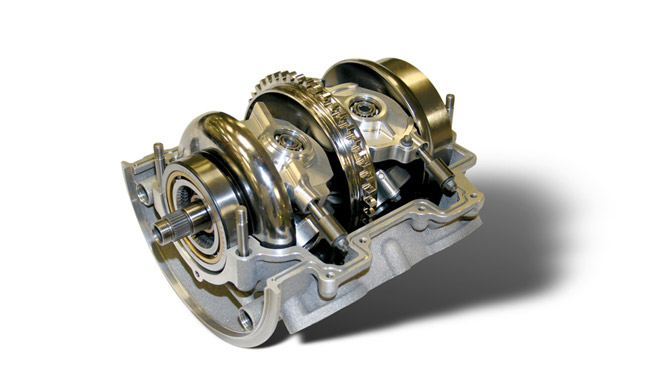
    Xtrac has been involved in energy efficient motorsport initiatives since 2001 and more recently has played a key role in designing, developing and integrating a mechanical KERS system for F1 with partners Flybrid and Torotrak.   Xtrac’s role is to provide the toroidal continuously variable transmission (CVT) between the flywheel and the vehicle powertrain.

    Given the need to develop systems in time for the 2009 season, the CVT has already undergone rigorous bench testing on Torotrak and Flybrid test rigs. The three F1 project collaborators all strongly believe that the mechanics of this system can be transferred to other technology areas including road vehicles.

    “There are some peculiarities which are distinct to F1 due to the regulations, such as the control system, integration of the ECU and the operating parameters,” says Moore, “but as the original Torotrak CVT concept was intended for road vehicle transmissions, the flywheel KERS opportunity readily allows for the use of toroidal CVTs in cars.

    “Historically, there are many instances where a new technology initially looks challenging to install in certain applications only to find a few years later that it is smaller, lighter and performs better than anyone ever envisaged.  F1 will certainly help advance this process.”

    The energy recovery rate and storage requirements of a flywheel for a road car could be considerably less than that required in F1 where the energy which can be recovered from 5g braking is significant.  As the flywheel is required to be charged, some preliminary motion may be required; though road cars could store energy in the flywheel directly from the engine, which is not currently permissible under F1 regulations.  Road driving conditions also vary from the stop-start conditions experienced in a town environment to constant speed cruising found on motorways.

    “Although still maturing, KERS has stimulated the introduction of radical new technologies to F1 and ultimately to other engineering sectors,” says Moore.  “The mechanical based concept offers one such solution and indeed could offer significant energy efficient benefits to the driveline of both race and road vehicles.”

    Moore is presenting a paper outlining the design and development of the CVT used in the Flybrid F1 system this week to leading automotive engineers and technical experts attending the Global Powertrain Congress being held in Vaals in the Netherlands.

    This is not the first time that Xtrac has presented a paper at this high level conference demonstrating the potential crossover of transmission technology between motorsport and road vehicles.  Last year it presented details of its gearbox developed for the world’s first commercially viable diesel-electric drivetrain.  The low-cost energy-efficient drivetrain had been prepared by automotive engineering consultancy Zytek for assessment by carmakers in a vehicle fully meeting the requirements of the UK government’s Ultra Low Carbon Car Challenge (ULCCC).

    A published copy of Xtrac’s latest paper on the CVT development for the flywheel KERS for F1 and its potential for road vehicles is available from the International Council for Powertrain Engineering and Management (ICPEM), the non-profit organisation that organises the conference.  Information is available at www.gpc-icpem.org.

    The Global Powertrain Congress, currently celebrating its 10th anniversary, has established itself as an international event focused exclusively on the needs of the powertrain community.  The event is sponsored by IPCEM to help advance knowledge of science, engineering and safety related powertrain technologies.