Tag: Bugatti Veyron

  • Bugatti Veyron Grand Sport Vitesse World Record Car Edition – 408.84 km/h

    Bugatti will introduce the Veyron Grand Sport Vitesse World Record Car Edition at the Shanghai Motor Show. The special edition hyper-car will be presented in order to celebrate that the Grand Sport Vitesse has officially become the fastest convertible in the world.

    During the high-speed test, the Grand Sport Vitesse managed to hit a top speed of 408.84 km/h (254.04 mph) at Volkswagen’s Ehra-Lessien proving grounds.

    The Grand Sport Vitesse is powered by the famous 8.0 liter W16 quad-turbo engine with 1200HP (883 kW) and 1500Nm (1106 lb-ft) of torque. The engine is paired with a 7-speed DSG gearbox. It sends all that torque to an AWD system. 0-100 km/h in 2.6 seconds and 0-200 km/h in 7.1 seconds, 0-300 km/h in 16 seconds. ¼ mile is covered in 10.0 seconds flat and 1 mile in just 25.0 seconds.

    Other interesting disciplines like 0-100-0 km/h take 5.9 seconds and 0-200-0 take 12.9 seconds. The interesting 0-300-0, which is brutal for the brakes take 23.9 seconds.

    The official fuel consumption is 23.1 l / 100 km on average cycle and the city cycle is around 37.2 l / 100 km.

    The overall weight of the vehicle is 1990 kg and the fuel tank can take up to 100 litres of fuel or around 250 km range in city.

    The suspension features three different settings: Standard, Handling and Top Speed.

    The brake system includes 400 mm front discs with 8 piston calipers and 380 mm discs at the rear with 6 piston calipers.

    Only eight Veyron Grand Sport Vitesse World Record Car Edition will be produced – price €1,990,000.

    Source: Bugatti

  • Bugatti Teases Upcoming New Supercar

    One of the most exceptional brands in the automotive world at the moment is undisputedly Bugatti. And every time we are to see something coming out of their luxury garage, makes us anticipate their new projects with greater eagerness.

    This time, Bugatti teases the public with the release of an image on their official Facebook page. The image promises to show company’s latest example of exceptional Bugatti performance vehicle. On the page was also stated that the model will be unveiled in the next few days, so we are definitely inpatient about it.

    And here are coming the big questions. Since from the released photo we can’t conclude which exactly will the model be, many suggestions appear. The best version is that it is going to be the Super Veyron, which probably won’t have a top speed limit.

    Other rumors speak that the power it is going to generate is around the mind-blowing 1600 horsepower (which are equivalent to 1176 kW). The supercar will be probably equipped with 8.0- or 9.6-liter W-16 unit.

    Wonder what the top speed and the acceleration time from 0 to 100 km/h will be here. Maybe fewer than 2 seconds this time? It is also a possibility for this particular model to make its debut this autumn at the Frankfurt Motor Show.

    Picture Source: Bugatti via Facebook

  • Bugatti Veyron 16.4 Grand Sport Vitesse Debuts at the 2013 Qatar Motor Show

    Bugatti-Veyron-Grand-Sport-Vitesse-THUMBBugatti Veyron 16.4 Grand Sport Vitesse Special Edition – the most powerful roadster ever, is going to be presented for the first time in the Middle East region. The unique “Bianco” and “New Light Blue” coloured vehicle is going to make an official appearance at the 2013 Qatar Motor Show.

    The exterior colors of the model were inspired by the famous Type 37A built in 1928, which won multiple Grand Prix races in its time and is now owned by Jay Leno. Furthermore, this Bugatti shows remarkable figures as no other vehicle: it has a maximum torque of 1500 Nm (1107 lb-ft) (at 3,000–5,000 rpm) and a maximum output of 1200 hp (882 kW) which is reached at 6,400 rpm.

    The reason for these astonishing numbers is the 7.9-liter capacity of the W16 engine. And within the instant of the 2.6 seconds, the Veyron has already covered the acceleration sprint from 0 to 100 km/h. The top speed here is of 410 km/h (255 mph) and makes the four-wheel drive Vitesse the fastest production roadster ever.

    There has been 199 hp (146 kW) increase over the Grand Sport which were achieved by the utilization of four larger turbochargers with new intercoolers. In addition, the brand has reinforced all drivetrain components in order to safely transfer the immense forces at all times. The fuel system with a four-pump tank has been taken from the Super Sport.

    Furthermore, the chassis of the Vitesse was reconfigured: the quick-responding dampers were adapted from motor racing, the control of the vehicle was further improved and balanced, reconfigured ESP was included, and the dynamic natural frequency was reduced.

    In addition, what is new here is the new roof spoiler for the Vitesse that significantly reduces wind noise and buffeting in the interior. In addition to this there is a new windbreak for the roadster which can be stored away compactly in the luggage compartment when not in use.

    To go further into details, numerous aerodynamic measures at the front and rear have been adapted for the Vitesse from the Super Sport. Consequently, the front end is therefore includes larger air intakes.

    The two central air intakes to the left and right of the radiator grille, bottom air vent, newly designed front spoiler, improved xenon headlights from the Super Sport framed in black all contribute to the extremely masterful stance of the car. Also derived from the Super Sport is the rear end, and it includes a double diffusor and a centrally positioned twin tailpipe.

    How about the interior? Pure carbon fibre along with stainless metals such as aluminium and magnesium can be seen dominating it. For instance, the centre console extension, a cover with EB logo in the rear-bulkhead leather trim (between the seat backrests) and the belt outlet covers on the seats are all made from carbon.

    In addition, from the same materials are made the décor on the centre console, the door inserts and the adjoining trim on the instrument panel. What is more, an accent of contrasting stitching featured on the leather armrest between the seats gives a sense of exclusiveness.

    More importantly, what is new here are the knee pads in the centre tunnel area, the additional 12 V socket (in the glove compartment), the restraint systems, the illuminated start and parking lock button, an instrument cluster with shift-up information and the power gauge.

    Source: Bugatti

  • Bugatti Veyron Grand Sport Venet

    Bugatti has presented their latest special edition Veyron – The Grand Sport Venet is prepared with the help of the French artist Bernar Venet. The conceptual artist was asked by Bugatti to help them with this project, which is built for this week’s Art Basel Miami Beach.

    Bugatti Veyron Grand Sport Venet features a special look including rust-like paint starting from the front of the hyper car. The drawings include many mathematic and scientific formulas and numbers.

    “A Bugatti is already a work of art in itself, one that transports both its beholder and its driver into new dimensions of reality. I realized how I could translate my passion for mathematical equations and scientific treatises into three-dimensional form. My works are usually self-referential. So I found the idea of translating the equations of the Bugatti engineers onto the bodywork of the car very appealing. It was, so to speak, a logical conclusion and a new challenge in terms of the specific form of collaboration and implementation. To me, the result is also exceptional when measured by artistic standards and bestows the object with a mythical character.”, commented Bernar Venet.

    The interior boasts nice brown leather for dashboard, door panels and seats. Again, there are some interesting orange formulas.

    The engine remains same – an 8.0 liter W16 quad-turbo – 1200HP (882 kW) and 1500Nm (1106 lb-ft) of torque. It is mated to a 7-speed dual-clutch gearbox. 0-100 km/h in 2.6 seconds and a top speed of over 410 km/h (255 mph).

    Nothing is mentioned about the price, but probably it will be more than €2,000,000.

    Source: Bugatti

  • Bugatti Veyron 16.4 Grand Sport Vitesse Rafale

    Bugatti Veyron 16.4 Grand Sport Vitesse Rafale is the latest model of the manufacturer. It was  presented at the Sao Paulo Motor Show.

    The car is based on Veyron 16.4 Grand Sport Vitesse (as you may suggest), but features some interesting upgrades like unique alloy wheels and a two-tone exterior with “Gris Rafale” paint and blue carbon fiber. The interior boasts lake blue leather seats, light grey stitching and blue carbon fiber trim. All details are matched perfectly and the comfort is sensational.

    This strong contrast of colours is found again in the interior but vice-versa: with lake blue leather seats and a stitching in light grey.

    The engine is the same – 8.0 liter W16 quad-turbo – 1200HP (882 kW) and 1500Nm (1106 lb-ft) of torque. It is mated to a 7-speed dual-clutch gearbox. 0-100 km/h in 2.6 seconds and a top speed of over 410 km/h (255 mph).

    Bugatti Veyron 16.4 Grand Sport Vitesse Rafale is priced at €1,900,000.

    Source: Bugatti

  • Bugatti Veyron 16.4 Grand Sport Vitesse in Action [video]

    Bugatti Veyron 16.4 Grand Sport Vitesse Special Edition is the most powerful roadster ever created by the luxury brand. It is finished in either Bianco and New Light Blue color scheme.

    The new Bugatti Veyron 16.4 Grand Sport Vitesse is powered by the well-known 8.0 liter W16 quad-turbo engine delivering 1200HP (882 kW) and 1500Nm (1111 lb-ft) of torque at just 3000RPM. 0-100 km/h in 2.6 seconds and a top speed of 410 km/h (255 mph). This means that Vitesse is the fastest production roadster ever.

    The supercar has new lighter 20” “Vitesse”-type alloy wheels. Bugatti has adapted the brake-cooling system as well. The brakes are unparalleled in terms of stability and performance and now get larger air intakes.

    A significant decrease in wind noise was achieved through the newly developed roof spoiler. Another innovation included in the roadster is the new windbreak, which can be stored away compactly in the luggage compartment.

    Bugatti Veyron 16.4 Grand Sport Vitesse Special Edition version costs $2 500 000.

    httpv://www.youtube.com/watch?v=RT-Y25o3IAQ

    Source: Bugatti

  • Russian Premiere for Bugatti Veyron 16.4 Grand Sport Vitesse Roadster

    Bugatti-Veyron-164-Grand-Sport-Vitesse-Roadster-THUMBBugatti Veyron 16.4 Grand Sport Vitesse Roadster is the fastest production roadster ever created! And it has just made its first appearance at the International Motor Show in Moscow.

    This open-top version of the Grand Sport delivers 882 kW (1200 hp) reached at 6,400 rpm. The remarkable maximum torque of 1,500 Nm (at 3,000–5,000 rpm) it delivers from its 7.9-liter W16 engine.

    These figures allow the car to reach 100 km/h in unbelievable 2.6 seconds. The top speed here is of 410 km/h (255 mph). These numbers say only one thing, the four-wheel drive Vitesse is the fastest production roadster ever!

    In order to achieve this outstanding performance, the engineers optimized the drive system. The 199 hp increase over the Grand Sport has been achieved by using four larger turbochargers with new intercoolers.

    Next, the gearing of the seven-speed dual-clutch gearbox (DSG) in particular has been adapted to the new requirements as well. In this context, the air ducting in the area of the drivetrain was also improved.

    The effect is larger turbochargers and the overall reduced back pressure. And interestingly enough, despite the enhanced output, it was possible to reduce the fuel consumption as well.

    The control of the vehicle has been further enhanced and perfectly balanced. The wheel-load fluctuations have been additionally reduced and now allow a maximum level of active safety.

    Furthermore, Bugatti developed a new roof spoiler for the new Vitesse which significantly reduces wind noise. This also makes possible the extremely relaxed, open-top driving even at speeds of around 200 km/h (124 mph).

    The front end here is characterized by larger air intakes; in addition the two central air intakes to the left and right of the Bugatti radiator grille are divided horizontally by a bar. The bottom air vent stretches sideways into the wheel housing and gives the Bugatti a masterful appearance.

    Below this air intake there is a new visually refined front spoiler that has been designed in a similar way to the splitters used in motor racing. Another new feature here is the improved xenon headlights framed in black.

    Next, the rear end includes a double diffusor and a centrally positioned twin tailpipe. A new Park Distance Control system (PDC) watches over the front and the rear.

    The interior of this Bugatti is dominated by carbon fiber and stainless metals such as aluminium and magnesium. For instance the center console extension, a cover with EB logo in the rear-bulkhead leather trim and the belt outlet covers on the seats are made from carbon fiber.

    The same material is used for the center console, the door inserts and the adjoining trim on the instrument panel. And on the armrest between the seats contrasting stitching is included.

    Bugatti Grand Sport Vitesse is painted in all black with red rims in a diamond pattern. Its carmine red interior and seats convey an aggressive, dynamic look. Only 300 units will be produced, each of which costs 1 790 000 euros.

    Source: Bugatti

  • Bugatti Veyron 16.4 Grand Sport Vitesse Special Edition Debuts at The Quail

    Bugatti Veyron 16.4 Grand Sport Vitesse Special Edition is the most powerful roadster ever created by the luxury brand. Painted in unique Bianco and New Light Blue color scheme, the supercar was publicly presented for the first time at “The Quail: A Motorsports Gathering”.

    The color combination of this Bugatti was inspired on the popular 1928 Type 37A model, which won a multitude of Grand Prix races.

    The new Bugatti Veyron 16.4 Grand Sport Vitesse shows remarkable maximum torque of 1,500 Nm (at 3,000–5,000 rpm) from the 7.9-liter capacity of its W16 engine. The maximum output here is 1200 hp (882 kW) and is reached at 6,400 rpm.

    This means that the car effortlessly reaches an acceleration time of 2.6 seconds for the sprint from 0 to 100 km/h. The top speed of 410 km/h (255 mph) makes the four-wheel drive Vitesse the fastest production roadster ever. Vitesse has an electronically limited speed of 375 km/h (233 mph).

    These numbers mean basically that the new model adds 199 hp to the Grand Sport. This was achieved by using four larger turbochargers with new intercoolers. Bugatti has also modified the air ducting in the area of the drivetrain.

    Additional result is an overall reduced back pressure and reduced the fuel consumption. The fuel system, with a four-pump tank, has been taken from the Super Sport.

    Some modifications have been done to the chassis as well, in order to put the unrivalled power onto the road absolutely safely. Quick-responding dampers that have been adapted from motor racing, the control of the vehicle has been further enhanced and perfectly balanced.

    The supercar was equipped with new lighter 20-inch “Vitesse”-type alloy wheels. Combined with the intelligent all-wheel-drive system, this ensures very good handling. Furthermore, Bugatti has adapted the brake-cooling system as well. The brakes are unparalleled in terms of stability and performance and now get larger air intakes.

    A significant decrease in wind noise was achieved through the newly developed roof spoiler. Another innovation included in the roadster is the new windbreak, which can be stored away compactly in the luggage compartment.

    Numerous aerodynamic improvements are also included. The front end now has larger air intakes; the two central air intakes to the left and right of the Bugatti radiator grille, which are divided horizontally by a bar.

    New and visually refined front spoiler has also been featured. The xenon headlights, which can be seen in the Super Sport model, are now framed in black. Moreover, the rear end now includes double diffuser and a centrally positioned twin tailpipe.

    The Park Distance Control system (PDC) included here observes carefully the front and the rear. In addition, the two air scoops on the left and right of the engine cover are a main characteristic of the model. They serve to pull in air for the engine and as a part of elegantly integrated anti-roll protection system.

    For the entire outer skin of this Bugatti is used carbon fiber and. This is the predominant material utilized in the interior as well. It can be seen on the following parts: the center console extension, a cover with EB logo in the rear-bulkhead leather trim (between the seat backrests) and the belt outlet covers on the seats, the décor on the center console, the door inserts and the adjoining trim on the instrument panel.

    Contrasting stitching is also included on the leather armrest between the seats. Some new features here are the knee pads in the center tunnel area, the additional 12 V socket (in the glove compartment), the restraint systems, the illuminated start and parking lock button, the instrument cluster with shift-up information and the power gauge that now goes up to 1200 hp.

    Bugatti Veyron 16.4 Grand Sport Vitesse Special Edition version costs $2 500 000.

    Source: Bugatti

  • Top Gear Test Track Summed Up

    Diehard Top Gear fans remember the times when the power lap board was pretty clean and simple – the Pegani Zonda C12 S took the lead right from the start and dominated the Top Gear Test track for 3 whole seasons. As the episodes rolled however, things sort of got out of hand and it became very hard to follow which is what and when.

    Recently we stumbled upon a chart which manages to round up all the times achieved and all the information available in a nutshell. Well… quite a big nutshell but still. At the very beginning we see a wheel-type graphic  which sorts all the cars that were tested by year of airing and track time and even indicates the weather conditions for every run.

    Scroll down bellow and we get a more comprehensive time table of those same cars and the respective leaders marked in yellow. We personally, found out how cars which have held the lead the power board for a limited amount of time, tend to get lost in our consciousness (i.e. the McLaren Mercedes SLR).

    Then there are the memorable runs such as the one of the Koenigsegg CCX which gained massive benefits from the Top Gear-suggested rear wing. Or the Bugatti Veyron‘s lap which at the time was eagerly expected but eventually flopped on the finish line ending up in the forth position leaving the Gumpert Apollo an undisputed king of times for 3 more seasons.

    From then, the Bugatti Veyron Super Sport makes a brief appearance but 2 episodes later, the Ariel Atom 500 V8 pretty much embarrasses everyone and climbs the ladder so high that even as we speak, it still is the fastest road legal thing ever tested on the track.

    Ariel Atom 500 V8 Front Angle

    Further down, there’s some info on the top 10 most affordable cars that were “power lapped” on the track, some info about the track itself and… some say there’s a word or two about the Stig as well.

    Finally, a number of awards which can only underline the show’s touch of comedic genius.The info graphic was styled and compiled by Boost Labs which deal with technology and design and share a fair amount of passion about cars believe it or not.

  • Underground Racing Lamborghini Gallardo Nera – 405 Km/h [VIDEO]

    UR-Lamborghini-Gallardo-Nera-thumbThere are many benchmarks when talking about the automotive world – some products strike as the ultimate in art and aesthetics. Other excel in real-life (that life with the bends and curves) road performance. Then there are these which have the sole purpose to push the boundaries of what’s physically possible. The Bugatti Veyron is a prime example of that but what we have here, is proof that after-market tuners, like the guys from North Carolina: Underground Racing, also have a reserved place at the engineering hall of fame – it’s a twin-turbocharged Lamborghini Gallardo Nera doing 405 km/h on a push-to-the-limit run. Telemeters don’t lie.

    Underground Racing Lamborghini Gallardo Nera
    Underground Racing Lamborghini Gallardo Nera

    Looking at the specs, this really shouldn’t come as a surprise to anyone – around 1700 bhp (1500 bhp effective). How? Slotting in two massive turbocharges of course. The Lambo’s naturally aspirated 5.2-liter V10 is an ideal host for some forced induction practices. Add some wheels (Hoosier R6A) which can bare the abuse, some explosive jungle juice for fuel and there you have it – 405 km/h and a lot of drama:

    httpv://youtu.be/H8K3Nk3PghU

    Source: DragTimesinfo via YouTube

  • Bugatti Veyron Sang Noir Wrapped by Cam Shaft

    Cam-Shaft-Veyron-Sang-Noir-thumbThe Veyron Sang Noir is an official limited edition from Bugatti that utilizes some black paint for the exterior, has its carbon bits exposed and wears an orange upholstery. Other deviations from the standard include the design of the grille, the headlights (tinted) and the wheels – except that interior, the Noir sounds like a subtle job, no? Sadly however, while there are only 15 such in the world, one is currently being ruined by a vinyl company. Unless this car belongs to an energy drink company, this desecration cannot be justified.

    The company responsible for this is known as Cam Shaft, based in Lower Rhine, Germany. Atrocities had begun even at the start of the restyling – chrome blue for a car that goes under the label Noir (Black). But we could have let that one slide. Black often can be a concept rather than something material. But then we get to the reflective foil “flash wires”. We see where they were going with this – wanting to make the Veyron angrier and scarier, more electric and so on. But it hasn’t worked. No, it looks more like a bad case of varicose veins. In addition the carbon fiber parts, the front and the headlights are covered with some sort of a paint protection film, which is fine by itself. However, the stated purpose of this film is a bit odd – reducing the likelihood of everyday road impacts at speeds of over 400 kmph. Because, leisurely driving up to the grocery store at 400 kmph is no doubt, an everyday issue.

    While the services of Cam Shaft are said to be $2,667 on average, this one goes in the “five-figure region”.

    P.S. – we are not entirely sure if Gemballa are somehow involved but the gallery certainly suggests so.

    Bugatti Veyron Sang Noir by Cam Shaft
    Bugatti Veyron Sang Noir by Cam Shaft

    Source: Miranda Media

  • Turbochargers Explained

    Turbocharged-badge-thumbEver wondered how WRC cars manage to deliver 300 bhp and above from an engine that, by rule, cannot exceed 2.0 liters of displacement? How on earth do the heavy, low-revving diesel engines in cars today stay competitive? Or what is it that makes it possible for the Bugatti Veyron to break the 1000 bhp threshold? Well, it certainly isn’t witchcraft. By means of “forced induction”, turbochargers today boost the automotive industry to a new direction of smaller, more-efficient and bloody good fun engines.
    Volkswagen like to brand their most successful turbo diesel range as TDI while Porsche, being more plain about it, call their turbocharged cars, Porsche (insert model here) Turbo. BMW, on the other hand, would never hesitate to utter their own terms like “bitrubo” or “TwinPower” whenever describing the latest M5 engine. The variety of depicting turbocharged cars is bountiful, but essentially the principles of work remain the same in every case.

    Beware reader, as I am now going to get technical:

    In order to understand how a centrifugal turbocharger works, one must also have some basic knowledge on how four-stroke, piston engines work. We have an engine block that contains the cylinders, right? Inside each cylinder, a piston moves up and down. Every movement made is a phase, a stroke. First we have intake – a mixture of fuel and air is sucked into the cylinder. Compression is the second stroke where the cylinder moves up and…well…compresses the molecules in the mixture. The next ignition stroke is downwards as the piston experiences pressure coming from the combustion of the mixture. The exhaust stroke has the job to expel the remaining gases through the exhaust valve. Then the intake valve lets in a new batch of fuel mixture and thus the process is repeated.

    However, as far as turbochargers are concerned, exhaust gases are not exactly throw-away material. Put simply, the turbocharger utilizes the energy of exhaust to compress the the newly arrived batch of air which is to be shoved in the cylinder. More air molecules means that more fuel can be injected into the mixture and more fuel means more power.

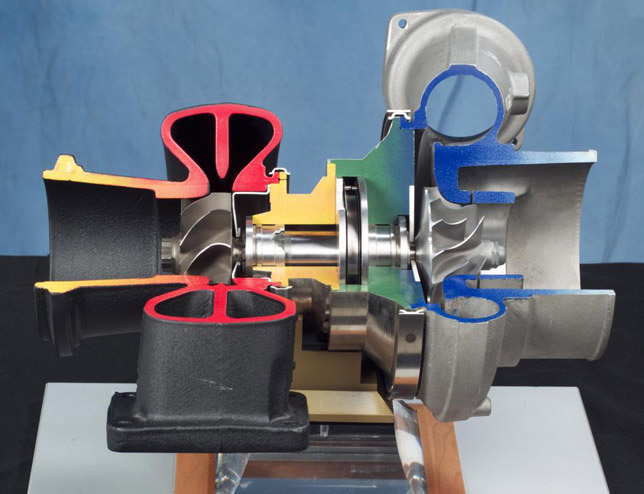
    Before those exhaust gasses reach the exhaust system they go trough a turbine connected to a shaft. The more exhaust that goes through the turbine blades, the faster they spin. On the other end of the shaft we find a compressor which welcomes fresh air from the atmosphere, compresses it using the force of the turbine and then feeds it into the engine. To further increase the efficiency of the turbocharging system, an intercooler is added – it looks much like a car radiator but instead of containing cooling fluid, it holds the compressed air from the compressor. Air is denser when cooler and that’s exactly what the intercooler does – it cools the incoming air.

    Cut-away view of a turbocharger held by a foil-bearing
    Cut-away view of a turbocharger held by a foil-bearing

    There are issues however. First of all, a turbine amidst the flow of exhaust is essentially an obstacle. The exhaust stroke has to deal with more back-pressure thus being slightly less efficient. A functional turboshaft has to handle extreme forces (speeds go up to 150 000 rpm within the turbocharger) so a special kind of baring is needed – liquid ones or state-of-the-art ball bearings. The latter is more efficient but more expensive. Then there’s the dreaded turbo lag. The problem here is that when you put your foot down, the response is far from electric. The turbine needs some time to kick off and start spinning the compressor blades. That’s why at low engine rpm one can’t really tell if the car has a turbo or not.

    There are various ways to tackle this nuisance. Make things smaller and lighter. Tiny turbochargers will grant you that off-the-line jolt but won’t be too good on the upper rpm range. Besides, if too much exhaust starts going through a relatively small turbine things may get hot and disbalanced. Usually however, there’s the wastegate in most turbines – a valve that knows how much exhaust passes through and regulates the flow by simply diverting some of the gases away from the turbine. Some companies have started putting more than one turbochargers in their cars. One small and the other, big. The small one guarantees a more immediate response while the big one takes over at higher speeds.

    Essentially, that’s the story with turbochargers. We can further dive into numbers and calculations about pressure and efficiency but this, I think, is already nerdy enough. Hopefully some of you learned something new while others refreshed their memory on how the turbocharger brings easy power to our everyday lives.