Peugeot is moving forwards in the world’s economy and the latest sign of that is the introduction of the 308 to Brazil which will happen March this year. Brazil will be the second South American country (after Argentina) to acquire the 308 two-box design as a mid-size option. The Brazilian version of the 308 distinguishes itself from the flock of Peugeots with three main characteristics – bald outer lines, abundant equipment trims and a an option of a Flex Fuel 1.6 engine, with the Flex Start® system.
The car itself, destined for Brazil, is made in Argentina and that’s a good thing as there is an internal free trade agreement between the Mercosur countries among which are Brazil and Argentina. There is something made in Brazil however – the clever EC5 Flex Fuel 1.6 engine develops 122 hp which ranks it as the most powerful one in the segment. Flex Start is a piece of technology, developed by BOSCH, that has never been seen in a Peugeot before. It is an alternative to the existing small additional petrol tank located under the bonnet, used for cold starting at low temperatures. Instead the Flex Start uses an electronic system to heat up the Ethanol for maximum efficiency even at the severest of temperatures. That innovation, brought the EC5 driven Brazilian 308 much praise from IBAMA, Brazil’s Federal Ministry of the Environment. They have now stuck a ‘green label’ on the model which indicates their contempt.
I want to talk about classics. These days we have so much technology at our front step that we have lost the ability to appreciate it. A thrust back in time might just be the thing that will kick-start the part of us which admires pure and brave automotive innovation. I am talking about the Mercedes-Benz 300SL – a car which, for a time, was the fastest one around, a car that was and still is in a class of its own.
In the 50’s, Germany was still experiencing the aftermath of war. The country was split and times of reform and renovation were still due to come. But not all was grime and despair – that same decade a car was about to change the automotive world. At that time Daimler-Benz AG were almost out of money but not out of ideas. In 1952, a strictly-for-race 300SL (W194) set out to win numerous races around the world, reaffirming the racing pedigree of the company. The thing is that the 300SL racing car wasn’t the most powerful car out there. In fact the W194 bore a really mildly impressive, production-based 3.0L. straight six engine equipped with an overhead camshaft and valves and three carburetors. The car’s innovative spirit however, manifested itself trough structure, aerodynamics and lightness (SL stands for “Super Light”). The body had a low drag coefficient and thanks to an image defining tubular frame, the W194 was rigid and lightweight.
Mrecedes-Benz 300SL (W194)
Some of that racing formula transferred directly to the road going 300SL (W198) which rolled out of the factory two years later in 1954. Roughly 3,258were built in both Coupe and Roadster versions. And even by today’s standards, it was a thing of beauty. The engine was the same 3.0L found in the racing car but instead of carburetors, it had a first-ever in a 4-stroke engine, fuel injection system by BOSCH. And that was the charm that radiated from the SL – it was a first in many, many things. Because of the fuel-injection system, power was almost double to the one found in the original carbureted version (215 PS). That made the SL, the fastest production car of its time capable of speeds up to 260 km/h (161 mph). The engine was awkwardly askew so that the hood would remain as low as possible and the fenders had horizontal “eyebrows” over the wheel openings to reduce drag. Because of the same tubular frame which resembled a plane fuselage, the 300SL engineers had to figure out a way to incorporate doors. Solution came with the, now emblematic, “gullwing” doors that gave the car a unique character.
Mercedes-Benz 300SL (W198 – the road version)Mercedes Benz 300SL Roadster
As with every ambitious and innovative project, the 300SL came with its own issues – the fuel injectors had the tendency to flood the oil pan and cylinders which proved problematic (changing the oil every thousand miles was recommended). But the sheer size of the oil tank was big enough to send an oil company into bankruptcy – ten…10…X…liters! Because of that lubricant volume the engine would never reach optimal temperature thus worsening the general effects of wear and tear. All wheels used drum brakes and at high speeds the swing axle at the back tended to act up in a terrifying manner. Regardless of the presence of doors on the “Gullwing”, one still had to be a fairly agile person to get in or out because of the remarkably high sills. The steering wheel also had to be tilt-away before even thinking about sitting at the driver’s seat. The trunk space was non-existent and the amount of fuel in the tank, to a certain extent, determined the handling of the car. And for all of that, there was the price which exceeded that of a really luxurious household.
But did all of this really matter in a bigger context? Of course it did… everything added up to form the first-ever supercar – ludicrous, impractical, dangerous, unstable and very, very exciting.
Audi TT RS is powered by five-cylinder 2.5 litre turbocharged direct injected TFSI engine. All the power is transmitted to the road through the company’s trademark – Quattro four wheel drive system. The powerful engine produce 335bhp.
Superchips ltd offer a perfomance package, which includes latest ECU remap, so the small sports car is boosted to 401 bhp, with a maximum power gain of 63bhp at 5989 rpm. The amazing result is achieved thanks to close examination of the TT RS’s Bosch ME9 ECU, so the experts revealed scope for performance improvements, realised through a combination of fine tuning ignition, fuelling and turbo boost settings. (more…)
The base of this race car is the Lotus Evora Type 124, which was introduced earlier this year. There are number of changes, which has been made the car specially for endurance races.
The Lotus Racercar will compete in several races during 2010/2011 season. One of them is the famous ADAC Nürburgring 24 Hours at Nordschleife race track in Germany.
Specifications:
Body: Lightweight composite and carbon fibre panels
Engine: V6 mid-mounted with 400ps
Gearbox: Six-speed sequential paddle shift racing gearbox
Brakes: AP Racing 6 piston callipers Front and Rear
Weight: 1200kg
Wheels: 18 inch rims with Pirelli racing slicks , 9 ½ J on the Front and 11 J on the Rear
Lotus Evora Type 124 Endurance RacecarThe base of this race car is the Lotus Evora Type 124, which was introduced earlier this year. There are number of changes, which has been made the car specially for endurance races.
The Lotus Racercar will compete in several races during 2010/2011 season. One of them is the famous ADAC Nürburgring 24 Hours at Nordschleife race track in Germany.
Specifications:
Body: Lightweight composite and carbon fibre panels
Engine: V6 mid-mounted with 400ps
Gearbox: Six–speed sequential paddle shift racing gearbox
Brakes: AP Racing 6 piston callipers Front and Rear
Weight: 1200kg
Wheels: 18 inch rims with Pirelli racing slicks , 9 ½ J on the Front and 11 J on the Rear
The BMW Group has opted for SB LiMotive as the supplier of battery cells for the future project Megacity Vehicle. This gives the company access to state-of-the-art lithium-ion storage technology. (more…)
The Pagani roadcar model range would not be complete without a Roadster version of the Zonda Cinque. As the name implies it is created in the Modenese Atelier in a limited production run of merely five exclusive pieces like its coupe sister. (more…)
 Peugeot is moving forwards in the world’s economy and the latest sign of that is the introduction of the 308 to Brazil which will happen March this year. Brazil will be the second South American country (after Argentina) to acquire the 308 two-box design as a mid-size option. The Brazilian version of the 308 distinguishes itself from the flock of Peugeots with three main characteristics – bald outer lines, abundant equipment trims and a an option of a Flex Fuel 1.6 engine, with the Flex Start® system.


 I want to talk about classics. These days we have so much technology at our front step that we have lost the ability to appreciate it. A thrust back in time might just be the thing that will kick-start the part of us which admires


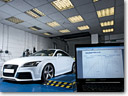 Audi TT RS is powered by five-cylinder 2.5 litre turbocharged direct injected TFSI engine. All the power is transmitted to the road through the company’s trademark – Quattro four wheel drive system. The powerful engine produce 335bhp.
 The base of this race car is the Lotus Evora Type 124, which was introduced earlier this year. There are number of changes, which has been made the car specially for endurance races.


 The BMW Group has opted for SB LiMotive as the supplier of battery cells for the future project Megacity Vehicle. This gives the company access to state-of-the-art lithium-ion storage technology.
 The Pagani roadcar model range would not be complete without a Roadster version of the Zonda Cinque. As the name implies it is created in the Modenese Atelier in a limited production run of merely five exclusive pieces like its coupe sister.