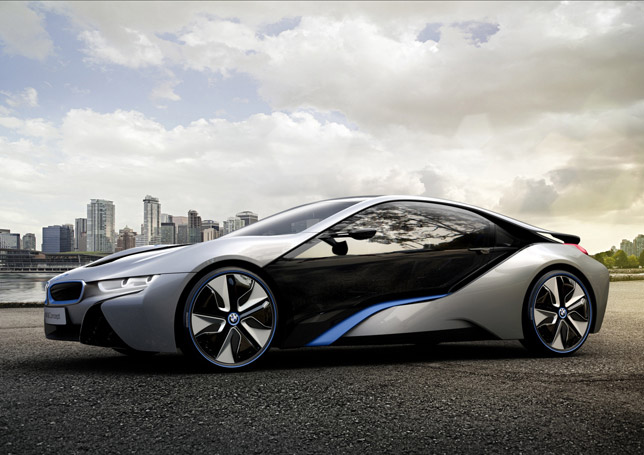
Tag: BMW i8

  • BMW i8 Concept Spyder

    The exceptional BMW i8 Concept Spyder is an open-top two-seater, which can grab literally any heart! It has the entire necessary characteristic and in addition adds to them with sporting and emotional appearance.

    This concept is purposefully built in order to meet the changing needs of customers and transform the understanding of personal mobility. It is equipped with intelligent technologies and definitely has an innovative design, however what is more is that now embraces a philosophy which adopts significant degree by sustainability throughout the value chain.

    This is the third BMW i model, which is here to “inform” us what will be the future of cutting-edge and emotionally appealing mobility concepts. It is not only a mixture between sporting design with an open-top two-seater, but is also a combination of lightness, dynamic capability and efficiency with a very special aesthetic value.

    What is worth mentioning as well is that it is a blend of intelligent lightweight design and state-of-the-art hybrid technology. This results in exciting sports car performance and driving pleasure combined with exceptional fuel-consumption unmatchable in this segment before.

    BMW i8 Concept Spyder has the upward-swivelling, windowless doors and a range of purpose-oriented on-board equipment which features electric kickboards stowed under a transparent tailgate. The concept vehicle is built on the innovative LifeDrive architecture. The latter includes lightweight modular construction and the utilization of high-quality high-tech materials.

    BMW i8 Concept Spyder
    BMW i8 Concept Spyder

    Furthermore, the BMW i8 Concept Spyder is a plug-in hybrid powered by an eDrive drivetrain. This drivetrain combines the excellent performance of the electric motor and petrol combustion engine, while the lithium-ion battery supplies the motor with power that can be recharged in an extremely short space of time from any domestic power socket. In addition, the car has significantly reduced weight, low centre of gravity and is precisely balance. Everything is combined with a system output of up to 260 kW (354 hp).

    Like its Coupe sibling (2+2-seater BMW i8 Concept), the BMW i8 Concept Spyder blends intelligent lightweight design with the leading-edge drivetrain technology eDrive, which delivers extremely low fuel consumption and emissions.

    The concept got compact dimensions and specific exterior paintwork. Additionally, it has the upward-swivelling, windowless doors and a transparent glass panel at the rear. How about the interior: a revised material is used and a colour concept provides an extra dose of sportiness.

    Moreover BMW i8 Concept Spyder is built around the innovative modular LifeDrive architecture, which comprises of independent functional units. For instance, the carbon-fibre-reinforced plastic (CFRP) Life module gives the car an extremely lightweight passenger cell, while the Drive modules bring together all the car’s operational driving functions, such as the powertrain, chassis and safety structure. And thanks to the intelligent lightweight design and the use of innovative materials, the vehicle delivers great fuel-efficiency. In particular in the LifeDrive architecture the front and rear axle modules are connected by an “energy tunnel”, which houses the hybrid battery, this results in low centre of gravity and ideal balance.

    The BMW i8 Concept Spyder’s includes emotion-led design as well which vividly spotlights the car’s qualities, with lightness, dynamic capability and efficiency highlighted to particularly prominent effect. The key elements which contribute for this sporty dynamic stance are the large body panels, a hunkered-down stance and numerous aerodynamic elements such as contact surfaces, spoiler lips, AirCurtains and aeroflaps.

    What is more here is that the front end offers a revealing window into the open-top two-seater’s dynamic talent. In addition a spoiler lip on the windscreen frame guides the airflow over the heads of the passengers. Of course there is also featured a two-section folding roof.

    Observed from side, the Spyder has short front and rear overhangs and a low-slung silhouette. Additionally, the alluring lines and forms generate a strong forward-surging stance even before the car powers off the line.

    Compared to the front end, the rear also is positioned low to the road. Its headline feature is a transparent cover revealing the two folded electric kickboards accommodated below. A rear diffuser, three-dimensional air outlets and the U-shaped rear lights makes the BMW i8 Concept Spyder with extremely wide appearance and further emphasize its sportiness.

    Going further, the interior of the BMW i8 Concept Spyder is defined by three levels. Each one has various functions. The interlocking of surfaces and lines for instance, is also one of the stand-out features of the interior design. On the other hand, the outer layer also frames the supporting structure, while the inner “comfort” layer includes seat surfaces and stowage compartments. The third layer is represented by the cockpit, and brings together the instrument panel, steering column and steering wheel with the instrument cluster, central information display and control elements. Of course, the car has a low drivers’ seating position. Moreover, an 8.8-inch (22.4 cm) screen displays the driving information in three-dimensional, high-resolution quality.

    BMW i8 Concept Spyder Interior
    BMW i8 Concept Spyder Interior

    Furthermore, the Spyder’s interior is a mixture of plastic, carbon and leather, with theoff-white of the outer layer and the bold orange tone of the naturally tanned leather generating a sporting atmosphere.

    The BMW i8 Concept Spyder with eDrive means that it is a plug-in hybrid which combines two different power sources: electric motor and combustion engine. First, the electric motor produces 96 kW (131 hp) and it is on the front axle. It works in combination with a turbocharged three-cylinder petrol engine delivering 164 kW (223 hp) through the rear wheels. When combined, both units generate an aggregate system output of 260 kW (354 hp) and peak torque of 550 Nm.

    And if you wonder about the acceleration data, well – here’s some: the Spyder accelerates from 0 to 100 km/h (62 mph) in just five seconds. It has a electronically limited top speed of 250 km/h (155 mph). It’s performance in other words is exceptional. However, despite these numbers, the two-seater burns just three litres of petrol per 100 kilometres!

    Furthermore, the electric motor gets its energy from a lithium-ion battery which can be fully charged from a domestic power socket in less than two hours. The battery is located in the energy tunnel between the front and rear axle modules.

    With its battery fully charged, the BMW i8 Concept Spyder can go up to 30 kilometres (19 miles) only on electric power. And if it is required, a high-voltage alternator hooked up to the combustion engine generates additional power, which is then stored in the hybrid battery.

    Additionally, the concept vehicle has as wee the ability to send power through the front, rear or all four wheels at the same time. It has the intelligent control electronics, which ensure that the optimum drive configuration is available for the situation at hand. Next, the electronic systems ensure maximum energy recuperation under braking or when coasting.

    BMW i is equipped with new generation of driver assistance systems such as the camera-based proactive Collision Warning system, Parking Assistant and Traffic Jam Assistant. Remote functions accessed via a smartphone are also included, such as the Last Mile Navigation function and the Intermodal Route Planning function.

    Two large displays can be found inside the BMW i8 Concept Spyder. They make up the interface between the car, its passengers and the outside world. They are positioned next to the instrument cluster behind the steering wheel. What is innovative here is that all the screens display their information in 3D.

    On the other hand the instrument cluster displays important driving and it is positioned alongside the digital speedometer. For example, the efficiency display allows drivers to view how much energy they are currently using, and shows extra navigation details and information on the car’s range as well. If the driver switches to energy-saving ECO PRO mode, the display turns blue in colour to signal the shift in functional emphasis, and the ellipses now also vary in form. By the same token, moving into SPORT mode treats the driver to an emotional orange hue. As well as the changes in colour, the displays also provide information tailored to the driving mode selected and to assisting the driver as effectively as possible.

    BMW i8 Concept Spyder Specifications

    Length/Height/Width L 4480 mm, H 1208 mm, W 1922 mm
    Wheelbase 2650 mm
    No. of seats 2
    Kerb weightTop speed

    Acceleration

    1630 kg250 km/h (155 mph) electr. governed

    0-100 km/h (62 mph) 5 s 80-120 km/h (50-75 mph) 4.0 s

    System output TwinPower Turbo engineFuel consumption (EU cycle) 260 kW / 550 Nm 164 kW / 300 Nm3 l/100km / 94 mpg imp
    eDrive output electric motor electric range battery charge time 96 kW approx. 27-30 km (17 – 19 miles)standard: 1.45 h for 100% charge

    Source: BMW

  • BMW Treats at Geneva Motor Show

    BMW-Geneva-lineup-shadowBMW is generating some hype before the 82nd Geneva Motor Show by listing all of its entries for this year. The lineup is a complex combination of European and World premiers that radiate innovation, quality, emotion and excitement. The i3 and i8 concepts will also participate in the form of BMW’s future vision of design and mobility. BMW‘s presentations won’t be on wheels only. With an array of original accessories and performance packages such as the “M performance”, the company will try to meet the needs of even the keenest BMW enthusiast. Three new engines for the 3-series sedan will also make an appearance with the prospect of even more to come this year. We do have more detailed articles on most of the vehicles in this list so feel free to browse around and find that which interests you.

    World Premiere: the BMW 6 Series Gran Coupe

    BMW 6 Gran Coupe (2013)
    BMW 6 Gran Coupe (2013)

    The BMW 6 Series Gran Coupe is a response to the current rivals, the Audi A7 and the Mercedes-Benz CLS. It is a 4+1 Coupe that is supposed to combine the incomparable sporty spirit of the 6-series with the practicality of a sedan. When compared to a standard 6 series Coupe, the Gran Coupe is wider by 4.5 inches and longer by 4.4 – that makes it a big, big car. At the start of this Summer, the Gran Coupe will only be branded 640i because of its TwinPower Turbo, 6-cylinder engine. However, later this summer a V8 650i will also be offered as well as an xDrive 650i. The price of the 640i is the only one given yet – $76,895. Whether this blend of practicality and lunacy has the best of both worlds or the worst, only time will show.

    World Premiere: The New 2013 BMW M6 Coupe

    BMW M6 Coupe (2013)
    BMW M6 Coupe (2013)

    Now entering a 3rd generation, the M6 Coupe is here to dominate the world of grand touring with more power, efficiency and dynamics. Thanks to its marvelous V8 M TwinPower Turbo engine and BMW‘s EfficientDynamics, burning rubber has never been that cheap. Torque is conveyed trough a 7-speed M-Double Clutch Transmission (M-DCT) while an Active M Differential optimizes power transfer between the rear wheels. Needless to say that behind all that power and frugality, there is also the backbone of every car – the chassis. It has been tuned by M engineers and employs a Variable Damper Control (VDC) system, DSC, ABS, CBC and DBC. The M6 itself can come as a Convertible if you need wind in your hair and tan on your face.

    World Premiere: BMW M Performance Automobiles

    BMW M550d xDrive Sedan (2013)
    BMW M550d xDrive Sedan (2012)

    The “M Performance” niche is a string of xDriven diesels that aims to set new standards. The BMW M550d xDrive, M550d xDrive Touring, X5 M50d and X6 M50d do not have the blistering performance of the more powerful M petrol line but they are out there – Under the hood in each and every one, hides a state-of-the-art TwinPower tri-turbo, common rail injected engine that feeds 280 kW/381 hp and 740 Newton meters (546 lb-ft) of power trough an 8-speed sports automatic transmission. And despite the lack of M wheel arches and numerous tail pipes, the M Performance BMWs have M tuned suspensions – subtle, discreet and serious. With that configuration, a BMW M550d accelerates in 4.7 seconds from zero to 100 km/h, while its average fuel consumption in the EU test cycle is 6.3 liters per 100 kilometers

    Premiere: BMW 116d EfficientDynamics Edition

    BMW 116d EfficienDynamics Edition (2013)
    BMW 116d EfficienDynamics Edition (2013)

    Porbably the most frugal car in the BMW lineup, the 116d EfficientDynamics Edition is powered by a 85 kW/116 hp TwinPower Turbo diesel engine that goes easy on the fuel (EU test cycle is 3.8 liters per 100 kilometers) thanks to the EfficientDynamics system which incorporates a Stop/Start system and braking energy storage.

    World Premiere: The New Updated 2013 BMW X6.

    BMW X6 (2013)
    BMW X6 (2013)

    It’s an updated version of the most premium SUV out on the markets. It has poise, it has agility and it has comfort. This ultimate X model comes with xDrive (naturally), still makes use of the company’s Dynamic Performance Control and it utilizes TwinPower Turbo Tech in the form of two engine choices. Visually the 2013 X6 now has bigger kidney nostrils and a better place for its fog lights. At the back, the taillights are also restyled and if that’s not enough light for you, it can be ordered with optional LED Adaptive headlights.

    BMW i3 Concept and BMW i8 Concept

    BMW i3 & i8 Concepts
    BMW i3 & i8 Concepts

    Closer than ever to production, the i3 and i8 Concepts are after all still be at the Geneva Show just to amaze the people there. They serve as an example of BMW‘s plan for a sustainable, electric future. Production of the “first electrically powered premium vehicle”, the i3, is expected to start early in 2013 while the plug-in performance hybrid, the i8 might be coming down in 2014.

    Other highlights of the BMW booth include the arsenal of originally made accessories for that extra look and feel of the new 3-Series Sedan – anything from unique 20 inch wheels to a fitted indoor/outdoor car cover. There will also be M Performance packages – Parts designed by the M division for the enhancement of standard BMW’s. We are talking about powertrain, suspension, aerodynamics and cockpit components that provide a tangible increase in driving dynamics by enhancing engine power, reducing weight and optimizing aerodynamic properties. Whether we have a 5-series or a-3 series or even the 1s, all parts are designed to belong.

    Source: BMW

  • BMW at the 2012 NAIAS Detroit

    With the North American International Auto Show (NAIAS) in Detroit dangerously close, BMW have kindly offered a glimpse of what their exhibit will look like. So here is a quick summary of what you should be excited about.

    BMW 3-Series Sedan – The sixth generation of the compact executive vehicle will be showcased there with an improved design and a new engine lineup. The company is eager to announce that now the new 3 series is around 45 mm wider and 93 mm longer than its predecessor. Despite these stretchy dimensions the sedan has actually managed to lose some weight (40 kg lighter). The trim and equipment level comes in three different categories: Sport Line, Luxury Line and Modern Line.

    Initially, customers will have the opportunity to chose from two petrol engines with two diesels coming later the same year. It is important to mention that all power plants will utilize the latest BMW TwinPower Turbo technology

    The BMW 328i will carry the new generation 2.0 liter, four-cylinder petrol engine. It will produce  180kW/245 hp and a peak torque of 350Nm (258lb-ft) from as early as 1.250 rpm. That sort of power will give the luxury sedan a 0 to 100km/h (62mph) sprint time of just bellow six seconds. Amazingly enough the stated fuel economy is a generous 44 mpg figure. Keep in mind that all of the trim levels will come with an Auto Start-Stop system as standard.

    BMW 3-Series Sedan F30 (2012)
    BMW 3-Series Sedan F30 (2012)

    The more power hungry can go for the BMW 335i. It will house a renown 3.0 liter straight-six which develops 225 kW/306 hp and a maximum torque of 400 Nm (295 lb-ft) at just 1,200 rpm. Thus in every single respect the 3 series will outperform their predecessors.

    Upon request an 8 gear automatic box can be paired to whichever engine you might chose. This option is claimed to bring benefits in terms of economy and driving experience.

    In true BMW spirit the cabin is full with neat gadgets such as a sharp Head-up Display, Active Cruise Control, the Lane Change Warning System and Lane Departure Warning System. A new Driving Experience Control switch not only offers Comfort, Sport and Sport + options, but also ECO PRO mode which will allow drivers to fully optimize their driving in order to achieve stunning fuel economy.

    BMW ActiveHybrid 5 – This is something that will make it’s debut on the NAIAS as

    the most powerful and efficient full hybrid in its segment. Fuel efficiency and power output are targeted

    To provide power, the same engine which can be found in the 335i and 535i is used. However, here it has a co-worker: a 40 kW/55 hp electric motor supplied with energy by a high-performance lithium-ion battery integrated into the luggage area. So that is 250 kW/340 hp overall power which thrusts the ActiveHybrid from 0 to 100 km/h (62 mph) in 5.9 seconds, limits average fuel consumption to between 6.4 and 7.0 litres per 100 kilometres (44 – 40 mpg imp) and puffs CO2 emissions of just 149 – 163 g/km.

    BMW Active Hybrid 5 (2012)
    BMW Active Hybrid 5 (2012)

    Not surprisingly, it is a very clever this hybrid. When the car is coasting or braking, the motor acts like a generator which in turn charges the high-performance battery pack. However, if you put your foot down, the motor will assist the straight-six petrol powerhouse to give the sort of dynamic boost you do not experience in ordinary cars. Then when you have reached a respectable amount of speed (up to 100 mph) what you can do is to shut down the engine and disengage it from the wheels so that you are back to coasting, using that gathered potential energy as efficiently as possible. You’ll be able to do that with no regrets as all safety features will be fully operational.

    BMW M5 – Yes, this sensational performance miracle will also be there. BMW boast about how their new engine (as opposed to the old one) has a 10 percent increase in power and 30 percent increase in torque and that consumption has dropped by 30 percent. This is the first time the company gives a chance to the turbo technology to prove itself better than the pure, naturally-aspired, brute force that was in the previous generations of M5s. As a result now the engine is a V8 rather than a V10 and the displacement is only 4.4 liters but the power is up – 412 kW/560 hp at 6,000 – 7,000 rpm, while its maximum torque of 680 Newton meters (502 lb-ft).

    BMW M5 F10 (2012)
    BMW M5 F10 (2012)

    To handle that massive lump of power, the M5 makes use of a very clever rear axle differential with a variable locking function. It works alongside with the DSC (Dynamic Stability Control) system to ensure the best rear-wheel drive experience there is. The suspension is also notable for its electronically controlled dampers. Dynamic Damper Control uses electro-hydraulic damping force adjustment to provide a set-up suited to the driving situation or the wishes of the driver.

    Here is a full list of it’s specifications:

    • V8 petrol engine, M TwinPower Turbo technology with Twin Scroll Twin Turbo, cross-bank exhaust manifold, High Precision Direct Injection and VALVETRONIC variable valve control.
    • Displacement: 4,395 cc
    • Power output: 412 kW/560 hp at 6,000 – 7,000 rpm,
    • Max. torque: 680 Nm (502 lb-ft) at 1,500 – 5,750 rpm.
    • Acceleration 0–100 km/h (62 mph): 4.4 seconds, acceleration 0–200 km/h (124 mph): 13.0 seconds
    • Top speed: 250 km/h / 155 mph (305 km/h / 190 mph with M Driver’s Package)
    • Average fuel consumption: 9.9 litres/100 kilometres (28.5 mpg imp)
    • CO2 emissions: 232 g/km, exhaust standard: EU5

    The i3 and the i8 – No, those are not the latest Apple products although they do have similar visionary ambitions. We are talking about two new concepts which will embody the BMW technological know-how.

    The i3 is a fully electric vehicle which is a result of BMW’s commitment to the environment. Suitable for the urban area, the i3 sets new standards for efficient use of materials, light weight technology and long-distance electricity runs. It has a 125 kW/170 hp electric motor which delivers an impressive amount of torque (250 Nm (184 lb-ft) to the rear wheels. It will take you under four seconds to reach 60km/h (37mph) from a standsill and around 8 seconds to reach 100km/h (62mph).

    BMW i3 Concept
    BMW i3 Concept

    BMW say it will  be spacious and practical too with a boot capacity of 200 liters, and enough space to breathe freely in the cabin.

    The more driver oriented i8 is a daring one with some innovative plug-in hybrid technology inside. Along with the electric wizardry that can be find in the i3, the i8 has a rear-mounted, high-performance three-cylinder combustion engine producing 164 kW/220 hp which delivers 300 Nm (221 lb-ft) of torque. Acceleration from 0 to 100 km/h (62 mph) is under five seconds while economy is stated to be three liters per 100 km (approx. 94 mpg imp). It can travel up to 35 kilometres (approx. 20 miles) on electricity alone and it has seating for four. Because of the two motors (the electric one at the front and the petrol one at the back) it has perfect weight distribution and a low center of gravity which is all beneficial to the driving experience.

    BMW i8 Concept
    BMW i8 Concept

    For more technological nirvana, be careful not to miss out on anything at NAIAS in Detroit which starts next year, January the 9th.

    Source: BMW

  • BMW Concepts at the 42nd Tokyo Motor Show

    BMW will bring the two famous concepts – i3 and i8 at the 42nd Tokyo Motor Show, next month. With the “i series”, the BMW Group is adopting an all-embracing approach, redefining the understanding of personal mobility with purpose-built vehicle concepts, a focus on sustainability throughout the value chain and a range of complementary mobility services. Both vehicles were introduced at the Frankfurt Motor Show, this year.
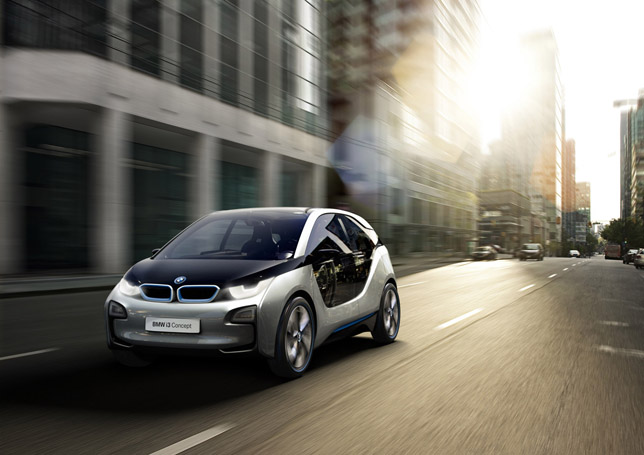
    BMW i3 Concept is a small 5-door city car, which can carry up to four occupants. It is powered by an electric motor with 170PS (125 kW) and 250Nm (184 lb-ft) of torque. 0 to 100 km/h in 7.9 seconds and top speed of 150 km/h (93 mph). The lithium-ion battery pack delivers enough energy for range up to 160 km (100 miles). It can be recharged in just 6 hours to 100%. The overall weight of the vehicle is 1250 kg (2755 lbs).

    BMW i8 Concept is a sports car, which comes with a three-cylinder turbocharger petrol engine combined with an electric motor. The total power is 353PS (260 kW) and 550Nm (406 lb-ft) of torque, so the performance is superb – 0 to 100 km/h in 4.6 seconds and top speed of 250 km/h (155 mph). The car weighs just 1480kg. The i8 can go on electricity alone up to 32 km (20 miles). The fuel consumption is amazing for such amount of power – 2.7 l per 100 km with CO2 emissions of 66 g/km.

    An additional range of mobility services – which can also be used independently of the cars – will be an integral component of BMW i alongside the vehicles themselves. A totally new development in this area will be vehicle-independent mobility services.

    BMW i3 Concept
    BMW i3 Concept

    Source: BMW

  • BMW i3 and i8 at the Frankfurt Motor Show

    BMW exhibits the ECO-friendly concepts i3 and i8 at the 2011 Frankfurt Motor Show. Both vehicles will set a new bars in turn of efficiency.
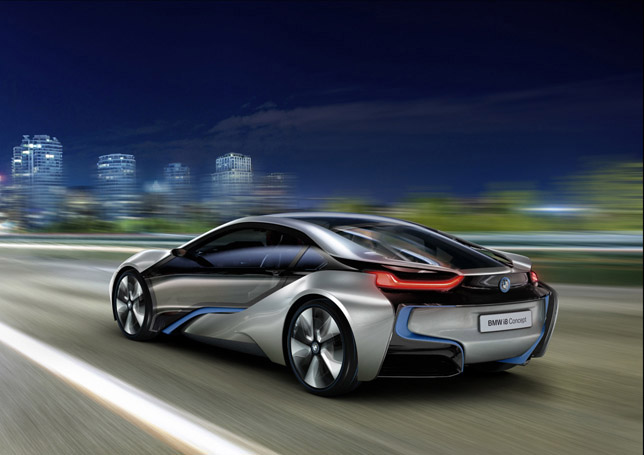
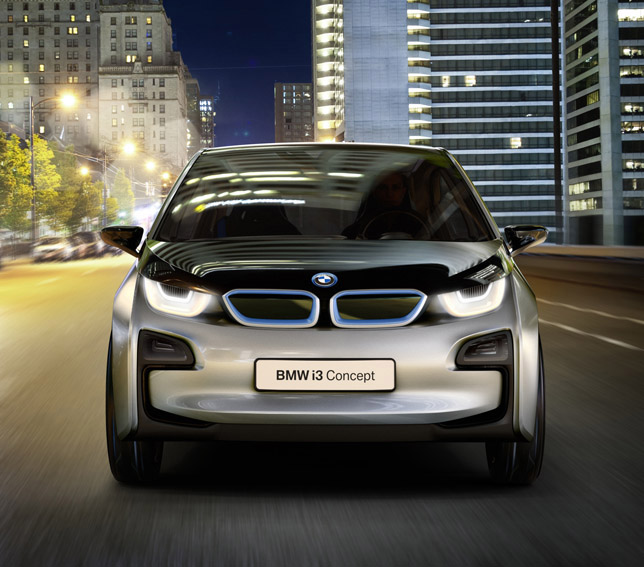
    The small i3 Concept is a four-seater city car with 5 doors, which is powered only by electric motor, but with astonishing power – 170PS (125 kW) and 250Nm (184 lb-ft) of torque. There is a lithium-ion battery package delivering up to 160 km (100 miles) range. 0 to 100 km/h in 7.9 seconds and top speed of 150 km/h (93 mph). The overall weight of the vehicle is 1250 kg (2755 lbs). BMW i3 is perfect for everyday driving with its range and once the battery is depleted, it can be recharged in just 6 hours to 100%.

    The i8 Concept is completely different vehicle. It comes with a turbocharged 1.5-liter three-cylinder petrol combined with an electric motor. The total power is 353PS (260 kW) and 550Nm (406 lb-ft) of torque. 0 to 100 km/h in 4.6 seconds and top speed of 250 km/h (155 mph). The curb weight of the vehicle is 1480kg, so the results are impressive.

    The i8 can go on electricity alone up to 35 km (20 miles), which means that you’ll need just 2.7 liters of fuel per 100 km and the CO2 emission are as low as 66 g/km.

    BMW i8 Concept Rear
    BMW i8 Concept Rear

    Source: BMW

  • BMW i8 and i3

    BMW has introduced the first series-production all-electric vehicle by the brand. Two vehicles will be exhibited at the 2011 Frankfurt Motor Show in September.

    The first is BMW i3 Concept, which is based on Mega City Vehicle concept. The small city car boasts RWD and an electric motor producing up to 170PS (125 kW) and 250Nm (184 lb-ft) of torque. 0 to 60 km/h in 3.9 seconds and to 100 km/h in just 7.9 seconds. Not bad for an all-electric vehicle. The range of the vehicle is 130 to 160 km (80 to 100 miles).

    The dimensions of i3 Concept are 3845 mm in length, 1537 mm height and 2011 mm width. The wheelbase is just a bit smaller than 1-Series – 2570 mm. The kerb weight is just 1250 kg, so the vehicle will be easy to drive with good dynamics.

    The luggage compartment is satisfying – 200 litres.

    BMW i3 Concept Front

    Second is the i8 Concept, which is a plug-in hybrid sports car. The same electric motor is mounted on the front axle and is couple with a 1.5 liter three-cylinder turbocharged petrol engine. The overall power is staggering – 353PS (260 kW) and 550Nm of torque.

    As you may suggest, the performance is awesome – 0 to 100 km/h in 4.6 seconds and top speed is limited to 250 km/h (155mph). Still, the vehicle manages to return 104 mpg, which is 2.7 litres per 100 km. The range on electricity is 35 km (20 miles).

    The dimensions of i8 Concept are 4632 mm in length, 1280 mm height and 1955 mm width. The wheelbase is 2800mm. The kerb weight is just 1480 kg.

    The luggage compartment is 150 litres.

    Check out the pictures, videos and full specifications, below!

    BMW i8 Concept Side

    BMW i3 Concept Specifications:

    Length/Height/Width L 3845 mm, H 1537 mm, W 2011 mm
    Wheelbase 2570 mm
    No. of seats 4
    Kerb weight 1250 kg
    Output 125 kW / 250 Nm
    Top speed 150 km/h / 93 mph
    Acceleration 0-60 km/h / 37 mph 3.9 s0-100 km/h / 62 mph 7.9 s

    80-120 km/h / 50-75 mph 6.0 s

    Electric range Everyday range: 130-160 km / 80-100 milesFTP72 cycle: 225 km / 140 miles
    Battery charge time Standard: 6 h for 100% chargeOptional: 1 h for 80% charge
    Luggage compartment approx. 200 litres


    BMW i8 Concept Specifications:

    Length/Height/Width L 4632 mm, H 1280 mm, W 1955 mm
    Wheelbase 2800 mm
    No. of seats 2 + (2)
    Kerb weight 1480 kg
    Output 260 kW /550 Nm system output of which petrol engine: 164 kW / 300 Nmof which electric motor: 96 kW / 250 Nm
    Top speed 250 km/h / 155 mph governed
    Acceleration 0-100 km/h / 62 mph 4.6 s80-120 km/h / 50-75 mph 4.0 s
    Fuel consumption (EU cycle): 2.7 l/100 km / 104 mpg imp (66 g CO2)
    Electric range approx. 35 km / 20 miles
    Battery charge time Standard: 1:45 h for 100% charge
    Luggage compartment approx. 150 litres

    Source: BMW

  • BMW i8

    BMW are preparing supercar with the name i8, which wont be powered by a diesel-electric hybrid like the Vision EifficientDynamics concept.BMW i8 is expected to be introduced in 2013 and it will be powered by a petrol engine.The recently announced ‘i’ sub-brand from BMW will launch the i8 supercar in 2013 but it will come with a petrol engine instead. (more…)