Tag: Bi-TDI

  • 2014 Audi A7 Sportback Facelift – Price

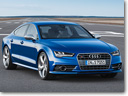
    Audi has finally revealed the new 2014 Audi A7 and S7 Facelift. The new model is slated to go on sale in the end of this summer with pricing starting from €51,300 for the A7 and €82,300 for the S7.

    2014 Audi A7 comes with a new single-frame grille as well as a modified front bumper surrounded by Matrix LED headlights (optionally available). The dynamic turn signal lights are now standard on the new taillights. At the rear, there is new bumper and updated exhaust pipe ends.

    The interior boasts high-quality materials like aluminum and Beaufort walnut inlay and Valcona fine-leather. There is also a revised color range 5 hues for the seats and door panels.

    The engine range now includes the new V6 3.0 TDI Clean Diesel with 272HP (200 kW) or 218HP (160 kW), which is able to return 50.0 mpg US (60 mpg UK or just 4.7 liters / 100 km) on combined cycle with CO2 emissions of 122 g/km.

    The more powerful 3.0 Bi-TDI has 320HP (235 kW) and is connected to an 8-speed tiptronic gearbox while the rest of the engines will get a 7-speed S-tronic. The top-of-range Audi S7 will be powered  by a 4.0 liter V8 twin-turbo TFSI  with 450HP (331 kW).

    Other innovations include MMI Navigation plus with MMI touch, which now benefits from an Nvidia graphics processor and comes as standard with Internet connectivity via LTE. There is also a night vision, adaptive cruise control with stop & go function, active lane assist, side assist and Audi’s pre sense safety system.

    httpv://www.youtube.com/watch?v=Vno0vzYUza0

    httpv://www.youtube.com/watch?v=RQufedroPCo

    httpv://www.youtube.com/watch?v=jGiIfOZo6zA

    Source: Audi
  • Audi’s Electric Bi-turbo Engine

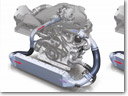
    Audi will produce a super high-efficient electric bi-turbo diesel engine. In this future technology, a secondary compressor boosts the main turbocharger at lower engine speeds.

    Audi has announced they are testing an electric bi-turbo diesel engine.

    The latest bi-turbo diesel from Audi is the 3.0 Bi-TDI. It develops 313HP (230 kW) and 650Nm (480 lb-ft) at just 1450RPM. This is a specific power output of 106HP (78 kW) per liter displacement. However, its combined fuel consumption in the A6 is only 6.4 / 100 km (36.75 US mpg) and CO2 emissions of 169 g/km.

    What all turbocharged engines have in common is that the turbocharger is driven by energy from the exhaust. This means that starting from very low revs, the rise in boost pressure and therefore torque becomes gradually greater only as the exhaust energy increases.

    A new development stage is the electric biturbo. This makes it possible – independently of the exhaust energy available – to build up charge pressure quickly and achieve high levels of torque even at very low revs.

    In advanced diesel development at Audi’s site in Neckarsulm, a 3.0 V6 TDI was built and calibrated with an electric biturbo. It is a combination of a conventional gas-driven turbocharger with a secondary electrically driven compressor – whose exterior appearance is almost identical to that of a conventional turbocharger.

    Instead of a turbine wheel driven by the exhaust gas stream, this is an auxiliary charging stage arranged in line with the gas-driven turbocharger. It integrates a small electric motor that can accelerate its turbine to very high speeds in an extremely short time. The electrically driven compressor is placed after the main turbocharger and intercooler in the charge air path. In most operating states, the charge air is routed around it via a bypass. However, when the flap integrated in the bypass closes – i.e. when the main turbocharger’s energy output is low – the air is directed into the electric compressor and is compressed there a second time.

    The results of the new concept are impressive. Torque buildup occurs significantly earlier in every drive-off, which the driver perceives as a distinct boost in performance.

    The energy required to drive the electric compressor is largely offset by battery regeneration during coasting phases, so that the end effect is essentially neutrall with regard to energy consumption.

    The flexible and compact charge air path enables two-stage turbocharging with just one turbine that is driven by exhaust gas. The reduced heat demand enables earlier activation of the catalytic converter.

    Source: Audi