Tag: automobiles

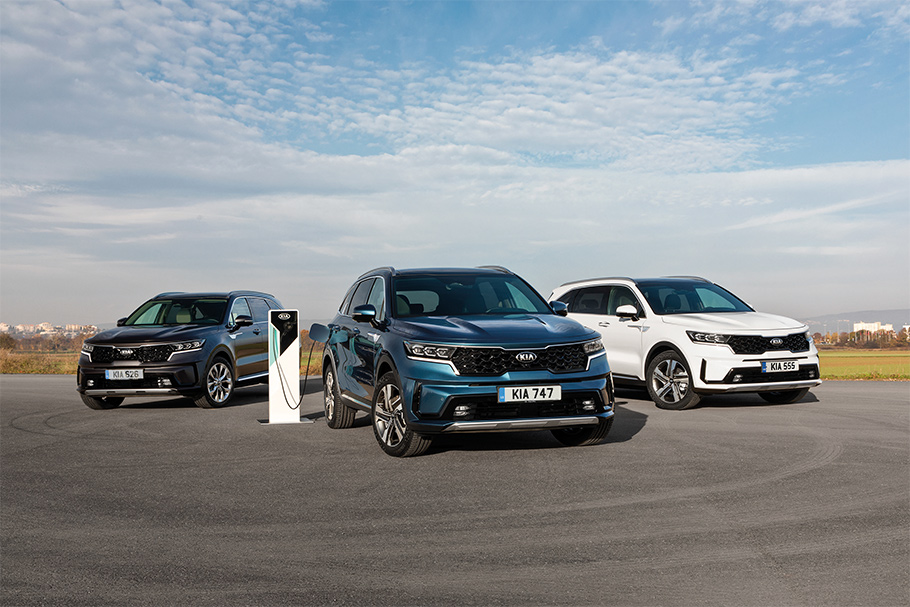
  • Kia Sorento PHEV

    2021 Kia Sorento PHEV1

    Following the arrival of the self-charging hybrid and diesel versions of the all-new Sorento earlier in the year, Kia Motors (UK) Limited is pleased to announce prices for the new Plug-in Hybrid variants of its flagship SUV. Available across the Sorento’s entire trio of trim levels, the grade ‘2’ kicks off at £44,995, while the flagship ‘4’ edition is priced at £53,095. Nestling in between is the generously specified ‘3’ variant, which has a price tag of £48,895. All three versions are available to pre-order now from Kia dealers, with the first examples set to reach showrooms early in the New Year.

    The Plug-in Hybrid is the second electrified drivetrain in the Sorento line-up and sits alongside the low-emissions Sorento Hybrid. The latest addition to the range blends a powerful 1.6-litre T-GDi Turbocharged Direct injection petrol engine with a high capacity battery pack and high output electric motor, allowing the driver to complete an average daily commute to work purely on all-electric, zero emissions power. And the low CO2 emissions of the all-new Sorento Plug-in Hybrid makes it attractive for business users, thanks to its super low company car Benefit-in-Kind taxation rates.

    While many plug-in hybrid vehicles result in compromise, the fourth generation Sorento was designed from the beginning to accommodate electrified powertrains and deliver spacious accommodation for up to seven occupants. The larger body and all-new platform ensure that the latest iteration of the Sorento is one of the most spacious, practical and versatile electrified models on the market today.

    With the addition of the Sorento Plug-in Hybrid to the Kia line-up, the company now offers four different plug-in hybrid products, across a variety of different segments. Ceed Sportswagon, XCeed, Niro and now the Sorento seven-seat SUV all offer the capability of zero-emissions driving, with the flexibility of a combined plug-in hybrid and petrol powertrain.

    The most powerful model in the range is also the lowest emitting

    The combination of a high-power output electric motor, high capacity lithium-ion polymer battery pack and a punchy 1.6-litre T-GDi turbocharged petrol engine results in the most powerful Sorento SUV ever. Power is sent to all four wheels via a newly designed six-speed automatic transmission. The gearbox allows the full power of the engine and electric motor to be harnessed and transferred in parallel, with a minimal loss in energy. The result is highly responsive acceleration, and the lowest CO2 emissions of any model in the Sorento line-up.

    The launch of the Sorento Plug-in Hybrid introduces a range of innovations throughout the powertrain that all combine to ensure that it is the most advanced, efficient PHEV to-date from Kia. An independent battery pack water-cooling system makes its debut for the first time in a plug-in hybrid and is designed to ensure optimal heat management and efficiency for the high-voltage battery pack. A new two-stage lamination process for the rotor on the electric motor aims to reduce noise and vibration levels, while the engine itself features Kia’s latest ‘Smartstream’ innovations, including Continuously Variable Valve Duration technology, which regulates the duration that the intake valves open and close, depending on the driving conditions. This innovation allows the powerplant to operate on different combustion cycles, seamlessly optimising both engine performance and fuel efficiency.

    The full-size, seven-seat SUV will deliver an equivalent all-electric range (EAER) of up to 57 kilometres (WLTP*) from a single charge of its 13.8 kWh battery pack. In urban environments it is capable of travelling up to 70 kilometres on a single charge (EAER city) before its turbocharged petrol engine starts up. Drivers are therefore able to complete many journeys, such as their daily commute, on zero-emissions electric power alone.

    Its plug-in hybrid powertrain also promises the lowest CO2 emissions ever offered by the Kia Sorento. With emissions of just 38 g/km (WLTP, weighted combined**), the new model is one of the most efficient vehicles in its class***.

    UK homologated figures will be announced in due course.

    Eye-catching design and room for seven in comfort

    The fourth generation Sorento is the largest SUV in Kia’s European line-up and features an all-new platform with electrification at the forefront of the bold design. The car’s high-capacity 13.8kWh lithium-ion polymer battery pack is located beneath the driver and front passenger seats. The battery pack is sandwiched between the cabin floor and the Sorento’s underfloor, meaning there is no compromise on space. The Sorento PHEV’s 67-litre fuel tank is located beneath the floor underneath the second row of seats, while the 3.3 kW on-board charger is situated beneath the cargo floor.

    Like its self-charging hybrid and diesel stablemates, there’s generous space for seven occupants, as well as offering one of the largest cargo carrying capacities in its class. With all seven seats in use, there’s still 175 litres of space for weekend luggage or shopping, while this expands to an exceptional 809 litres with the rearmost seats folded down flat and the Sorento operating in five-seat mode.

    The cabin of the all-new Sorento is arguably one of its biggest attributes, and this remains largely unchanged in Plug-in Hybrid guise. The 12.3-inch fully digital instrument cluster gets a makeover, however, with new graphics and dials to provide drivers with the powertrain’s status. This enables drivers to keep an eye on the battery’s charge status, as well as the flow of electricity and petrol power through the powertrain. From the ‘3’ grade up, the 10.25-inch touchscreen infotainment system has additional functionality to enable drivers to more easily locate vehicle charging points while on the go.

    Three comprehensively equipped trim levels

    All models in the Sorento Plug-in Hybrid line-up, including the phenomenally specified Sorento ‘2’, feature LED technology for the headlights and rear combination lights, as well as for the daytime running lights, front and rear fog lights and high mounted brake light. 19-inch alloy wheels and a temporary space saver spare wheel are standard equipment, with roof rails not only boosting the all-new Sorento visually, but also adding versatility if there’s ever a need to carry additional loads. A black front radiator grille is married to wheel arch body mouldings and side sills in the same colour, with all versions featuring front and rear skid plates in silver.

    Black cloth upholstery is married with light grey headlining to deliver a smart two-tone appearance in the cabin, and the front seats and leather steering wheel are both heated. Seven seats are standard on all editions of the Sorento, including the PHEV, unlike some rivals, with 60:40 split, remote folding and reclining for the second row and a 50:50 split and fold arrangement for the rearmost chairs. USB charge ports are handily provided for all three rows, ensuring that occupants continue to be entertained while on the move, and don’t run out of juice. Dual-zone automatic air conditioning also includes outlets for seats six and seven.

    Electrically folding, adjustable and heated door mirrors feature integrated LED indicator lights, and there’s an auto-dimming rear-view mirror, rain sensing front wipers and automatic headlight control.

    In car entertainment is looked after thanks to DAB radio with a multi-device Bluetooth® connection and voice recognition and music streaming, Android AutoTM and Apple CarPlayTM smartphone integration. A reversing camera system with dynamic guidelines is integrated into the 8.0-inch touchscreen and includes front and rear parking sensors.

    A suite of safety systems features on the all-new Sorento, with seven airbags that incorporates a front centre airbag, in addition to the usual driver and front passenger, twin curtain and pair of front side airbags. Forward Collision Avoidance Assist (FCA) incorporates city, pedestrian, cyclist and junction detection, the latter warning of an oncoming car from the other side of the road when turning at a junction and, if a

    collision appears likely, applies the brakes to stop the car. The system relies on the front camera and radar and it is dependent upon the indicators being operated, as doing so allows the system to understand the driver’s intent to turn across the traffic.

    Lane Follow Assist (LFA), Intelligent Speed Limit Assist (ISLA), Manual Speed Limit Assist (MSLA), Trailer Stability Assist (TSA) and Driver Attention Warning (DAW) all feature, along with Hill-start Assist Control (HAC), Downhill Brake Control (DAC) and an electronic parking brake (EPB) with Auto Hold functionality. Drive Mode Select allows the driver to tailor the driving experience more to their tastes, with a choice of ‘Smart’, ‘Eco’ and ‘Sport’ modes, while Terrain Mode Select incorporates three settings – ‘mud’, ‘snow’, and ‘sand’. Multi-Collision Brake Assist (MCBA) is a new innovation for all-new Sorento, as is Smart Cruise Control with Stop and Go functionality and E-call, which automatically summons the emergency services in the event of an accident. An advanced anti-theft alarm system is provided with remote central door locking with fold-away key.

    Move up to ‘3’ specification and the radiator grille gains a more striking glossy black appearance, and a satin chrome finish is applied to the exterior door handles. The LED headlights adopt bi-functionality and privacy glass is included as standard. Inside, the centre fascia adopts a premium etching finish that is both striking and classy. The upholstery is upgraded to black leather, there’s eight-way power adjustment to both of the front seats, and heaters are provided for the outer chairs on the second row. The cabin’s Mood Lighting system allows users to tailor the cabin even further, with the interior illuminated in one of seven pre-set ‘core’ colours, or from a wider range of 64 shades.

    The Sorento ‘3’ also includes Kia’s innovative UVO Connect telematics system, connecting drivers by providing invaluable information via the in-car touchscreen and on their smartphone. Featuring Kia Live services and accessible through the uprated 10.25-inch LCD widescreen, the system displays live traffic information, weather forecasts, points of interest, and details of potential on- and off-street parking (including price, location and parking availability). UVO Connect also enables drivers to send route directions to their car before a journey and check the location of their vehicle at any time. A wireless smartphone charger also sits at the base of the centre console

    An engine start/stop button with Smart Entry system adds to convenience, alongside a Smart power tailgate and Highway Driving Assist (HDA), a driving convenience and safety system that reduces driver burden on motorways and A-roads by controlling the vehicle’s steering, acceleration and deceleration functions to maintain the speed set by the driver, keeping a safe distance from the vehicle directly ahead, and positioning the car in the centre of its current lane. Comfort levels are further boosted by the fitment of self-levelling rear suspension.

    At the pinnacle of the all-new Sorento range is grade ‘4’, and this flagship model features fine black Nappa leather upholstery with a contemporary black headlining and 10-way power adjustable driver’s seat with electric lumbar support and integrated memory system. There’s ventilated front seats and a panoramic sunroof with tilt and slide functionality and automatic electric roller blind. A head-up display projects driving information onto the base of the windscreen in the driver’s line of sight, with the system displaying alerts from the car’s numerous driver assistance technologies, details of vehicle speed, and turn-by-turn navigation instructions. A powerful 12-speaker BOSE® surround-sound audio system is also included on the top-of-the-range Sorento ‘4’, delivering a more immersive sound to all three rows.

    Smart metal pedals deliver a dynamic ambience to the cabin and Blind-spot Collision Avoidance Assist (BCA) helps the driver avoid collisions on busy sections of the motorway. A 360-degree Around View Monitor is incorporated into the 10.25-inch touchscreen and works alongside the Parking Collision-Avoidance Assist (PCA) system. PCA works by preventing the vehicle from colliding with pedestrians or nearby obstacles when the driver parks the car or is reversing out of a parking spot. Using its rear-view camera and rear ultrasonic sensors, if it anticipates a collision, the system warns the driver with visual and audible alarms while engaging the vehicle’s brakes automatically to prevent the collision.

    Production begins, with pre-order books open now

    The Kia Sorento Plug-in Hybrid has started production this week at Kia’s Hwasung manufacturing facility in Korea. Like all Kia models, the Sorento PHEV is covered by Kia’s 7-year/100,000 mile warranty. The warranty also covers the car’s electric motor and battery pack.

  • Naran Automotive reveals the Naran – A 1,048HP, four-seater, GT3-inspired hyper-coupé

    Naran1

    Naran Automotive, the new manufacturer of luxury ultra-high performance cars, has revealed the exterior design of its first model – The Naran.

    The four-seater hyper-coupé will deliver an authentic GT3-style driving experience for the road when it arrives next year, combining the uncompromising performance and dynamics of a track-focused hypercar, with opulent ultra-luxurious materials inside and out.

    Just 49 examples of the first-of-its-kind, four-seater, all-wheel-drive, front-mid engined hyper-coupé will be created. Each vehicle produced will be individually tailored to the personal taste of the collector, including the designation of a bespoke model name – a convention normally reserved for luxury superyachts.

    Naran Automotive has brought together a team of world-class partners from the pinnacle of automotive design, motorsport, material innovation and powertrain development to create The Naran.

    Jowyn Wong, founder of Wyn Design and visionary behind the Apollo IE and De Tomaso P72, is leading the design, while colour and materials design is being tailored by Kate Montgomery, former Aston Martin Lagonda designer.

    The bespoke 5.0-litre twin-turbo V8 engine is being crafted in Germany with partners Racing Dynamics and development of vehicle dynamics is being overseen by EY3 Engineering and Daniel Mense, renowned for his work on the NIO EP9 – the electric car Nürburgring lap record breaker.

    Performance
    The Naran will be capable of 0-60mph in less than 2.3 seconds, 0-100mph in 4.56 seconds and an expected top speed of over 230mph, with the 5.0-litre twin-turbo V8 engine producing 1,048 bhp and 1,036Nm of torque. The motorsport-inspired aerodynamic package helps produce an industry-leading 1,377kg of downforce, exceeding that of a GT3 race car.

    Power is delivered by an all-wheel-drive system, providing both secure traction and confidence-inspiring performance in all conditions, with the option to switch to rear-wheel drive for a challenging, yet rewarding, analogue driving experience. The bespoke, race-derived double-wishbone suspension will apply adjustable front and rear anti-roll bars and camber and toe adjustments so customers can tailor the dynamic set-up to meet track specific demands.

    Damping is provided by an Ohlins four-way adjustable race-spec system, enabling the driver to push their vehicle to the absolute limit even in the most demanding track conditions. The Naran will also adopt a race-grade hydraulic steering rack, carbon ceramic brakes developed for endurance racing, and spherical bearings for improved steering feel and precision.

    Design
    Designed by the founder of Wyn Design, Jowyn Wong, the man behind the Apollo IE and De Tomaso P72, The Naran encompasses a monolithic design language with sharp, purposeful lines, delivering an unmistakable coupé silhouette.

    The long, leaping bonnet, performance-focused rear wing and aggressive front intakes give it an unrivalled presence on the road and track. The front splitter and rear diffuser appear as one-piece, with the exposed functional aerodynamic elements balancing the beautiful form of The Naran’s ultra-lightweight carbon composite body. The performance-focused theme is continued with the addition of 22-inch hybrid-carbon wheels and a distinct side aero blade exposing the front wheel arch for cooling and aerodynamic efficiency.

    The Naran features bespoke detailing and first-class attention to detail, showcasing industry-first flax carbon composites in expressive material inserts across the exterior, with the natural fibres giving each of the 49 examples a tailored finish. The biodegradable flax composite is ultra-lightweight and not only provides a unique aesthetic in visual form, with a range of finishes available, but also delivers improved vibration damping over carbon fibre.

    Ameerh Naran, CEO and founder of Naran Automotive, said: “Our vision is to create the most beautiful and thrilling cars in existence, inspiring future generations to pursue their wildest dreams.”

    “With The Naran, we are creating a unique ownership experience and a new perspective on shared driving experiences – a GT3-inspired, driver-focused, front-mid engined 2+2 hyper-coupé, that delivers unrivalled material innovation and a commitment to reviving the analogue driving experience. The Naran is the true embodiment of art on wheels, designed and developed by some of the greatest minds in the industry.”

    The model will debut in early 2021. For more information about the brand visit naran-automotive.com.

    INTRODUCING NARAN AUTOMOTIVE
    Naran Automotive’s founding team is both deeply respected and highly experienced. Our senior engineering and design experts have been hand-selected from the very best the automotive industry has to offer.

    Meet the team behind Naran Automotive:

    Founder/CEO: Ameerh Naran
    Ameerh Naran, 34, is CEO and founder of Naran Automotive. During Ameerh’s early years, he raced in several single-seater championships before turning his entrepreneurial ambitions towards establishing himself in the premium luxury sector. After building Vimana Private Jets into a globally recognised brokerage, he is now focused on delivering a truly unique, and record-breaking, portfolio of cars.

    COO: Steve Pegg
    Leading the vehicle programme is Steve Pegg, a highly experienced senior vehicle engineer who has previously worked on highly successful and challenging portfolios for both established OEMs and electric vehicle start-ups.

    Design: Wyn Design
    The design team is led by Wyn Design founder Jowyn Wong. Jowyn created the Apollo IE – a $2 million hypercar that was a halo product for the new brand. Equally memorable was the De Tomaso P72 – a $1 million supercar tasked with reviving a dormant brand by re-introducing a 1960s race car-inspired design language.

    Powertrain: Racing Dynamics
    Racing Dynamics, a manufacturer of performance parts and specialist vehicles with 40 years of experience and heritage in racing, is crafting the Naran’s bespoke engine. Racing Dynamics has supported premium brands including BMW, Mercedes-Benz and Rolls-Royce to deliver TÜV-accredited performance systems.

    Engineering: EY3 Engineering
    Leading vehicle dynamics specialist, EY3 Engineering, was founded in 2016 and has designed three manufacturer-backed international touring cars, all of which took a race win on their debut and championship honours in their inaugural seasons. The team is being led by Daniel Mense, renowned for his work on the NIO EP9 – the electric car Nürburgring lap record breaker.

    Materiality: Kate Montgomery
    Kate is responsible for The Naran’s unique interior. An experienced designer specialising in colour, material and finish, trend insight and forecasting, Kate has consulted on projects in automotive, aviation concept and rail. She has worked at Aston Martin Lagonda, where she assisted in shaping the interior design strategy for several years.

  • Well-balanced and sporty at the same time– the new id.4 chassis

    The new Volkswagen ID.4

    Nimble in the city, agile on country roads, relaxed on the highway: the new ID.4 from Volkswagen is an all-rounder that is effortless and easy to drive. Volkswagen has invested a great deal of know-how in the chassis of the E-SUV – in the mechanical components and the electronic control system.

    “The purely electrically driven SUV ID.4 is great fun to drive, similar to the compact ID.32,” explains Karsten Schebsdat, Head of Driving Dynamics, Steering and Control Systems at Volkswagen. “In its chassis, we have implemented numerous ideas and new control systems that further increase safety and driving pleasure.”

    Sporty handling due to low center of gravity. The ID.4 already offers the best prerequisites for a great driving pleasure. The rear-wheel drive ensures strong traction – the driver experiences this already when they arrive at a set of traffic lights in the wet. The high-voltage battery is located between the axles at the lowest point of the car. This benefits the center of gravity and weight distribution: with all drive variants, it deviates from the ideal value by no more than one percent, 50:50.

    The front axle of the ID.4 follows the McPherson design, the steering is translated with a 15.9:1 ratio. For the first time at Volkswagen, the steering system is located in front of the center of the wheel, this position guarantees high stability during fast cornering. At the rear is a complex new development – a compact five-link suspension with a subframe that is elastically connected to the body. Parts of the suspension are made of lightweight aluminum to reduce weight.

    Large wheels and powerful brakes. The range of wheels for the ID.4 starts with the 18- inch format, either in steel or aluminum. Starting with the ID.4 Life model, 19-inch wheels are standard; above that, there are only light-alloy wheels with 20- or 21-inch diameters. Although the large wheels in the wheel arches take up a corresponding amount of space, the ID.4 only requires a turning circle of 10.2 meters – extremely little for a car in its class.

    The wheels are aerodynamically optimized by their flat design, the tires have low rolling resistance. In the ID.4 Pure and ID.4 City entry-level models, they are 235 millimeters wide at the front and rear, with cross-sections varying according to wheel size. All other ID.4 models roll off the production line on combination tires – 235 millimeters wide at the front and 255 millimeters at the rear.

    The robust E-SUV has powerful brakes – the discs on the front axle of the ID.4 models with the 77-kWh battery are 358 millimeters in diameter. Drum brakes operate on the rear wheels. Their pads are designed to last the lifespan of the car. Corrosion is impossible, although the brakes are rarely used in everyday driving. Most of the deceleration is performed by the electric motor, which recovers energy in the process.

    Progressive steering, DCC chassis control and driving mode selection. With the “Plus” sports package (in the top model ID.4 Max), the ID.4’s chassis takes on a whole new form. One of its two components is the Progressive Steering, which works more and more directly as the steering angle increases – its ratio ranges from 15.9:1 to 14.5:1. The other component is the DCC adaptive chassis control, which works depending on the road surface and the driving situation. It regulates the characteristics of the damper on each wheel 200 times per second – this enables a high level of ride comfort or a tight connection to the road.

    The DCC and Progressive Steering are coupled with Driving Profile Selection, which gives the driver a choice of four modes. Eco, Comfort and Sport are preconfigured. In Individual mode, the driver is given additional setting options on the central display: They can select fine intermediate levels between Comfort and Sport or make both modes even more extreme – in other words, even more comfortable or even more dynamic.

    The Vehicle Dynamics Manager. When the driver wants to, the ID.4 takes corners very quickly, stably and almost naturally – also thanks to the electronic Vehicle Dynamics Manager, which works closely with the stability control ESC. Volkswagen has introduced it in the new Golf. The Driving Dynamics Manager controls the wheel- selective brake interventions of the XDS electronic transverse drive lock and the work of the DCC damper control. It uses a digital target model to achieve optimum driving and steering behavior in every situation. As soon as the vehicle turns into a corner, the ID.4 behaves more spontaneously, linearly and accurately.

    The ESC in turn cooperates closely with the control units for the electric engine and the power electronics. Although a rear-wheel drive car tends to oversteer in principle, this networking ensures that the rear wheels of the ID.4 find stable grip in every situation – during full acceleration, when cornering fast and when decelerating by brake recuperation. This traction control – another innovation at Volkswagen – is speed-based. And it takes place automatically every millisecond, i.e. so fast and therefore so gently that the driver hardly feels it.

    Start with eight models. The ID.4, Volkswagen’s first fully electric SUV and the brand’s first electric world car, will be launched after the 1ST Edition with eight preconfigured models. The high-voltage battery is available with 52 or 77 kWh energy capacity (net), the range is up to 520 kilometers (WLTP). The electric motor is available in three power levels between 109 kW (148 PS) and 150 kW (204 PS).

    The future of mobility is electric. As part of the “Transform 2025+” strategy, the Volkswagen brand is investing eleven billion euros in electromobility by 2024. The ID.4 is the second model of the ID. family following the ID.3. This new product line has recently been added to the brand’s traditional portfolio. The term ID. stands for intelligent design, identity and visionary technologies.

    1ID.4 – Power consumption in kWh/100 km (NEDC): 16.9 – 16.2 (combined); CO2 emission in g/km: 0; efficiency class: A+.
    2ID.3 – Power consumption in kWh/100 km (NEDC): 15.4 – 14.5 (combined); CO2 emission in g/km: 0; efficiency class: A+.

  • One in four still looking to spend on premium goods despite challenges of pandemic

    DS 7 CROSSBACK E-TENSE 1

    Despite the challenges of 2020 and the Covid-19 pandemic, new research by DS Automobiles has revealed almost a quarter of the UK public (24%) are still likely to make a premium purchase over the next twelve months. According to the poll, respondents plan to invest over £3,500 on average to procure items including jewellery, technology, designer clothing and holidays; while over a quarter of those surveyed (28.3%) are looking to purchase a new car.

    When making a premium purchase decision, 60% of respondents cited the price point as the most important factor, in addition to other aspects including the materials used (42%), the brand name (39%) and the reputation of the brand product or service (39%).

    And it seems provenance is also important to us when purchasing luxury goods, Parisian brands topped the table in the survey of 2,000 people conducted by OnePoll; with a quarter of respondents associating the French capital with luxury goods. One third of the UK public also believe Paris is the most stylish capital in the world (33%)* beating the likes of Milan (23%), London (19%) and New York (9%).

    When asked about making a premium car purchase specifically, nearly half of those surveyed stated high levels of interior technology and features as the main qualities they look for when making a decision, with standout design (35%) coming in second on the list. Other desirable qualities included high performance powertrains and the use of fine interior materials such as leather and crystal glass. DS Automobiles is leading the way when it comes to the very best in French know-how and avant-garde style through its DS 7 CROSSBACK, the Premium SUV.

    As a celebration of Paris, the interior of DS 7 CROSSBACK is faithful to the DS philosophy of personalisation. With sculpted shapes and the intricate aesthetics of its alloy wheels to its elegantly contrasting lines and jewellery inspired DS ACTIVE LED VISION headlights, the model presents the very best in French savoir-faire.

    Head of Product at DS Automobiles, Vince Clisham said: “It’s no surprise that Paris has been voted the most stylish capital by the UK public as it is well known for producing the very best in premium goods, be it cars, fashion, cosmetics or jewellery.

    Every DS model we produce is built with French savoir-faire in mind, meaning that from the way the car is designed to how it performs is all with a premium look and feel in mind, to provide our customers with the ultimate driving experience.”