 The concept of the airbag, a soft pillow to land against during a crash, had been around for many years before anyone thought of using them in cars. In fact, the first patent on an inflatable crash-landing device for aircraft was actually filed during World War II. None were made during the conflict and it wasn’t until the 1980s that the technology migrated into the automotive industry.
The early automotive airbag designs were impractical and expensive. The main concern for design engineers was the storing and releasing of a compressed gas. Issues were raised such as where to store the container for gas in the car, how to develop a mechanism that allows the gas to expand quickly, and how to make sure that the stored gas would have a shelf life at least equal to that of the car.
These issues were addressed in the 1970s with the invention of small propellant “inflators,” devices that initiate a chemical reaction that releases hot nitrogen gas into the airbag. This device was a major stepping-stone in the development of airbag technology.
Technically, the goal of an airbag is simple: slow the passenger’s forward motion in a crash as evenly as possible but do it in a fraction of a second. The whole process starts with signal from a motion sensor.
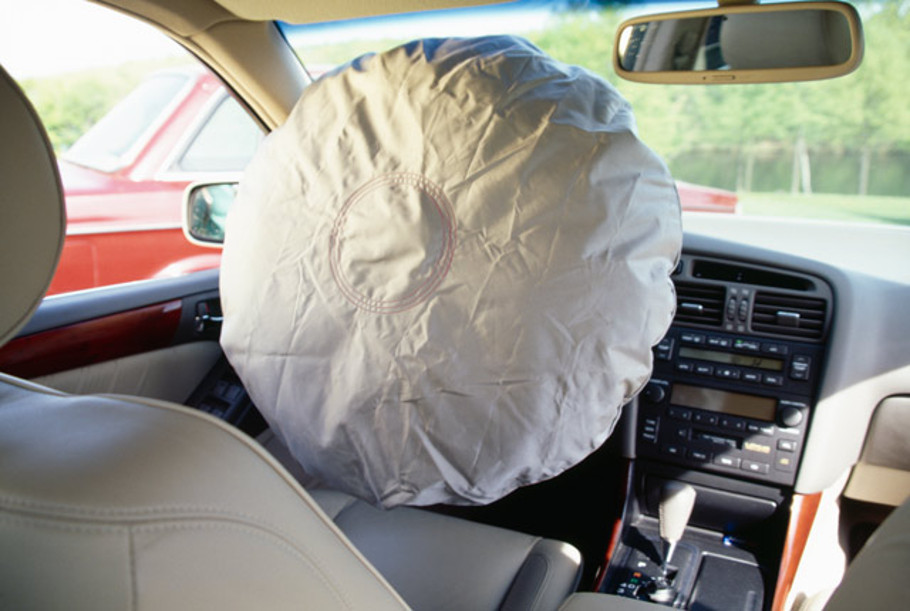
Motion sensors are chip-based accelerometers that continuously measure forces on moving cars. When one of these sensors detects a large, collision-level force, it sends an electrical pulse to the automobile’s airbag inflation system. Typically this ignites a charge that produces a hot blast of gas which drives the airbag out from its storage site in the car at more than 200mph. The inflated airbag, along with seatbelts, prevents the driver and passengers from being thrown very far forward. The whole inflation process happens in only one-twenty-fifth of a second and serious injury is usually avoided.
It didn’t take long to learn that the force of an airbag can hurt those who are too close to it, particularly children. Researchers have determined that the risk zone for driver airbags is the first 2 to 3 inches of inflation. So, placing yourself 10 inches from your driver airbag gives you a clear margin of safety. The rules are different for children. An airbag can seriously injure or even kill an unbuckled child who is sitting too close. Experts agree that children 12 and under should ride buckled up in a properly installed, age-appropriate car seat in the rear seat of a car.
In certain special cases, car owners can request the ability to deactivate their airbags. Generally speaking, you can’t deactivate your airbag without installing a retrofit on-off switch. And you can’t just have a dealer install one for you. Dealers have to contact the NHTSA and get permission. Go online and look for the NHTSA brochure, “Airbags and On-Off Switches: Information for an Informed Decision,” and the accompanying form, Request for airbag On-Off Switch. This information will allow you to decide whether disabling your cars airbag system will make your car safer under the conditions that you typically drive in.
Source: Earnhardt Chrysler