 Apparently Honda have figured out a way to keep us out of traffic jams. Actually, they want to prevent jams from happening in the first place. The plan is to introduce an already developed system, first of it’s kind according to Honda, which can “determine whether the driving pattern of the vehicle is likely to create traffic jams”. Well that’s easy – if the car is moving, you’re okay. If not, you’re stuck. After figuring out that the acceleration and deceleration of a single vehicle may influence the whole traffic stream, Honda and the Research Center for Advanced Science and Technology at the University of Tokyo started conducting tests. The initial results showed that with the system the voyaging vehicle’s average speed was increased by around 23% while the fuel efficiency was up by 8% when trailing. Public road testing is to be commenced next month in Italy and Indonesia.
So how does it work? Well, the system monitors the acceleration and deceleration patterns of the vehicle to determine whether the driver’s driving pattern is likely to create traffic congestion. If the car knows what’s going to happen next, maybe the driver can do something about it to prevent it. Information is being fed trough a color-coded display on the on-board terminal.
Even further than that, by connecting the on-board terminals to Honda’s cloud servers, the drive can be aware of and in sync with the driving patterns of vehicles by activating the ACC (Adaptive Cruise Control at the right time to maintain a constant distance from the other back ends.
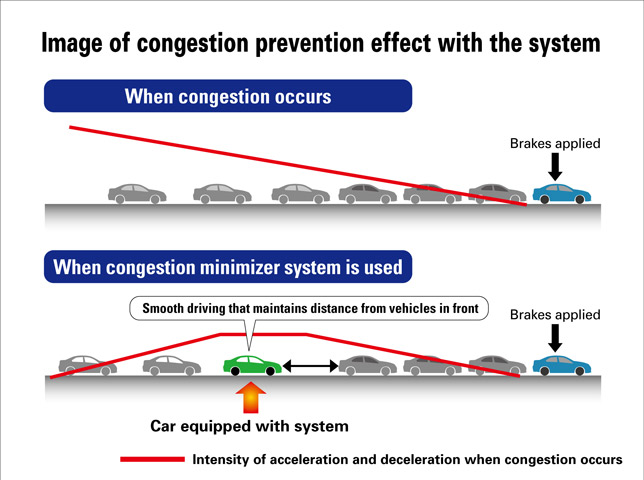
If this turns out to be a successful endeavor, finally we will see the fuel efficiency battle on two fronts – one is the stop/start function which is designed to relief the effects of congestion while this would be a preventative measure. The traffic does affect CO2 emissions, time and mileage. It also creates possible bumper-to-bumper accident risks.
Source: Honda
 The vehicle was presented before two months and now it is available with two new engines. The first one is 2.0 litre twin turbo diesel and the second is 1.6 litre turbo petrol.
 Toyota Prius is undoubtedly the most famous hybrid car in the world. It is already one of the most technologically advanced cars offered on the market and the third generation Prius now offers even more sophisticated features with the introduction of a new Safety Pack option.
 About 100 Volvo V70 and XC70 cars, equipped with cameras and computers are included in a huge European field test project.