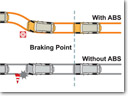
 Before Anti-lock Braking Systems (ABS) were installed on cars, drivers were told to rapidly pump their brakes if they felt a tire start to skid. Today, you don’t need to pump your car’s brakes when skidding, anti-lock braking systems do this for you. In this article, we’ll learn about anti-lock braking systems and how they work.The operational theory starts with the fact that a skidding wheel has less traction than a non-skidding one. The best thing to do when a skid does occur is to slow your engine down and let the tires “grab”. ABS systems do the same thing, they sense when a wheel is skidding during braking and then they pulse the brake automatically to regain traction. This not only allows you to stop in a shorter distance, you’ll be able to regain your steering too. Here are four components we should quickly discuss:1) Speed Sensors – The ABS needs some way of knowing when a wheel is about to lock up. Speed sensors, which are located on each wheel assembly, provide this information.2) Brake Line Valves – There is a valve in the brake line of each brake controlled by the ABS. This electrically-controlled valve controls the brake pressure going to each brake assembly.3) Electric Pump – When a Brake Line Valve reduces the pressure in a brake line, there is an electric pump to bring the restore the pressure.4) ABS Controller – The ABS controller is a small computer. It runs the whole ABS system.The ABS Controller is the brain of the system. It constantly monitors the four wheel speed sensors, looking for speed decelerations in any of the four wheels that are out of the ordinary. The ABS controller knows that rapid deceleration is technically “impossible” under normal driving conditions, so it reduces the brake line pressure to the brake involved until it sees it speed up again. The result: this gives the system maximum braking power. When the ABS system is in operation you will feel a pulsing in the brake pedal; this comes from the rapid opening and closing of the valves.Have you ever wondered what you should do when your car starts to skid? First, do not pump your brakes! The ABS system does this for you. In an emergency stop in a car with ABS, you should just apply your brake pedal firmly and hold it while the ABS does all the work. You will feel a pulsing in the pedal that may be quite noticeable but this is completely normal so don’t let off the brake. When your ABS system is functioning properly, you should have some steering control quickly return so use that to get back on course.
Tag: ABS
-
How Your Car’s Anti-Lock Braking System Works
-
VXR Nurburgring Edition
This is the most powerful Corsa, ever. The VXR Nurburgring Edition is already available on the market with a price of £22,295. However, you can buy it second hand for a lot less and to spent other money for further modifications. Find out more information!
Vauxhall Corsa VXR Nurburgring is powered by a 1.6 liter turbocharged four-cylinder engine with 205HP (151 kW) at 5,750RPM and 280Nm (207 lb-ft) of torque. The Corsa VXR Nurburgring has a modified engine management and turbocharger system, sports exhaust with reduced back pressure. It will run properly with 98-Octane fuel.
0-100 km.h in 6.5 seconds and a top speed of 230 km/h (143 mph).
Other highlights include a mechanical LSD (limited slip differential), revised suspension, lowered ride height (-20 mm front and -15 mm rear), ultra-light Brembo brake system, recalibrated ABS, TC (Traction Control) and ESC (Electronic Stability Control).
The exterior gets stainless steel dual exhaust, a set of new wheels and „Nurburgring” logos. There are also two new colours apple green „Grasshopper” and red „Henna”.
The interior features front Recaro seat backs, bespoke stitching and black / red „Nürburgring” lettering.
-
Avoiding winter car accidents: How safe is your car?
 Adverse weather conditions can make driving in winter a risky business.
Ice on the roads causes skids and slippage, snowstorms impair vision and sub-zero temperatures can make your car become temperamental. You should always leave plenty of time to make any journeys and drive more slowly than usual in winter.
Leave plenty of space between you and other cars around you in case either you or they hit a patch of ice and skid. Be sure to check your car over frequently as you don’t want to be the cause of an accident.
All cars must be fitted with seatbelts in the front by law, and most will have them in the back too. If you have children or frequent passengers, be sure your car has a proper shoulder belt in the middle of the back seat rather than just a lap belt.
Airbags will cushion the impact of a collision but can be dangerous to children under 12 so always seat them in the back where possible.
If you are planning on buying a new car this winter look for one with additional safety features such as ABS, all-wheel drive and electronic stability control. Generally heavier cars are safer for the occupants than lighter ones so it can be worth upgrading if you have a family.
If you do still find yourself skidding remember to ease off on the pedals and steer gently into the skid to slow it down.
In poor weather it is vital to pay attention not only to your own driving but also to anticipate what other cars may do. Don’t ever get too close to another car if the roads are icy as you or they could easily skid and cause a collision.
Be especially wary of anyone driving at speed and remember that just because you drive safely doesn’t mean you are safe from other drivers.
Don’t let festive high spirits tempt you into having just one more drink for the road. Drink driving is dangerous at any time of year, but you especially need all your wits about you when the roads are iced over.
If you do find yourself a victim of someone else’s careless driving this winter and suffer whiplash or any other medical injury, my recommendation is to contact a leading medical solicitor .
-
BMW M6 Coupe and Convertible
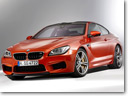 The latest from the M division comes in the form of an M6 – Coupe and Convertible. It has retained its characteristic body line and still is the ultimate in gran touring thanks to its V8 M TwinPower Turbo engine and clever design. BMW‘s EfficientDynamics on the other hand keep it frugal and refined.
The profile is familiar but there are bodily innovations – a new front apron has been introduced with massive, honeycombed air-intake patches. No matter how massive however, they are unable to steal away the headlamp department which features the characteristic BMW Corona rings that make use of the latest Adaptive LED headlight technology. A 30 mm increase of the front track has resulted in a noticeable swelling of the wheel arches which are as ever complemented by the indicator and M badge housing gills behind them. At the back we have quad tail pipes separated into two pairs, flanking the clever diffuser. The M6 sits on 19-inch alloy wheels in a star-spoke (seven double spokes) design that come in two finishes. Alternatively, as an option one can go with the 20-inch ones that have five double spokes for the sake of lighness. As always, lightness for the Coupe is also guaranteed by the carbon-fibre reinforced plastic roof panel which lowers the center of gravity significantly with improved agility and handling as an end result. In the mean time, the Convertible M6 gets the standard 6 Series Convertible retractable roof with its independent retractable rear window. The party piece is the fact that you can operate it while in motion of up to 25 mph.

BMW M6 Coupe (2013) 


Inside, the M6 is a blend of luxury and sportiness – Merino leather everywhere while an instrument fascia featuring a Black Panel technology, dials with red needles and white backgrounds adorn the dashboard. The windscreen is also affected as a HUD display provides speed readout and speed limit identification, gear and rev counter and shift lights to the driver. It’s not all flash and glam though. The new M6 has more space inside and a luggage capacity of 460 litres (300-350 litres for the M6 Convertible). The M Sport seats are more complicated than a smartphone with their electric pneumatic adjustments and the manually adjustable under thigh support.
The power plant for the new M’s is the same one found in the M5 – a mighty 560 hp V8 M TwinPower Turbo 4.4 petrol unit. That’s 53 more hp than the V10 predecessor. Put your foot down behind one of these V8‘s and you’ll be greeted by a maximum torque of 680Nm as early as 1500 rpm and will be escorted by it up until 5,750rpm. That is a lot of power at your disposal ready to thrust you back into your seat when pressed. Deep down in the confounds of the engine one would find the reason for all of that grunt – twin turbochargers built in to the twin scroll principle and direct fuel injection plus a Valvetronic variable valve timing and Double VANOS continuously variable camshaft control – that translates into 0-62mph sprint of just 4.2 seconds for the M6 Coupé, with the M6 Convertible following at 4.3 seconds. The top speed limiter starts screaming at the 155 mph mark. It’s not all muscle and grease though. Thanks to BMW’s EfficientDynamics technology, the M6 has a Stop/Start function, Brake Energy Regeneration and Active Aerodynamics – all of which help reduce consumption up to 30% in comparison to previous models: The M6 Coupé has a combined fuel consumption of 28.5mpg (Convertible 27.4mpg) with CO2 emissions of 232g/km (Convertible 239g/km).
As standard, all that power coming from the engine is digested trough a seven-speed Double Clutch Transmission (M DCT) with DRIVELOGIC. It is a uniquely complex and high-tech gearbox that has three modes of shifting (thanks to the logic thing) so that the driver has the freedom to chose a style from sportiness to comfort. It also allows manual shifting trough the paddles behind the wheel or the gearstick.

BMW M6 Convertible (2013) 


Surely, with that kind of power, one needs some stability feedback from the chassis. That is why M engineers have fiddled in that area as well – The rear axle subframe has been bolted directly to the body while the front axle kinematics have been redesigned with M-specific settings, and a number of 6 Series suspension components replaced with forged aluminum items. The shock absorbers are electro-hydraulically operated trough the car’s Variable Damper Control (VDC) again with three settings. Driver aids come in many abbreviations such as DSC, ABS, CBC and DBC but thankfully all can be overridden with the very important M Dynamic Mode (MDM) which allows you to do what one must do with an M car – wheel spinning, oversteer and other tire-destructive activities. For the braking power, the M6 comes as standard with 400mm front discs and 396mm rear discs clamped by six-piston calipers (at the front at least). Novice or trackday drivers can opt for the Ceramic Brakes which are more heat resistant and counter fading after much abuse.
It all sounds really wonderful but will it be a better value from the M5? There is no answer to that question as both cars have target groups: The M6 is for the hardcore performance bachelors while the M5 is for the hardcore performance family men.
Source: BMW
-
Ariel Atom – Primitive Pure Fun
Having fun on four wheels these days is easy, right? Indeed, there is a lot of power out there to play with. However, “with great power comes great responsibility”… is what many car manufacturers have in mind now. That is why today we have speed limiters, brake assist, lane departure warnings, ABS, ESC, TCS, xDrive, and many, many more abbreviations that keep us safe and sound and on the road. Everything is automatized and we as drivers start to feel isolated and neglected. All is rather convenient and indeed safe, but there’s something amiss. Our primal instinct to be in a constant search for the ultimate thrill is starting to boil and cars today are having a hard time satisfying it.
Happily however there are exceptions – a familiar, yet small company called Ariel still offers that what many other do not any more – an unbridled fun generator called the Atom. Founded in 2001, Ariel is a 7 employee, Somerset (England) based firm that produces performance vehicles. It’s production portfolio consists of four projects – The Ariel Atom 1, 2 and 3 and the Ariel Atom 500 – all rather limited in numbers and there’s a reason for that. To begin with, if it’s a car it doesn’t look like one, if it’s a bike, it has four wheels and a steering wheel. It doesn’t come with a windshield nor a roof and not even a boot for that matter. The chassis is also a body and a frame and all the various car mechanics are slightly or completely exposed to the human eye. So, in terms of practicality it is a disaster. But now we are going somewhere – it’s exciting just to look at.

The Atom certainly wasn’t made to pull up next to that fancy restaurant you were thinking of visiting. I mean, because of the disheveled person sitting next to you who used to be your elegant partner and because of the bugs in your hair and between your teeth you are likely to be rejected a table that evening. And why would you and your passenger look like that upon arrival? Well, when you operate an Atom you always feel the temptation to give it the beans, partly because it’s so light (612 kg) and partly because it has a magnificent supercharged 2.0 L, 300 bhp Honda Civic Type R engine ready for exploiting. And that is if you don’t go with the 500 which has an even more hardcore 3.0 liter John Hartley V8 engine that develops 500 bhp (in a car weighing less than a ton!). So in essence, when you put your foot down your body is getting destroyed by immense G forces and skin pulling wind resistance (no windshield, remember?).

That gives us an idea how much the Ariel Atom does not care about safety and driver aids. While thundering down the road, stomp on the brakes and you’ll end up skidding off in a vast cloud of tire smoke for there are no anti-locking systems to interfere. Dare a mistake at a high-speed bend and you’ll miss the electronic stability control that puts you back in line. Yet, the thing about the Atom is the improbability of something going wrong and that has something to do with it’s nimbleness and ease of control. It doesn’t need all the computerized gizmos which only add weight in excess. Instead, steering is light and sharp (you can actually see, while driving, the front wheels clipping apexes and working their magic), the gearbox is a charm and 0 to 60 takes less than 3 seconds – what more does an adrenaline junkie need?
So it’s no wonder that the Atom gained such praise from automotive reviewers and critics over the last several years. It’s a technological landmark that is fun and extraordinary to drive – just a little bit of road legal lunacy in our everyday sensible lives.
Picture Source: Ariel
-
BMW – Dynamic Stability Control
The DSC (Dynamic Stability Control) is BMW’s electronic stability control system. It controls the suspension with the help of three other single programs – ABS (Anti-lock Brake System), ASC + T (Automatic Stability Control + Traction) and CBC (Cornering Break Control).
The system was firstly introduced back in 1997 offered on BMW 740i/L and 750i/L. Nowadays, all BMWs come with DSC III as standard including DTC (Dynamic Traction Control). The DTC allows more wheel slip meaning a more dynamic driving style with higher wheel traction including DSC controlling stability. In other words, the DTC will allow you to drive more aggressively without suiciding yourself.
The DSC system is very complex and interesting. It constantly checks vehicle speed, steering angle, wheel rotation, lateral and transverse acceleration, brake pressure and yaw to register imminent instability when cornering, especially on slippery conditions like snow and rain. When instability moment is registered, the DSC intervenes via the engine management system. It reduces drive torque and activates each wheel brake individually to keep the car stable. Everything this happens within milliseconds, so do not think you don’t need this system.
So, the DSC uses ASC+T to cut the engine power and, if this is insufficient to maintain traction, it also uses ABS to apply braking power wherever it is needed.
httpv://www.youtube.com/watch?v=ncE-Vk7egRo
The DSC uses a lot of sensors to work properly. First, it monitors the steering angle sensor to detect the driver’s chosen path. After that it uses lateral- acceleration to define the forces, which must be transmitted to the road by the tires. The rate-of-turn sensor defines the car’s degree of rotary movement and the brake-pressure sensor define the longitudinal forces acting between tires and road surface under braking.
If something went wrong while driving and the car begin to oversteer or to understeer, the DSC can counter the situation by applying brakes. All electronic and hydraulic systems are very rapid and precise, so the driver can hardly feel them.
- While ASC + T analyzes the longitudinal forces occurring in straight-ahead operation, DSC additionally registers and analyses lateral dynamic forces.
- When cornering at high speeds, DSC counters unstable vehicle states such as oversteering or understeering
- The DSC feature can provide maximum stability when cornering.
- With DSC there is a significant reduction in the risk of skidding.
The DTC (Dynamic Traction Control) is a sub-function of the DSC system. Besides offering sports-style driving, it provides a small amount of wheel spin improving traction, especially on deep snow, slush or loose terrain. In some occasions more slip generates better better traction and more thrust.
The DTC alloys sports-style driving and even permits controlled drifts. Still, the driver retains complete control over the vehicle in every situation and the Dynamic Stability Control’s stabilising measures remain active even when the DTC is activated.
When you start the car and you are in normal driving mode, the DSC is active. One short push on the DSC button: the DTC is enabled and DSC restricted. One long push on the DSC button: DSC and DTC off.
So, we strongly do not recommend turning the Dynamic Traction Control off, because it is very dangerous.

BMW DSC button E46 -
Subaru XV Price – from £21,295
 The Subaru XV is getting even more close to assuming the position of one of the most value-for-money crossovers in the world. The office in the UK has released a list of specifications, trimmings and prices with the lowest one starting at £21,295 for the 1.6i S model (the base one).
The XV boasts a considerable amount of occupant safety (especially for children) while remaining stylish and practical without an effort. Two very important highlights give it away that it is a Subaru: A Boxer engine and a Symmetrical AWD. In other words we have a great centre of gravity and a brain that ensures the best possible grip under a variety of conditions.
Power comes from three Euro 5 power plants – 1.6 and 2.0-litre petrol, and 2.0-litre diesel. The 1.6-litre and 2.0-litre petrol engines develop 114ps and 150ps respectively, while the 2.0-litre diesel produces 147ps and 350Nm. All those figures can go after that trough a six-speed manual or a CVT automatic gearbox, depending on customer choice
Null to sixty is done in 9.3 seconds with the 2.0 diesel. It gets even more impressive when we know that it offers a class-leading fuel economy of 50.4mpg on the combined cycle and emits 146g/km of CO2. The petrol units also go easy on the precious liquid as they benefit from Subaru’s Auto Start Stop System for non-diesels. Seamless cut out/kick off guaranteed.

Subaru XV (2012) The features which are included in the entry model, the S, are just mind boggling – ABS, traction control, Subaru Vehicle Dynamics Control (SVDC), front, side, curtain and knee airbags, 17-inch alloy wheels, daytime LED running lights and automatic air conditioning as standard. To step it up a notch, the SE adds cruise control, rear-view camera, Bluetooth functionality and USB/iPod connectivity to all the standard equipment while the SE Lux leather seats and satellite navigation, a start button, sunroof and keyless entry.


Source: Subaru
-
2011 Lancia Ypsilon
 Lancia has unveiled the new Ypsilon at the 2011 Geneva Motor Show and now the manufacturer released full information about the 5-door hatchback. The car has a nice design with interesting grille, LED rearlights and hidden rear door handles. The dimensions are 384 cm long, 167 cm wide and 152 cm high, with a wheelbase of 239 cm. Although, it is not from the big ones in the segment, Ypsilon offers great comfort and enough interior room.
The interior boasts a center-mounted instrument cluster and metallic accents. There are also three trim levels – Silver, Gold and Platinum as the most expensive features leather upholstery, a premium audio system and Blue&Me-TomTom. The customization is practically unlimited.
The engine range includes a 1.2 liter EVO with 69PS (51 kW) and 102Nm (75 lb-ft) of torque. The performance is poor – 0 to 100 km/h in 14.5 seconds and a top speed of 163 km/h (101 mph). However, the power unit is extremely efficient 62.8mpg (4.5 litres per 100 km) with just 115 g/km of CO2.
The second power unit is the 0.9 liter TwinAir two-cylinder, which powers Fiat 500. It develops 85PS (63 kW) and 145Nm (107 lb-ft) of torque. 0 to 100 km/h takes 11.9 seconds and the top speed is 176 mph (109 km/h). The average fuel consumption is 4.2 liters per 100 km (67.3mpg) and it goes sub 100 g/km of CO2 (99 g/km, exactly).

The third engine is a powerful 1.3 liter MultiJet II with 95PS (70 kW) and 200Nm (147 lb-ft) of torque. 0 to 100 km/h in 11.4 seconds and top speed of 183 km/h (114 mph). The fuel consumption is amazing 3.8 liters for 100 km (74.3 mpg) and CO2 emissions of just 99 g/km.
Afterwards also the 1.2 Fire EVO II Bi-fuel engine (petrol and LPG) will be available.
The safety is at very decent level: electronic stability control complete with ASR and Hill Holder, ABS with EBD, from 4 to 6 airbags (front, window-bags and side), in addition to the ISOFIX attachments.
Price list is not announced, yet. 2011 Lancia Ypsilon will hit the market in June.
Pricing information hasn’t been released, but the new Ypsilon will be launched in June. A Chrysler variant will follow in September for the United Kingdom.


Source: Lancia
-
Abarth Punto Evo – True hot hatchback
 Abarth Punto Evo is powered by award-winning MultiAir 1.4 litre turbo engine featuring cutting edge technologies. The power unit combines performance and eco-friendliness. The numbers are astonishing – 0 to 62 mph in 7.9 seconds and still the car returns 47.1mpg on the combined cycle. And by employing Start&Stop and an in-cockpit Gear Shift Indicator (GSI) this Abarth both conforms to Euro 5 emissions regulations and emits a very un-performance car-like 142g/km of CO2.
The sports package includes 17″ alloys, body coloured rear spoiler and side skirts, specially tuned race suspension and satin finish twin tailpipes. (more…)
-
Blistering Cts-V Launches Into The Uk: Cadillac Supersaloon’s Prices Announced
 The all-new CTS-V ‘supersaloon’ – the most powerful Cadillac ever – is available from February 2009 and will be priced from £56,495 on-the-road (£58,995 for the automatic transmission model).
CTS-V’s supercharged 6.2-litre V8 engine delivers 564 ps (415 kW) and 747 Nm, launching the car to 60 mph in just 3.9 seconds and on to 191 mph where legal (175 mph for the automatic transmission). Its incredible performance capabilities enabled the CTS-V to claim the unofficial lap record for a production saloon (7 mins 59.32 secs) around the Nürburgring’s legendary Nordschleife circuit in October 2008. (more…)
-
Fiat Qubo: Stylish Family Motoring – Made Simple
 Blending an eye-catching and attractive new form with class-leading function, the new Fiat Qubo offers chart-topping family friendliness.
Using the highly acclaimed Grande Punto platform as a base, Qubo is aimed at drivers who want to combine versatility, space and a car-like driving experience without sacrificing individuality. (more…)
-
Suzuki Splash To Make Greener Impact
 Suzuki is introducing a new entry-level variant of the Splash GLS mini-MPV model which was launched earlier this year, as motorists increasingly face pressure to downsize and shift to models which offer low CO2 emissions and high fuel economy.
The Splash GLS will feature a 68 bhp 1.0-litre three-cylinder petrol engine producing 120 g/km of CO2, which makes it the third model in the Suzuki range to benefit from emissions of below 121 g/km, and annual road tax of only £35 as of April, 2009. (more…)


