Tag: 919 Hybrid

  • 2015 Porsche 919 Hybrid Makes Track Debut in Abu Dhabi

    The second generation of Porsche’s Le Mans prototype – 2015 Porsche 919 Hybrid, has completed extensive testing yesterday at the Abu Dhabi’s Yas Marina Circuit. Tests are continuing till 22nd of January. As scheduled, this shows that it is time for Porsche to start the 2015 motorsport season. 919 Hybrid has already had its roll-out on company’s test track called Weissach. Since the WEC season is planned to open on April 12 in Silverstone, there will be also several performance and endurance tests conducted before this date.

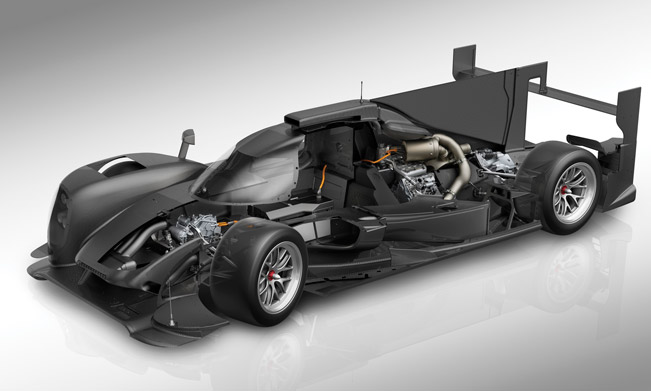
    The second generation model is a sophisticated evolution of the successful car, which we have seen rising in 2014. The new hybrid sports car will include the same innovative drivetrain concept. It comprises of a 2-liter V4 turbocharged petrol engine, working with an electric motor powering the front wheels, and two energy recovery systems.

    The powerplant revs up to 9,000 rpm and sends the power to the rear wheels. At the same time the electric motor provides force for the front wheels. The brake energy recovery and a thermal energy recovery system are included in the exhaust. This means an 8 megajoule per lap energy recovery boost function.

    The first roll-out of the new gen gar was 15th of December 15 on Weissach track. The driver behind the wheel was Marc Lieb.

    Source: Porsche 

  • 2015 Porsche 919 Hybrid is Here!

    2015 Porsche 919 Hybrid is the second generation of Porsche’s Le Mans prototype and more importantly – it is already here. By “here” I mean that it has just rolled-out at company’s test track in Weissach. The driver behind the wheel was Marc Lieb from Germany. With this introduction, the Porsche team could end the 2014 motorsport season with successful debut in the WEC as planned.

    The technical director of LMP1, Alexander Hitzinger, said that this roll-out of the race car is not only much anticipated but also a milestone achieved by the Stuttgart based company. The target of the specialists at the team developing the race car is to make the Porsche 919 Hybrid for the 2015 season right before Christmas. Mission achieved.

    In addition, he also confirmed that the car was almost optimized on every level and compared to its predecessor it has been significantly developed. The 2014 version of the vehicle features a drivetrain which consists of a single-turbo V4 2.0-liter direct-injection gasoline engine working with a front axle-mounted electric motor and a lithium-ion battery pack.

    The powerplant revs up to 9,000 rpm and sends the power to the rear wheels. At the same time the electric motor provides momentum for the front wheels. There are also a brake energy recovery and a thermal energy recovery system included in the exhaust. This means an 8 megajoule per lap energy recovery boost function.

    The first meaningful test with the new race car is scheduled to take place from January 18 to 22 in Abu Dhabi.

    Note: The photos included in the article depict the 2014 Porsche 919 Hybrid. 

    Source: Porsche 

  • What Makes Porsche 919 Hybrid Unique

    Porsche-919-Hybrid-THUMBIf you wonder what lies under the skin of the new Porsche 919 Hybrid, which is the most complex Porsche race car ever built, it is the V4 2.0 liter Turbo Engine. The car was designed and developed in-house by Porsche engineers and it is going to compete in the top LMP1 category of World Endurance Championship (WEC) and Le Mans. 919 Hybrid is entered in the ‘6-megajoule’ class. According to the rules, this means that the 500 hp+ petrol engine must consume just 4.78 litres fuel per lap. The complex hybrid drive system was created exactly to satisfy these regulations, due to its ability to recuperate the thermodynamic energy from exhaust gases.
    Optimum energy conversion efficiency is equal to the best possible ratio between supplied and used energy. This has influence every aspect of Porsche’s hybrid, its aerodynamics as well as its weight. What makes the energy efficiency a primary factor however, is the amount of fuel available per lap. In addition, hybrid system is also a pre-requisite for the factory cars starting in the LMP1-H category.

    Porsche has registered the 919 Hybrid for the 6 megajoule category, which means that the car can use exactly 1.67 kilowatt hours (kWh) of energy per 13.629 km (8 mile) long lap. In other words, with the energy the LMP1 Porsche prototype recuperates during the Le Mans race you could cover 4,576 km.

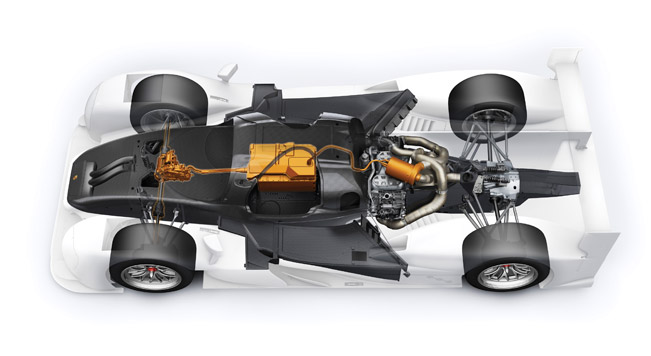
    The car also uses highly innovative recuperation of thermodynamic energy from exhaust gases. It uses extra turbine generator unit instead of the wastegate. The energy from the exhaust gases drives a generator that produces electrical energy. This means that the Porsche 919 Hybrid is the only car which uses the braking energy as well as the “acceleration” energy. Both systems convert kinetic and thermal energy into electrical, which is then used in the liquid cooled lithium ion battery.

    The approach used for the combustion engine is also unique. The V4 turbo unit with two litre engine displacement and direct injection represents the perfect combination of low weight and compact size. In addition, it also has structural rigidity and high power output – over 500 hp. Although the driving performance is the same as last year, the permissible amount of energy is 30 per cent lower.

    Source: Porsche

  • Porsche 919 Hybrid V4 2.0 liter Turbo Engine

    Porsche 919 is officially unveiled in Geneva, which means that the manufacturer is actually returning in Le Mans competition. The LMP1 car packs all latest technologies as well as extremely powerful and economical drivetrain and super lightweight chassis.

    The drivetrain consists of a newly developed single-turbo V4 2.0-liter direct-injection gasoline engine working with a front axle-mounted electric motor and a lithium-ion battery pack. The V4 engine revs up to 9,000RPM and sends the power to the rear wheels, while the electric motor provides momentum for the front ones, which means a temporary AWD.

    There are also two energy recovery systems – a brake energy recovery and a thermal energy recovery system incorporated in the exhaust system. This means an 8 MJ (megajoule) / lap energy recovery boost function. Actually, this is the maximum allowed under current LMP1 regulations.

    According to the race regulations, the Porsche 919 Hybrid must not exceed a length of 4,650 mm and a height of 1,050 mm, and vehicle width must be between 1,800 and 1,900 mm. The car’s aerodynamics have been fine-tuned in over 2,000 hours of wind tunnel testing since February 2012. Aerodynamics make an important contribution to the overall efficiency of the race car and reduce air drag while supplying the increased cooling air needed for the hybrid drive and the downforce needed for high cornering speeds. The aerodynamic design of the Porsche 919 Hybrid can be modified for different course characteristics.

    Source: Porsche