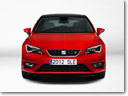
Seat has announced the 3-door Leon SC, which will make its official debut at the 2013 Geneva Motor Show in March. Without compromising everyday usability, it becomes the most sporting model in the SEAT range, blending stunning looks with a functional interior – a compelling mix of excellent workmanship and premium materials, with plenty of room for all occupants.
The 2013 Leon SC comes with a wide range of engines from 1.2-liter to 2.0 liter TSI and TDI – from 105HP (77 kW) to 180HP (132 kW). Every one combines power with cost effectiveness, with the cleanest 1.6-litre TDI emitting less than 100 g/km CO2 with an average fuel consumption of 74.3 mpg. The top of range 1.8TSI boats 180HP and 250Nm of torque.
Depending on the engine variant, power transmission is handled by a manual five- or six-speed gearbox, or by the compact and lightweight DSG dual-clutch automatic. It changes its six or seven gears at astonishing speeds and is exceptionally efficient. A freewheeling function is integrated into some versions to reduce fuel consumption even further.
Just like the five-door Leon, the Leon SC is offered in S, SE and FR specifications in the UK.
The Leon line-up will be boosted later this year by the ST Estate model.
SEAT has announced the full price list for the all-new five-door 2013 Leon. The car starts from £15,670 RRP OTR for the entry level. It will hit the UK market from 1 October 2012 and the first deliveries will be in March 2013.
“The new Leon requires no compromise for the customer. For the first time ever, the Leon range will expand to include a three-door and sports tourer versions. They will expand the Leon’s appeal as well as its reach within the segment.”, commented SEAT S.A. President James Muir.
The new Leon arrives during the busiest period of new product activity in the company’s history. SEAT’s recent product offensive has seen the introduction of its new city car, the Mii, as well as an extensively refreshed Ibiza and the launch of the fourth generation Toledo hatchback.
And while the updated range will provide a platform for sales growth, James Muir underlined that the future success of SEAT will also be built on product expansion: “Coupled with our strategy of market expansion, which saw SEAT launch in China earlier this year, SEAT’s future success will be built on new products, in more segments, in more markets,” he said.
Three trim levels will be available from launch: S, SE and FR.
In addition to the standard S specification, SE trim adds luxuries such as ambient interior spot lighting, a leather wrapped steering wheel and gear knob, chrome dashboard detailing, front fog lights w/cornering, cruise control, 16-inch alloy wheels, SEAT’s XDS electronic differential lock system, and hill hold control.
SEAT’s iconic FR badge will adorn range topping versions from launch, adding a host of visually striking and performance-enhancing kit. Only the most powerful engines in the Leon line-up will sit under the bonnet of FR cars, whose standard equipment roster includes 17-inch alloy wheels, redesigned front and rear bumpers, twin chrome exhaust pipes, dark tinted windows, front sports seats, a flat-bottomed leather steering wheel, dual-zone climate control, LED tail lights, sports suspension and SEAT Drive Profile.
The engine range includes 1.6 TDI 105 PS with Ecomotive Technology returns 74.3 mpg and 99 g/km*, while even the most powerful version at launch, the 2.0 TDI 184 PS FR, boasts a startling average consumption figure of 65.7 mpg, with 112 g/km CO2* – and that’s despite having more torque than a Porsche Cayman R, helping it to complete the 0-62 mph benchmark in a rapid 7.5 seconds.
Available with five- and six-speed manual gearboxes, as well as the highly efficient and quick-shifting 7-speed DSG twin-clutch automatic, no Leon from launch will exceed 140g/km* CO2emissions. In fact, every engine bar the high-performance 1.8 TSI 180 PS puts out less than 120g/km*.
2013 Seat Leon is in fact the third generation of brand’s range icon, which was revealed to the general public this summer. The model was developed on the Volkswagen Group’s new MQB platform.
However, the new Leon was designed and developed by Seat engineers. As an important part of the comprehensive development process, the new Leon was taken to the extremes of the Arctic Circle, as well as the heat of the Spanish desert to test the limits of the car. The brand just revealed a footage showing this grand test.
At theses extreme conditions, the engineers tested everything from the fit and finish of the car’s interior on extreme surfaces, to the engine’s resistance to dust. And this video definitely shows why Seat is famous with its benchmark engineering. Take a look!
2013 Seat Leon has just been introduced officially, combining beauty and practicality. The Seat vehicle was entirely redesigned, packed with high-end technology, having a new chassis, advanced infotainment systems and sophisticated driving aids.
In addition the new Seat Leon comes equipped with new full-LED headlamps, which are made in striking design and have exceptional illumination. Full-LED lights are available for the first time in the compact class.
What is more the new Leon is more practical now. Although the exterior is more compact, the interior offers more spaciousness. At 4.26 metres long, the new Leon is around five centimetres shorter than its predecessor. However the wheelbase is up by almost six centimetres.
2013 Seat Leon
The rear end of the new SEAT Leon has redesigned as well. You can see the large logo, which now serves as an opener for the rear hatch.
On the other hand the interior has a clear and uncluttered look, which adds even more elegance to the vehicle. The dashboard is unconventional and elegant, with a two-tone design that makes. A lot of attention has been put on the details: for instance, the large air vents, the controls for the air conditioning and the three-dimensional form of the trim elements. The luggage compartment now has bigger volume of 380 litres.
In addition, the new Seat model has a longer wheelbase because of the new architectured implemented. This contributes also to a more balanced distribution of axle load – factors that bring about more comfort and sporty handling.
httpv://youtu.be/_SI7oK4fNso
More importantly, the car is powered by a series of fuel-efficient TDI and TSI engines, ranging from 1.2- to 2.0 litres. All engines include direct injection and turbocharging, and have been engineered for low internal friction and fast warm-up.
The 1.6 TDI generates 104 hp (76 kW) and 250 Nm (184 lb.ft) of torque. In the Ecomotive version with start/stop system and brake energy recuperation, it returns an astonishing 74.3 mpg on average, equating to just 99 g/km CO2.
The 2.0 TDI has the impressive 70.6 mpg in the Ecomotive version, however it still generates 150 hp (110 kW) and 320 Nm (236 lb.ft) of torque.
In the early 2013, Seat will launch the 1.2 TSI engine in two versions with 86 hp (63 kW) and 105 hp (77 kW); a 1.4 TSI with 122 hp (90 kW); and at the top of the petrol range, a 1.8 TSI with 180 hp (132 kW) and a combination of direct and manifold injection.
The diesel line-up will be enhanced by the 1.6 TDI with 90 hp (66 kW) and the powerful, range-topping 2.0 TDI with 184 hp (135 kW), which delivers a maximum torque of 380 Nm (280 lb.ft).
In the new Leon, the customers will find up-to-date infotainment solutions. Seat has included the Easy Connect operating system, which controls the Sound System entertainment and communication functions via a touch-sensitive screen in the cockpit.
The new Leon also features driver assistance systems such as the drowsiness detection feature, an advanced camera mounted behind the rear-view mirror, Full Beam Assistant, Heading Control lane-keeping assistant.
The refreshed badge of the company will be included in this model, which makes it the first one to carry it. It can be seen on the grille, rear and steering wheel of the car. The logo is now with cleaner design and now represents the precision and elegance of the brand’s design language, while also reflecting the company’s engineering and quality leadership.


 2013 Seat Leon is in fact the
 2013 Seat Leon has just been introduced officially, combining beauty and practicality. The
