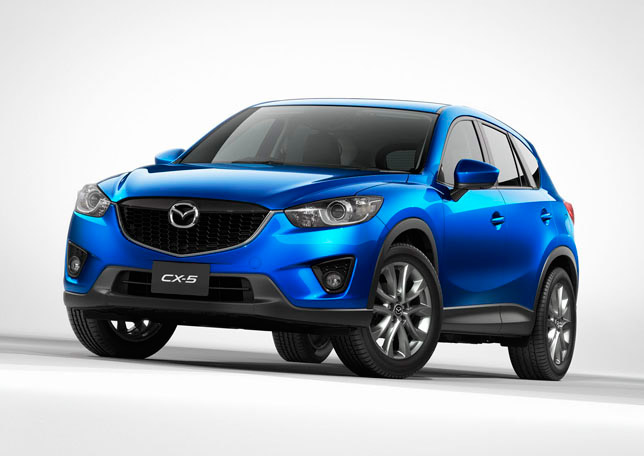
Tag: 2013 Mazda CX-5 SUV

  • 2013 Mazda CX-5 with high-tech safety features

    mazda-cx5-THUMB2013 Mazda CX-5 is the all new production vehicle offered by Mazda Motor Corporation.  The compact crossover SUV will arrive this spring in dealerships and moreover will be equipped with a range of breakthrough technologies. The SUC was designed to appeal to the corporate sector and some of the technologies included in it for the first time. Such are safety features as Smart City Brake Support, state-of-the-art passive safety structures, lightweight yet highly-rigid SKYACTIV-Body and various impact-absorbing structural innovations.

    First, the Smart City Brake Support (SCBS) helps the driver to avoid or minimise the impact of a frontal collision when driving at low speeds, for instance when in traffic. The technology is standard across the Mazda CX-5 range. In particular it uses a laser sensor mounted at the top of the windscreen to detect a vehicle or obstacle in front. And in case the driver fails to slow their vehicle appropriately, the SCBS automatically activates the brakes and reduces the engine output at the same time. Thus, the system helps avoiding collision or mitigating the damage from rear-end collisions at low speeds.

    Secondly, Mazda’s SKYACTIV technology is featured for the first time on the vehicle. In fact, it is the first sixth generation model, and promises major total cost of ownership due to major fuel savings and low emissions.

    Next, Mazda has developed a straighter and more continuous frame and an extremely efficient multi-load path structure for the SKYACTIV-Body of the vehicle in the event of a crash. The structure efficiently absorbs the load at the time of a crash by dispersing it in multiple directions.

    2013 Mazda CX-5
    2013 Mazda CX-5

    Additionally, there are other standard safety equipment highlights on the new 2013 Mazda CX-5, which include front and rear parking sensors, Dynamic Stability Control with Traction Control System, Hill Hold Assist, Tyre Pressure Monitoring System, dual front and front side airbags and front and rear curtain airbags; driver, passenger and rear-seat audible seatbelt reminder warning and a reversing camera. Furthermore, there are also some optional safety features (CX-5 Safety Pack) such as: Rear Vehicle Monitoring via a door mirror-mounted warning light and audible alert; lane departure warning via an audible warning, which uses a camera on the windscreen to monitor the position of the white lane markings at speeds of 40mph and higher, and if the system detects a risk of an unintentional lane change, it warns the driver with a sound through the speakers originating from the applicable side of the vehicl; and High Beam Control System (HBCS), which automatically switches between low and high beams to ensure good night visibility for everyone.

    The starting price of 2012 Mazda CX-5 is £21 395. The customers can choose between four equipment levels – SE-L, SE-L Nav, Sport and Sport Nav with manual and automatic options – a SKYACTIV-G 2.0-litre 165ps (121 kW) 2-wheel drive (2WD) petrol engine and SKYACYTIV-D 2.2-litre 150ps (110 kW) and 2.2-litre 175ps (129 kW) diesel engines with two and all-wheel drive choices.

    Source: Mazda

  • 2013 Mazda CX-5 featuring SKYACTIV TECHNOLOGY offers environmentally friendly fun

    Mazda CX-5 SUV Thumb2013 Mazda CX-5

    The brand-new generation and one of the most efficient Mazda ever is the all-new 2013 Mazda CX-5, which will hit the growing European compact crossover SUV market in the spring this year. What is ore important here is that the new CX-5 model will feature the ground braking SKYACTIV TECHNOLOGY. The latter is Mazda’s innovative new line-up of engines, transmissions, chassis and bodies. It is especially developed for cars which are affordable, fun yet economical to drive, and environmentally friendly. The figures are more than impressive: at 4.6 l/100 km and 119 g/km, the CX-5 with SKYACTIV-D diesel engine has combined cycle fuel economy and CO2 emissions. This makes it one of the best in its segment not only in Europe, but also all around the world.

    The key design behind the innovative SKYACTIV technology is the internal combustion. And namely this technology is going to be the predominant engine technology for the next decade, with industry coverage of at least 80%. Mazda made a great step into improving the basics of internal combustion power, coming up with a range of unique innovations. The idea is to progressively supplement this enhanced basis – SKYACTIV petrol and diesel engines – with advanced technology. From the i-stop idle-stop system and regenerative braking to hybrid systems and more, their efficiency will continually enhance. This strategy stands under the name “Sustainable Zoom-Zoom”, and it goes beyond optimizing internal combustion. What is more here is that the Sustainable Zoom-Zoom is also about lightweight designs. Here Mazda’s goal is to make each new model generation 100 kg lighter than its predecessor. The ultimate goal for 2015 is to improve the average fuel efficiency of its global model line-up by 30% relative to 2008 levels.

    New Mazda CX-5 diesel CO2 emissions and fuel consumption:

    Model FWD 150 PS 6MT FWD 150 PS 6AT AWD 150 PS 6MT AWD 150 PS 6AT AWD 175 PS 6MT AWD 175 PS 6AT
    Average fuel consumption (l/100 km) 4.6 5.3 5.2 5.5 5.2 5.5
    CO2 (g/km) 119 139 136 144 136 144

    Source: Mazda

  • Mazda CX-5 SUV with world’s lightest bumpers

    Mazda CX-5 SUV ThumbWorld’s lightest bumpers are going to be used in the design of the all-new Mazda CX-5 SUV. Mazda Motor Corporation in collaboration with Japan Polypropylene Corporation has developed, resin material for vehicle parts that maintains the same rigidity as parts made with conventional materials while achieving significant weight reduction.

    Thank to this material, the manufactured parts are now thinner. The effect of this results in significant reduction in the resin, which is required to manufacture parts. In addition, when the material is used for both front and rear bumpers, it contributes to weight reduction of approximately 20%. Hence, the bumper has reduced thickness which allows a shorter cooling period for molding. Furthermore, by using computer-aided engineering (CAE) technology, the fluidity of the resin material has also been optimized. The result of this is that the bumper molding time, previously 60 seconds, has been halved to 30 seconds, leading to major reductions in the amount of energy consumed in the production process.

    Further to be mentioned is that Mazda plans to adopt the lightest bumpers in the class using this resin material. The company is going to feature it in the all-new Mazda CX-5 SUV which is going to go on sale this spring. Other models are considered for such modification too. In details, the bumpers are positioned at the very front and rear end of a vehicle. More importantly, their weight has a major impact on fuel economy and driving performance. On the other hand, bumpers are multi-functional, requiring both rigidity to absorb impact, and molding and painting properties suitable for great exterior design.

    The constituents of resin are two components found in polypropylene and rubber. They have different properties, and are successfully included in the double-layer structure in line with the required function for the surface and the inside of the base bumper material. As a result, the surface has excellent paint film adhesion and the inner section retains high rigidity and impact absorption, with actually reduced thickness. Mazda Motor Corporation will remains committed to the aim of reducing vehicle’s weight and improving dynamic performance.

    Mazda CX-5 SUV
    Mazda CX-5 SUV

    Source: Mazda