Ford has announced the pricing of the new 2013 Ford Fusion, which is a very good choice, if you are searching for a midsize saloon.
The engines are very fuel-efficient (from 22 mpg in city to 34 mpg on highway). The car also boasts sharp handling, good ride and very low noise in the cabin. Other highlights include advanced technology and a lot of safety systems.
The exterior is really eye-catching compared to other vehicles in the same segment.
There are three trim levels available – S, SE and Titanium. The 2013 Ford Fusion S is priced from $21,900 and includes SAT NAV system, Bluetooth, iPod input, front/side and curtain airbags, stability control and traction control. The SE trim level is priced from $23,855 and the top-of-range Titanium starts at $30,500.
2013 Ford NASCAR Fusion was enhanced thanks to the CFD. And if you wonder what this abbreviation means – it stands for Computational Fluid Dynamics. In fact, this was the key tool of the development of the new NASCAR Fusion.
To go further into details, the Computational Fluid Dynamics is an engineering tool used by many industries in the world. With it they look at the aerodynamics of the vehicle on the computer, in order to make better, more efficient cars.
The brand new racing car was created in relatively short time – only for 18 months. This was the reason, a method such as CDF to become an integral part to the process. Furthermore, nowadays the engineers are not allowed to test the cars any track race, hence computer-aided and engineering tools like this are becoming more and more valuable.
Another advantage, next to being able to make a series of changes in a short period of time, is the ability of CDF to show the aerodynamic strengths and weaknesses of the vehicle from a variety of perspectives.
With this technology, the engineers can see the flow of air over the car, as well as the pressures on the surfaces. Here’s a video where professionals from Ford discuss the process of utilization of this technology.
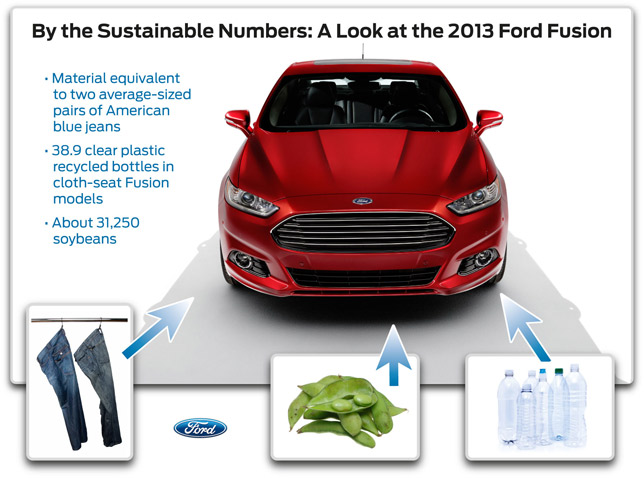
Ford seem to be aware that the latest fad is to go organic. The shops are brimming with lettuce which has been (so they tell us) grown out in the open, natural fertilizers, no pesticides no GMO no nothing. Indeed, very healthy and sustainable. But consider a 2013 Ford Fusion now and try to draw a parallel. Some of the materials used in it, Ford people say, are completely organic, recyclable and downright green.
“Building vehicles with great fuel economy is our highest priority in reducing impact on the environment,” says Carrie Majeske, Ford product sustainability manager. “With every new product design, we also are charged with increasing the use of renewable and recyclable materials in our cars, utilities and trucks to reduce impact on the environment.”
Issues like noise and vibrations have been tackled with something very common in real life and yet it sounds out of place – denim. That’s right, more than two pairs of jeans have given it’s life for the sake of comfort and convenience. Inside, the upholstery is made with pure Repreve yarn which is woven from both post-industrial and post-consumer waste products. The models that will carry such kind of cloth on theirs seats would contain an equivalent of 38.9 recycled, clear 16-ounce plastic bottles. Supposedly, the material is strong as well.
The soft bits within the seats have been garnished with soybeans. Soy foam to be exact. A single Fusion requires approximately 31,250 which sounds a lot but remember; it’s sustainable. It’s not that uncommon actually. The technology was first introduced in 2007 and Ford have been making cars with soy ever since.
Various, not-that-important bits are protected from plastics. Plastics of former car batteries so it’s cheap to replace as well.
“We are holistic in reducing our environmental footprint by utilizing post-industrial (blue jeans), post-consumer (battery cases) and sustainable materials technologies (soy foam),” Majeske says. “We do whatever makes the most sense for each application and environmentally from a lifecycle perspective.“
Ford is going back in NASCAR with the 2013 Ford Fusion Sprint Cup car, which was unveiled as part of the Charlotte Motor Speedway Media Tour. It is specially created by Ford designers in an effort to bring brand identity back to the sport.
Featuring a completely redesigned sleek new silhouette and fresh face, the 2013 Fusion Sprint Cup car was designed to be the face of a new era of stock car racing.
”We wanted Fusion to be the car that helped return ‘stock car’ to NASCAR.” said Jamie Allison, director, Ford Racing.
“I think fans, when they see the car, are just going to smile and cheer. It is going to reengage them with the sport and make the sport better because there is just something natural about seeing race cars that look like cars in their driveways.”, he added.
Ford Design Center staff, led by Garen Nicoghosian, and Ford aerodynamicist Bernie Marcus, spent the past year doing the early design development, freeing up the Ford race teams to concentrate on weekly NASCAR competition.
The new NASCAR Fusion entries will be tested throughout the 2012 campaign in preparation for their racing debut at the 2013 Daytona 500 in February.
The NAIAS in Detroit is now a fact of life. Ford are also aware of this and are there to delight us with a next-generation Ford Fusion (that would be the Mondeo for Europeans later this year). Keeping pace with Ford’s innovative spirit, the Fusion boasts an array of efficient gasoline and hybrid drivetrains, an audacious design and cleverness.
It is no secret that currently Ford is grappling with other car makers for the lead position in global markets when it comes to economic vehicles and the Fusion is the latest example of that. Engine lineup consists of two EcoBoost™ four-cylinder power plants: a 1.6 with a best-in-class, non-hybrid economy returning 26 mpg urban and 37 mpg on the highway. For those that desire a bit more grunt there’s the EcoBoost l4 2.0 mated to a CVT automatic transmission that can send power trough 19 inch alloys and a dynamic all-wheel-drive which can shift torque distribution towards the back end.
The Hybrid division lures economy minded customers with the Fusion Hybrid – a 2.0 liter Atkinson-cycle engine which is not as big as the previous 2.5 one, but performance hasn’t been lost say Ford. In fact, instead of nickel-metal hydride batteries, lithium-ion ones are now used which in turn saves weight and produces more power. The end result is a speed up to 62 mph on electricity alone. The Fusion Energi Plug-in Hybrid however, is the ultimate in efficiency terms with a stunning figure of up to 100 mpg – more efficient than the Volt or Prius. Just like the other big players, Ford is now making use of a stop/start system in its vehicles which really does miracles to fuel-efficiency.
Ford Fusion (2013)
On the outside, the Fusion is not unrecognizable but some visual tweaks do leave an impression: sleeker and smother lines eliminate the “three box design” feel that is commonly present in other mid-sized saloons. The front grille has shrunken and so have the headlights. The wheelbase is longer and the overall height has increased while width is down by 35 mm.
Technological innovation manifests itself within the new multi-link rear suspension, the aerodynamic guards underneath the car which keep the noise down as well. There is also a multitude of handy gizmos that assist newbie drivers and such in every possible aspect – Being vigilant about road lanes will be a thing of the past because of the Fusion’s lane-keeping system which monitors the road ahead and alerts if the car is drifting too close to the lanes and it will even dare to adjust the steering wheel by itself if the driver fails to response. That same system also monitors the traffic ahead and keeps the car at distance from the others. Active park assist quite literally takes parking in its own hands by identifying a suitable parallel parking space, taking measures and doing the steering for you. The BLIS system uses sensors on the rear fenders that can scan otherwise blind spots to drivers and thus prevent a lane-changing disaster.
Inside the cabin distraction is brought down to a minimum with systems like SYNC and MyTouch that allow interaction with the multimedia and control system from a distance (e.x. voice activation). The dashboard has retracted nearer to the windscreen and the seats are thinner so that it is even more roomier than the predecessors.



 Ford is going back in NASCAR with the 2013 Ford Fusion Sprint Cup car, which was unveiled as part of the Charlotte Motor Speedway Media Tour. It is specially created by Ford designers in an effort to bring brand identity back to the sport.

 The NAIAS in Detroit is now a fact of life. Ford are also aware of this and are there to delight us with a next-generation Ford Fusion (that would be the Mondeo for Europeans later this year). Keeping pace with Ford’s innovative spirit, the Fusion boasts an array of efficient gasoline and hybrid drivetrains, an audacious design and cleverness.


