Although Volkswagen, after its original name, builds cars for the people, i.e. rather simple and above all affordable cars, this is not always the case these days. After the attempt to place a luxury sedan on the market with the Phaeton more or less failed and has now been terminated, apart from the Touareg, the most luxurious model in the Wolfsburg-based range is currently the Arteon.
A copy of the four-door coupé has now been equipped with a set of high-quality wheels from Cor.Speed Sports Wheels. The specialists from JM Car Design from Bergheim near Cologne, who act as the Cor.Speed dealer base, were responsible for the conversion. The choice fell on the powerfully drawn DeVille rims in the dimensions 9×21 inches, which are covered with 225/30 tires. With their gunmetal matt finish, they perfectly match the silver-gray paintwork of the VW. The wheel could be mounted without any adjustments to the body – despite the additional KW Variant 3 coilover kit that was installed, which lowered it by 45 millimeters at the front and 40 millimeters at the rear, thus ensuring an even more harmonious appearance.
A true mid-engine classic from Great Britain, which has been manufactured over a truly long period of 28 years and continuously developed during this time, is the Lotus Esprit with up to 354 hp. The team from JM Car design from Bergheim near Cologne, in cooperation with JMS Fahrzeugteile, has given a copy of this unforgettable sports car a refinement in the form of a new wheelset.
This presents itself absolutely stylish and contemporary: It is a three-part Kerscher CS rims in a filigree Y-spoke design with silver stars and polished and stepped outer beds. The dimensions are 8×17 inches at the front and an impressive 10×18 inches at the rear, which means that the wheel arches are really perfectly filled. The mounted tires measure 225/25ZR17 and 285/35ZR18.
The implementation of the conversion, which, thanks to a special registration with JM Car design, is of course duly approved for road use, was quite demanding: The rims are specially tailored for this use, for which the brake contour and the available space in the wheel arches were measured in advance.
This Mini One R50 undeniably could win innumerable cups thank to its unique design. The latter is made by the talented creatives from JM Cardesign. The company from Bergheim is responsible for turning the mini from a serial car to a motorsport look show car. Moreover it has huge range of modifications and detail improvements!
First of all in the fascia of the MINI JM Cardesign integrated with the characteristic air inlet motor hood (which is usual for its big compressor brother Cooper S and its side indicator lights, including the red “S”). Furthermore a very special upgrade was made on the doors: with the LSD hinges installed by JM Cardesign, they now open upwards. In addition the company included as wee racing style side sills which are located below. Above the tail windscreen, there is a carbon tail wing of the series spear tip “John Cooper Works”. And as you can see, the car looks very similarly to a racing car form the mini cup. This effect is due to the many decals which were applied to the body.
Unfortunately, if you expect that with this car you can participate in racing competitions, well – you will be disappointed. This car is a show vehicle rather than a racing one. This means that the 1.6 litre four-cylinder motor was not changed, and still has an output of 90 HP (66 kW). However with its special exhaust system from the cat, the small motor will pretend successfully that it had at least twice its actual output.
2011 JM CarDesign Mini One R50
Another detail which probably reminds you for the racetrack is the white-painted CR Kai light metal wheel rims from Work Wheels. The Bergheim tuner combined the 7.5×18-inch racing look one-part wheel rims with Dunlop rubbers in 215/35ZR18. And if you wonder whether there’s something improved behind the wheels, this time you will be content to hear that there are perforated Brembo braking discs that look decorative while also enhancing the deceleration performance. And the perfect road adhesion of the mini, was achieved by installing an H&R threaded chassis. Between the two front strut towers, a red Wiechers bar was installed to improve stiffness.
The interior of the One is also made in racing style. For instance there are two Recaro pole position shell seats, which are placed in the white Wiechers roll cage, securing passengers with 3.5 inch wide Schroth-4-point belts. To match the car body great parts of the dashboard cover were painted in the car’s colour and decorated with decals. In the current modification of the MINI the back seat was removed, and an original mini cup racing tank is placed behind the back of the roll cage. In addition, the mini was given a basic multimedia system in the form of a Clarion-Head unit with Flip-Monitor and connected reversing camera.
It is a regularly recurring process: if a car manufacturer presents a new model, its predecessor generation often seems outdated and old-fashioned all of a sudden, even though there was no reason for complaint previously. This happens at a time when the model usually has already gone through more or less intense model care. Although this kind of “spontaneous aging” is rather below average for the first-generation-BMW Z4, JM Cardesign from Bergheim performed a very special kind of face-lifting on the E85-Roadster presented here. The tuner fitted the “old” Z4 with the front pieces of the new E89 model. The front bumper and grille were modified in extensive handiwork to match the headlights, mudguards and bonnet of the E85. The result is very harmonious: even MBMW enthusiasts will take a moment to entirely identify the cross-generation transformation. JM Car Design also applied some classic craftsmanship in the area of the rear wheel runs.
JM CarDesign BMW Z4 E85
The sheet was extended by about 30 millimetres on each side, and the wheel running edge was then re-built in the “original” look. Of course, this widening also required adjustment of the rear apron and side sills to the new situation. The latter also had ventilation openings integrated that facilitate the cooling air flow to the rear brake system (in connection with the corresponding ducts). Before the vehicle was re-painted from silver to solid black in the in-house paint shop, JM Cardesign made the antenna, which is usually located on the rear left mudguard, vanish. It is now invisibly placed in the rear bumper. The door handles, side mirrors and side indicator lights in a BMW logo shape at the doors were also equipped with coming-home-lighting LEDs by JM Cardesign.
The car is lowered by a 3-thread chassis version KW, adjustable in several parameters (height, pressure and tensile dampening), which also provides for fresh driving dynamics. The three-part screwed Work VS XX-light-metal wheel rims with their stars in matte “Gunmetal” are also put in the best light this way; at the front, the 9×20 inches ET32 size is used – at the rear even a full 11×20 inches ET32. The fine wheels were equipped with Dunlop Sport Maxx high-performance tyres in 245/30R20 and 285/25R20 respectively. The long front end of the vehicle is given added stiffness by the Wiechers dome rod installed under the bonnet. The Eisenmann end muffler with its 76 millimetre double-end tube emphasises the deep six-cylinder sound of the Z4 3.0i audibly. JM Cardesign took action in the interior as well. Various interior parts like the dashboard cover, entrance bars, steering wheel spokes and the gear knob were painted the same colour as the car.


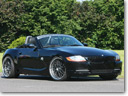 It is a regularly recurring process: if a car manufacturer presents a new model, its predecessor generation often seems outdated and old-fashioned all of a sudden, even though there was no reason for complaint previously. This happens at a time when the model usually has already gone through more or less intense model care. Although this kind of “spontaneous aging” is rather below average for the first-generation-BMW Z4, JM Cardesign from Bergheim performed a very special kind of face-lifting on the E85-Roadster presented here. The tuner fitted the “old” Z4 with the front pieces of the new E89 model. The front bumper and grille were modified in extensive handiwork to match the headlights, mudguards and bonnet of the E85. The result is very harmonious: even MBMW enthusiasts will take a moment to entirely identify the cross-generation transformation. JM Car Design also applied some classic craftsmanship in the area of the rear wheel runs.


