Here’s a Kahn Rolls Royce Ghost modified in ways you would least expect it to be. Yes, this particular one is all dressed up in a shadow line finish and riddled with subtle styling features that make a difference. But the most substantial change is underneath. And sadly, I’m not talking about the engine.
Let’s start from the top. The side indicators are now clear, the headlights have surrounds, the tail ones as well, the windows also…apparently and there’s some underfloor lighting. Four 9.5 x 22-inch Kahn Silver Mist Rolls Royce wheels complement the overall Kahn look. One still gets Rolls Royce’s original emblazoned center cap however. All and all, not ground braking work this, but enough to give the Ghost some character so that it fits the Kahn philosophy about not submitting to uniformity and striving for perfection.
The thing about this Rolls Royce is that it offers a great deal more security than the standard one. Although one can only guess by the appearance, all the glassware is bullet resistant. It’s an optional extra that comes with armor reinforced body shell underneath. We are not sure if that takes a toll on the Ghost’s 6.6L twin-turbocharged V12, 563 bhp engine and even if it does, a few extra kilos won’t maim it, right? In fact, at Kahn claim that the technology used in making all the bullet proof glasses results in an overall lighter construction. That’s a bold statement.
What goes inside the Ghost is up to the customer. For example, instead of reclining separate seats at the back, one can have a single sofa bench which greatly improves the interior atmosphere. When it comes to color – whatever fits best.
Peugeot UK now offers their EV – iOn with lower OTR price of just £21 216 after the Government’s £5,000 Plug-in Car Grant.
The EV range will be boosted additionally by other all-electric models along with the recently introduced world’s first diesel-electric HYbrid4. The manufacturer displays its commitment to addressing the environmental challenges facing carmakers, communities, businesses and private car owners.
Peugeot has also introduced a lot of technological solutions and services, adapted to an array of customer needs and designed to drive powerful breakthroughs in fuel efficiency and CO2 emissions.
These include the introduction of Stop & Start Systems, diesel-electric hybrids and zero-emission vehicles, enabling Peugeot to increase its leadership in the European low-carbon vehicle segment and extend its expertise to other markets.
The Peugeot iOn has also been included in the development of existing mobility solutions like ‘Mu by Peugeot’, a personalised mobility service, based on a new vision of mobility.
“2011 marked a return of EVs for Peugeot in the UK. We want to continue to develop our EV strategy as the technology becomes more accepted by consumers and the charging infrastructure continues to develop. Peugeot has been at the forefront of the EV market with iOn and this latest development is a key part in our low CO2 strategy.”, commented Phil Robson, Peugeot UK’s Fleet and Used Car Director.
2012 Mazda3 has achieved amazing result on the latest EcoTest from the German Automobile Club (ADAC). What they determined is that the 2012 Mazda3 1.6-litre petrol with 77 kW/105 PS was the only car of the eight tested models which used less fuel than the official average published by the manufacturer. In addition, what amazed the professionals was the fact that instead of an average fuel-consumption of 6.4 litres (the official numbers given by Mazda), Mazda3 1.6-litre showed on the stricter EcoTest just 6.3 litres per 100/km. Moreover, all other models that were tested, including vehicles with petrol, diesel and electric powertrains, were times above their officially published average for fuel consumption. Germany’s ADAC EcoTest measures fuel consumption, CO2 and toxic emissions using new and stricter criteria. And theses criteria now include NEFC measurements, test using the world cycle or WLTP, and the Autobahn driving cycle test from ADAC itself. In particular, the latter one features driving at highway speeds of 130 km/h and full-throttle acceleration. Additionally, all three cycles were measured with low-beam headlights on, and on the world and gighway test with the air conditioning on.
Two concept vehicles, both in green paint will shine in the range line among Chevrolet models. Chevrolet aims with these concept performance cars to make any enthusiast green with envy. Of course, don not take this literally. The firs concept vehicle is the outstanding Chevrolet Camaro Hot Wheels Concept, which you already might be familiar of. The car in fact can fulfill every child’s wish, who has ever played with the little model. The news here is that the Chevrolet Camaro Hot Wheels Concept will return next month to the New York International Auto Show, after its successful debut last autumn at Specialty Equipment Market Association (SEMA) Show. The vehicle was inspired by the “Custom Camaro” – the dazzling green Spectraflame® 1:64-scale toy that was one of the original 16 Hot Wheels cars released back in 1968. This beautiful green paint finish was achieved using a meticulous, several-step process which included applying a liquid-metal solution and several layers of green tint.
Chevrolet Camaro Hot Wheels Concept
Next to be paid attention to is the 2013 Chevrolet Spark, which was designed to challenge preconceived notions of how an affordable mini car can look. And it definitely does this very well! More importantly, the “Spark” will begin shining in dealerships this Sumer and in addition will feature a attention-grabbing exterior finishes including Jalapeno, Salsa, Denim, Lemonade and Techno Pink. In particular, this Chevrolet is a four-passenger, five-door hatch, and it was designed to appeal to first-time buyers and city dwellers with its bold styling, affordability, 10 standard air bags, fuel efficiency and maneuverability.
Ford just announced today that the launch of the new dynamic 2012 Ford Tourneo Custom will be later this year. The concept vehicle of the model already won lot of hearts at this years Geneva Motor Show. In particular, the production vehicle of the model will be unveiled at the 2012 Birmingham Commercial Vehicle Show in April. And what we are to see then. Well, the new Tourneo has new levels of style and function which are visible at first sight because of its new dramatic appearance, car-like interior design and driving dynamics. In addition, the smart technologies and outstanding fuel economy makes the Ford Tourneo Custom even more appealing.
First of all, what we can see is that the model has an improved streamlined profile based on the “Kinetic” design approach, which includes a sportier stance, bold rising shoulder line, flush glazing, distinctive trapezoidal grille and prominent wheel lips. In addition, the vehicle is available in eight or nine seat configurations, and is offered in two variants: a short wheelbase (4.97 metres) and long wheelbase (5.34 metres). The additional length of the long wheelbase is perfect when one has to put some extra luggage. At a height of less than two metres, the Tourneo Custom also comfortably complies with most car park height limits.
The interior of the Tourneo Custom has car-like style and sophistication and is made of course from high quality materials. The stylish, sculpted driver-focussed instrument panel includes technologies closely-related to those found in the Ford car range. The cabin is further enhanced by a highly adjustable driving position with the steering column. In addition, the rear seats are a completely new design that can be easily folded into multiple configurations and removed in segments or completely. What is more important here is that the rear passengers will undoubtedly enjoy a spacious environment and comfortable, fully-trimmed cabin.
2012 Ford Tourneo Custom
Furthermore, the Ford features some importantSmart vehicle technologies: ECOnetic Technologies – Ford’s advanced low-CO2 features including standard Auto-Start-Stop and Smart Regenerative Charging on all Stage V emission vehicles; SYNC voice-activated, in-car connectivity system – enables mobile phones and music players to be connected to the vehicle, and operated by voice control; Emergency Assistance – enabled by SYNC, this award-winning new feature is designed to assist occupants to contact the Emergency Services in the event of an accident, providing vehicle location information; Advanced restraint system– includes driver, passenger, side and curtain airbags; Rear-view camera – integrated into the rear view mirror; Lane Keeping Alert and Driver Alert – latest driver assistance features alert the driver if the system detects the vehicle is inadvertently drifting out of the lane, or the driver is becoming tired behind the wheel.
At last but not least is to be mentioned the exceptional fuel economy which the T Tourneo has. Here, the powertrain is an advanced version of Ford’s 2.2-litre Duratorq TDCi diesel engine, which is offered with three power ratings: 100 PS (74 kW), 125 PS (92 kW) and 155 PS (114 kW). To the engine is mated a six-speed manual transmission with a standard Auto-Start-Stop. Thus, the Tourneo Custom delivers combined fuel consumption of 6.9 l/100 km and 182 g/km CO2 emissions. Moerover, the vehicle is based on a new Ford global platform, engineered to deliver agile and responsive handling for car-like dynamics, enhanced ride comfort and reduced noise-levels. What it basically offers is excellent functionality, durability and low cost of ownership.
Schmidt Revolution introduced their tuning program for Audi RS6 (C6).
The powerful touring car comes with astonishing 5.0 liter twin-turbocharged V10 with 580PS (426 kW) and 650Nm (479 lb-ft) of torque. 0-100 km/h in 4.6 seconds, 0-200 km/h in 12.7 s and a top speed of 250 km/h (155 mph) – electronically limited.
However, the tuning specialists from Schmidt Revolution consider these times slow, so they bumped the engine up to whopping 700PS (515 kW) and 790Nm (583 lb-ft), which is an increase of 120PS and 140Nm. The acceleration is not mentioned although it will be a lot faster, especially the 0-200 km/h, but the top speed is approximately 330 km/h (205 mph).
The upgrades don’t stop here and the tuned RS6 also boasts a set of new 10J x 22” CC LINE light alloy wheels with polished external bed. They are wrapped in 265/30 ZR22 tires all around.
Renault has released a teaser image in Facebook of their 2013 Talisman model. The car will make it official debut at the 2013 Beijing Motor Show. Still, we can’t see much of the car and probably it will share a lot of features from the Samsung SM7.
The luxurious four-door coupe will come with a lot of extras and some efficient engines from a new generation including a 2.5 liter V6 with 190PS (140 kW) and 243Nm (179 lb-ft) and a mighty 3.5 liter V6 with 258PS (190 kW) and 330Nm (243 lb-ft) of torque.
So, the 2013 Talisman is expected to be the new “Safrane” and if it has a connection with SM7, it will have the same platform as the Nissan Teana.
However, Renault does not have huge success in China, so the manufacturer will try to change that with this new premium model.
Stay tuned for more information and pictures about 2013 Renault Talisman.
Ever wondered how WRC cars manage to deliver 300 bhp and above from an engine that, by rule, cannot exceed 2.0 liters of displacement? How on earth do the heavy, low-revving diesel engines in cars today stay competitive? Or what is it that makes it possible for the Bugatti Veyron to break the 1000 bhp threshold? Well, it certainly isn’t witchcraft. By means of “forced induction”, turbochargers today boost the automotive industry to a new direction of smaller, more-efficient and bloody good fun engines.
Volkswagen like to brand their most successful turbo diesel range as TDI while Porsche, being more plain about it, call their turbocharged cars, Porsche (insert model here) Turbo. BMW, on the other hand, would never hesitate to utter their own terms like “bitrubo” or “TwinPower” whenever describing the latest M5 engine. The variety of depicting turbocharged cars is bountiful, but essentially the principles of work remain the same in every case.
Beware reader, as I am now going to get technical:
In order to understand how a centrifugal turbocharger works, one must also have some basic knowledge on how four-stroke, piston engines work. We have an engine block that contains the cylinders, right? Inside each cylinder, a piston moves up and down. Every movement made is a phase, a stroke. First we have intake – a mixture of fuel and air is sucked into the cylinder. Compression is the second stroke where the cylinder moves up and…well…compresses the molecules in the mixture. The next ignition stroke is downwards as the piston experiences pressure coming from the combustion of the mixture. The exhaust stroke has the job to expel the remaining gases through the exhaust valve. Then the intake valve lets in a new batch of fuel mixture and thus the process is repeated.
However, as far as turbochargers are concerned, exhaust gases are not exactly throw-away material. Put simply, the turbocharger utilizes the energy of exhaust to compress the the newly arrived batch of air which is to be shoved in the cylinder. More air molecules means that more fuel can be injected into the mixture and more fuel means more power.
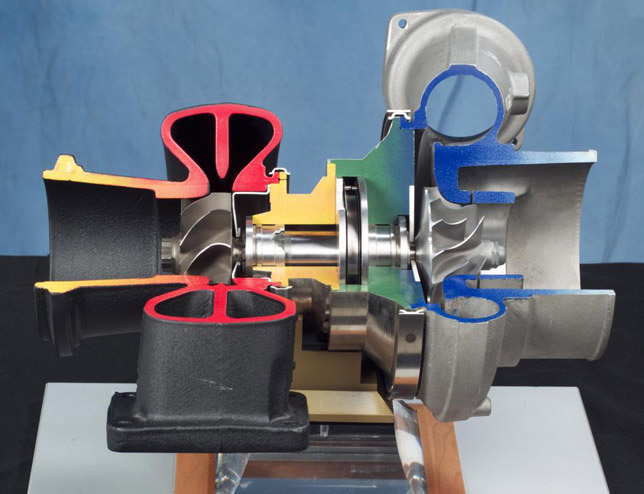
Before those exhaust gasses reach the exhaust system they go trough a turbine connected to a shaft. The more exhaust that goes through the turbine blades, the faster they spin. On the other end of the shaft we find a compressor which welcomes fresh air from the atmosphere, compresses it using the force of the turbine and then feeds it into the engine. To further increase the efficiency of the turbocharging system, an intercooler is added – it looks much like a car radiator but instead of containing cooling fluid, it holds the compressed air from the compressor. Air is denser when cooler and that’s exactly what the intercooler does – it cools the incoming air.
Cut-away view of a turbocharger held by a foil-bearing
There are issues however. First of all, a turbine amidst the flow of exhaust is essentially an obstacle. The exhaust stroke has to deal with more back-pressure thus being slightly less efficient. A functional turboshaft has to handle extreme forces (speeds go up to 150 000 rpm within the turbocharger) so a special kind of baring is needed – liquid ones or state-of-the-art ball bearings. The latter is more efficient but more expensive. Then there’s the dreaded turbo lag. The problem here is that when you put your foot down, the response is far from electric. The turbine needs some time to kick off and start spinning the compressor blades. That’s why at low engine rpm one can’t really tell if the car has a turbo or not.
There are various ways to tackle this nuisance. Make things smaller and lighter. Tiny turbochargers will grant you that off-the-line jolt but won’t be too good on the upper rpm range. Besides, if too much exhaust starts going through a relatively small turbine things may get hot and disbalanced. Usually however, there’s the wastegate in most turbines – a valve that knows how much exhaust passes through and regulates the flow by simply diverting some of the gases away from the turbine. Some companies have started putting more than one turbochargers in their cars. One small and the other, big. The small one guarantees a more immediate response while the big one takes over at higher speeds.
Essentially, that’s the story with turbochargers. We can further dive into numbers and calculations about pressure and efficiency but this, I think, is already nerdy enough. Hopefully some of you learned something new while others refreshed their memory on how the turbocharger brings easy power to our everyday lives.
Do you know that funny little wingless cartoon birds. Well if you do, you are probably fan of the popular game “Angry Birds”. And more importantly we have some really good news for you. If you are looking forward to this year’s Formula 1 and are addicted to this particular game, then you will see some characters from the game onto the racing track. Till the present, maybe Formula 1 was one of those few areas where we couldn’t see our favourite characters. Nevertheless, recently the Finish company Rovio announced their newly signed contract with the Formula 1 racer Heikki Kovalainen. The Finnish god of the racing-track will wear a helmet, which was especially ornated with the logo of “Angry Birds” and in addition is designed to look just as the red wingless bird from the game. Actually, the Finnish F1 star has already debuted wearing this helmet on this weekend’s inaugural Formula 1 race in Melbourne, Australia. Furthermore Kovalainen seems to be a big fan of the game, and shares that given this fact and since he is Finn (as the funny characters are) he would be proud to wear the helmet.
Heikki Kovalainen Angry Birds Helmet
In details, Rovio is a Finnish based entertainment company, which became extremely popular with the launch of the above mentioned game. It is a casual puzzle game, which catches the attention with its unique cartoon characters. Moreover, it became an international phenomenon in just one year since its release and currently is number one paid application of all time.
Pictures Source: Heikki Kovalainen Official Web Page
To have Peugeot‘s latest hybrid modular technology it takes a 2.0-litre HDi engine and a 37 bhp electric motor put on a single frame. The diesel engine deals with the front axle while the electric motor operates the rear. Such a setup was fist used in the 3008 HYbrid4. Now the Peugeot 508 RXH and 508 Saloon also join the company’s hybrid fleet by succumbing to the HYbrid4 badge.
By adding such frugal technology to otherwise resourceful saloons and all-roaders (such as the RXH and Saloon), Peugeot hope to optimize the driving performance and economy and increase the model’s versatility. Lower taxation is expected too.
Both of these AWD cars will carry the same HYbrid4 gear thus delivering identical figures of power – 163 bhp from the 2.0 HDi unit plus 37 bhp from the motor at the back. That’s 200 bhp in overall power. Their combined drive cycle economy is a charm, yet the RHX is the thirstier from the two with 68.9 mpg – the Saloon can go for almost 10 more miles on a gallon. Also the Saloon has a sub-hundred figure on CO2 emissions standing at 95 g/km. The RHX manages 107 g/km. The top speed for both is around 130 mph and zero to sixty takes 9.0 seconds (9.5 for the heavier RHX).
In terms of equipment, the Saloon HYbrid4 is pretty similar to the 508 Allure – Keyless entry, an ignition button, cruise control with a speed limiter, automatic parking brake with Hill Assist, automatic dual-zone air conditioning, electric folding door mirrors, Peugeot Connect Navigation (RT6) with Bluetooth, Peugeot Connect SOS and Assistance, automatic headlamps and wipers, 18” alloy wheels and half leather seats are all included. All of that for $49,788.
The Saloon however, is trumped by the $53,343RXH which has an even vaster array of luxuries. On it, you will find 18” Attila alloy wheels, parking aid, a panoramic glass roof, an additional Colour Head Up display, an USB point and acoustic laminated side windows. It also has a higher stance that gives it an overall crossover look.
Both models are available for ordering while shipping will start in May for the RXH and in July for the Saloon.
In search for an executive saloon but tired of BMWs or Audis and Mercedeses? They are the usual choice but one can never get hurt from trying something different. Oh Look! Here’s an Opel Insignia… and it’s been tweaked by German motoring specialists JMS. It’s a starter project with more options due to come. I basically depends on the customer.
What you do get however, is a KW coilover version 3 inox for a suspension. That will set you back $2,226. Because of it, the Insignia will be lower than usual – specifically, 55mm lower at the front and 45mm at the back. For a more modest sum of $315 you’ll also get a JMS racelook apron which you can screw on the standard front bumper and apply…glue, apparently.
By far the most expensive feature on this Insignia are the 9×20 AR1 Race wheels wrapped in 245/35R20 tires. All four of them cost $3,423.
More exterior enhancements and exhaust pipes can be ordered upon request for an overall complete look.
Here is a nice video of Mercedes-Benz SLS AMG Roadster tested by Sport Auto.
It is powered by a 6.2 liter naturally aspirated V8 with 571PS (420 kW) and 650Nm (479 lb-ft) of torque. It is mated to the AMG SPEEDSHIFT DCT 7-speed sports gearbox, which shifts in as little as 100 milliseconds. There are also four different driving modes: “C” (Controlled Efficiency), ”S” (Sport), “S+” (Sport plus) or “M” (Manual).
0-100 km/h in 3.7 seconds and a top speed of 317 km/h (197 mph). The kerb weight is 1661 kg (3661 lbs).
The exterior boasts full AMG performance package as well as the interior. There is also – leather upholstery, mettalic accents and nice AMG sports seats with AIRSCARF. The options list includes a Bang & Olufsen audio system and an AMG Performance Media system.
It stands on 19” rims at the front fitted with 265/35 ZR19 ultra-performance tires and 20” rims at the rear wrapped in 295/30 ZR20.
Check out the acceleration from 0 to 327 km/h and some other interesting moments in the video below.
 Here’s a Kahn Rolls Royce Ghost modified in ways you would least expect it to be. Yes, this particular one is all dressed up in a shadow line finish and riddled with subtle styling features that make a difference. But the most substantial change is underneath. And sadly, I’m not talking about the engine.


 Peugeot UK now offers their EV – iOn with lower OTR price of just £21 216 after the Government’s £5,000 Plug-in Car Grant.


 Schmidt Revolution introduced their tuning program for



 Ever wondered how WRC cars manage to deliver 300 bhp and above from an engine that, by rule, cannot exceed 2.0 liters of displacement? How on earth do the heavy, low-revving diesel engines in cars today stay competitive? Or what is it that makes it possible for the Bugatti Veyron to break the 1000 bhp threshold? Well, it certainly isn’t witchcraft. By means of “forced induction”, turbochargers today boost the automotive industry to a new direction of smaller, more-efficient and bloody good fun engines.
 Do you know that funny little wingless cartoon birds. Well if you do, you are probably fan of the popular game “Angry Birds”. And more importantly we have some really good news for you. If you are looking forward to this year’s Formula 1 and are addicted to this particular game, then you will see some characters from the game onto the racing track. Till the present, maybe Formula 1 was one of those few areas where we couldn’t see our favourite characters. Nevertheless, recently the Finish company Rovio announced their newly signed contract with the Formula 1 racer Heikki Kovalainen. The Finnish god of the racing-track will wear a helmet, which was especially ornated with the logo of “Angry Birds” and in addition is designed to look just as the red wingless bird from the game. Actually, the Finnish F1 star has already debuted wearing this helmet on this weekend’s inaugural Formula 1 race in Melbourne, Australia. Furthermore Kovalainen seems to be a big fan of the game, and shares that given this fact and since he is Finn (as the funny characters are) he would be proud to wear the helmet.


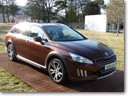 To have Peugeot‘s latest hybrid modular technology it takes a 2.0-litre HDi engine and a 37 bhp electric motor put on a single frame. The diesel engine deals with the front axle while the electric motor operates the rear. Such a setup was fist used in the 3008 HYbrid4. Now the Peugeot 508 RXH and 508 Saloon also join the company’s hybrid fleet by succumbing to the HYbrid4 badge.


 In search for an executive saloon but tired of BMWs or Audis and Mercedeses? They are the usual choice but one can never get hurt from trying something different. Oh Look! Here’s an Opel Insignia… and it’s been tweaked by German motoring specialists JMS. It’s a starter project with more options due to come. I basically depends on the customer.


 Here is a nice video of Mercedes-Benz SLS AMG Roadster tested by Sport Auto.


