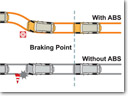
 Before Anti-lock Braking Systems (ABS) were installed on cars, drivers were told to rapidly pump their brakes if they felt a tire start to skid. Today, you don’t need to pump your car’s brakes when skidding, anti-lock braking systems do this for you. In this article, we’ll learn about anti-lock braking systems and how they work.The operational theory starts with the fact that a skidding wheel has less traction than a non-skidding one. The best thing to do when a skid does occur is to slow your engine down and let the tires “grab”. ABS systems do the same thing, they sense when a wheel is skidding during braking and then they pulse the brake automatically to regain traction. This not only allows you to stop in a shorter distance, you’ll be able to regain your steering too. Here are four components we should quickly discuss:1) Speed Sensors – The ABS needs some way of knowing when a wheel is about to lock up. Speed sensors, which are located on each wheel assembly, provide this information.2) Brake Line Valves – There is a valve in the brake line of each brake controlled by the ABS. This electrically-controlled valve controls the brake pressure going to each brake assembly.3) Electric Pump – When a Brake Line Valve reduces the pressure in a brake line, there is an electric pump to bring the restore the pressure.4) ABS Controller – The ABS controller is a small computer. It runs the whole ABS system.The ABS Controller is the brain of the system. It constantly monitors the four wheel speed sensors, looking for speed decelerations in any of the four wheels that are out of the ordinary. The ABS controller knows that rapid deceleration is technically “impossible” under normal driving conditions, so it reduces the brake line pressure to the brake involved until it sees it speed up again. The result: this gives the system maximum braking power. When the ABS system is in operation you will feel a pulsing in the brake pedal; this comes from the rapid opening and closing of the valves.Have you ever wondered what you should do when your car starts to skid? First, do not pump your brakes! The ABS system does this for you. In an emergency stop in a car with ABS, you should just apply your brake pedal firmly and hold it while the ABS does all the work. You will feel a pulsing in the pedal that may be quite noticeable but this is completely normal so don’t let off the brake. When your ABS system is functioning properly, you should have some steering control quickly return so use that to get back on course.
Category: Car Makes
Car Makes
-
How Your Car’s Anti-Lock Braking System Works
-
All About Continuously Variable Transmissions
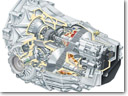
 Today we have a new type of transmission to consider and it is called a continuously variable transmission (CVT). A CVT is a type of automatic transmission but it operates very differently than older automatics. CVTs provide more useable power, better fuel economy and smoother driving than traditional automatic transmissions. CVTs have been around for years in motorized applications such as snowmobiles and off-road recreational vehicles, but just started to be used in regular automobiles a decade or so ago.Conventional automatic transmissions use sets of gears inside that provide different ratios or speeds. Control units sense speeds and shift a transmission’s gears automatically to provide the most appropriate ratio for a given driving situation: lowest gears for low speeds, middle gears for acceleration and passing, and higher gears for efficient cruising. This is visually indicated in most vehicles with a selector display (P-R-N-D-L).A CVT replaces the complex gears sets common in standard transmissions with two variable-diameter pulleys, each shaped like a pair of opposing cones, with a metal belt running between them. One pulley is connected to the engine, the other to the drive wheels. The way it works is that during operation the pulleys move in and out such that a drive belt between moves higher on one pulley, lower on the other. You can picture this roughly as the way a 10-speed bike works, by routing the chain over smaller or larger gears to change the gear ratios.The controls for a CVT-based car are the same as an automatic-based car: Two pedals (gas and brake) and a P-R-N-D-L-style shift pattern. When driving a car with a CVT, you won’t hear or feel the transmission shift, though. It simply raises and lowers the engine speed as needed, calling up higher engine speeds (or RPMs) for better acceleration and lower RPMs for better fuel economy while cruising. Many people find that driving a CVT-based automobile is a little disconcerting because of the sound it makes. When you push hard on the accelerator, the engine races a bit as it would with a slipping clutch or a failing automatic transmission. This is normal, the CVT is simply adjusting itself to provide optimal power for acceleration.Engines do not develop constant power at all speeds; they have specific speeds where either torque, horsepower or fuel efficiency are at their optimum levels. Because a CVT can theoretically adjust to any gear ratio, engineers can program it to give maximum performance during all these situations. For example, when power is needed, or maximum fuel-economy is desired, a CVT can adjust to those conditions more accurately than a standard automatic transmission.The CVT’s biggest problem has been user acceptance. Because the CVT allows the engine to rotate at any speed, the noises coming from under the hood can sound odd to ears accustomed to conventional automatic transmissions. The gradual changes in engine note sound like something is “slipping”– signs of trouble with a conventional transmission, but perfectly normal for a CVT. Automakers have gone to great lengths to make the CVT feel more like a conventional transmission.Because early automotive CVTs were limited as to how much horsepower they could handle, there has been some concern about the long-term reliability of the CVT. This has not proven to be a problem, though. Advanced technology has made the CVT quite robust and reliable. Nissan has more than a million CVTs in service around the world and says their long-term reliability is comparable to conventional transmissions.The future of the CVT remains to be seen. In spite of the obvious efficiencies of CVTs, customers can be fickle and may prefer and older technology. We will likely see how CVT transmissions fare over the next few years or so.
-
Lexus LS Gets Exclusive Updates for MY2015

 A quarter-century ago Lexus made real history in the automotive world by introducing the Lexus LS. One of the main reasons is that it was equipped with the powerful V8 engine as a standard. Back then this powerplant was a very expensive extra-cost option and not even available in others. It seems like in 2015 the history is repeating. 2015 Lexus LS features as a standard the 386-horsepower (284 kW) 4.6-liter V8 unit, which is coupled to an eight-speed automatic transmission. The nearly silent acceleration is the other striking hallmark aspect of driving a Lexus LS. In addition, the model also offers the option of a more engaging driving experience due to the addition of the F SPORT Package.
The LS 460 trim is introduced as a regular and long-wheelbase, with a choice of a rear-wheel drive or all-weather drive. At the top is positioned the LS 600h L hybrid that generates a total of 438 horsepower (322 kW) from its 5-liter V8 engine and the electric motor. This trim level also features all-weather drive.
A new multimedia system and Lexus Enform Remote are also there. The latter can be used to control certain vehicle features via mobile application. Key elements include remote door lock/unlock, remote stop/start for the engine and climate control, vehicle finder, guest driver monitor and more.
This car also comes as a standard with frequency-dependent suspension dampers that deliver agile handling and driving smoothness. Through the Drive Select, the person behind the steering wheel can select one of three settings: “Normal,” “Eco” or “Sport S”. The system automatically adjusts several performance parameters such as transmission shift points and throttle response.
Of course, “Eco” mode prioritizes fuel efficiency. The “Sport” on quickens responses for a livelier feeling, while the models equipped with the air suspension, offer two additional drive settings, “Comfort” and “Sport S+”.

Lexus LS 460 F SPORT is the trim level featuring the sport-tuned air suspension. It runs on 19-inch forged alloy wheels behind which there have been positioned Brembo six-piston caliper front brakes. In terms of exterior, the F SPORT adds a unique front fascia with mesh spindle grille featuring a black surround, larger air intake openings and round fog lamps. Its interior is adorned by Alcantara headliner, aluminum trim and leather-wrapped steering wheel with paddle shifters.
Also new for 2015 model year are the multimedia system with enhanced Navigation features, Lexus Enform App Suite which adds Slacker and upgrades to iHeartRadio 4.0 and Lexus Enform Remote. In addition, new are also the LED dome lamps and the dynamic gridlines added to backup camera. Turning radius of the 2015 Lexus LS was reduced by four inches on cars with 18-inch wheels, which also include as a standard new suspension. The F SPORT gets badge added to rear.
In terms of safety and security the car can get an optional Lane-Keep Assist system (LKA) as well as Blind Spot Monitor (BSM). The latter feature includes also Rear Cross Traffic Alert (RCTA). Available luxury options for the interior include power rear seats with Climate Concierge and Ottoman Seating Package with Shiatsu massage and a Rear Seat Entertainment System featuring a Blu-ray Disc DVD player, an SD card slot and a retractable, ceiling mounted, nine-inch full-color VGA screen.


Source: Lexus
-
Citroen C4 Cactus Chrome Edition Shown at Q Awards 25th Anniversary

 Citroen is releasing a one-off C4 Cactus Chrome Edition in order to celebrate the 25th anniversary of the Q Awards. This signifies that the company has continued the sponsorship of the event for another year, thus remaining in-tune with the UK music industry. The prestigious Q Awards took place yesterday (22 October) at the Grosvenor House Hotel and was hosted by Absolute Radio’s Christian O’Connell. In addition, Citroen revealed that it will sponsor this years ‘Best Solo Artist’ category winner – Ed Sheeran.
A fleet of chauffeur-driven Grand C4 Picasso and C4 Cactus models were there to transport the celebrity guests to the venue. The star in company’s range of vehicles at the event was the one-off chrome-finished C4 Cactus, which also appeared on the red carpet.
It immediately gathered glances and was the transport-of-choice for the French composer, performer and music producer Jean-Michel Jarre. He also got an award – the coveted Q Innovation In Sound Award.
Citroen C4 Cactus Chrome Edition includes the special Airbump feature. It does away with dents and scratches in real life and it is found on the front and rear bumpers and the sides. Airbump provides a type of buffer zone which protects the actual body. The car is also equipped with an array of driving aids such as the park assist, a reversing camera, hill-start assist, to name a few.
The C4 Cactus is powered by Citroen’s latest-generation engines. These modern and efficient engines, PureTech petrol and BlueHDi diesel with Stop & Start, need very little fuel to run. The gasoline powered are the naturally aspirated three-cylinder PureTech VTi 82 engine with capacity of 1.2l and the turbocharged PureTech e-THP 110 engine with a central direct-injection turbocharger and dual VVT.
On the diesel side is the BlueHDi 100 unit, which is an example of another step towards cleaner diesel, cutting CO₂ emissions to a record low 82g/km and keeping fuel consumption on a tight rein up to 91.1mpg on a combined cycle.


Source: Citroen
-
Petty’s Garage Ford Mustang to Debut at SEMA Show

 In two weeks Ford is bringing performance oriented Mustangs to the halls of the Specialty Equipment Market Association (SEMA) show. Among the modified Mustangs will be the Galpin Auto Sports version, as mentioned earlier today, as well as versions by other tuners such as Roush, Petty’s Garage, MRT and many more. The performance specialists will not only show how they have boosted the 2.3-liter EcoBoost four-cylinder engine sleeping under the hood of the pony car, but also will demonstrate newly developed aftermarket parts which enhance its track handling.
Petty’s Garage will also be among the featured customizer at the show. It will be bringing a Mustang wearing Richard Petty’s famous blue paint and a discrete No. 43. The secret about this number is that this is Petty’s car number in his NASCAR days. In addition, this car will be equipped with Roush’s supercharged V8 engine.
Ford has also stated that this particular model will be auctioned by Barrett-Jackson and the proceeds will go to the Victory Junction. The latter is dedicated to helping chronically ill children attend summer camp.
2015 Ford Mustang features new independent rear suspension and multilink front suspension. They have been both improved by Roush and Steeda. SEMA will also see plenty of 5.0-liter V8s roaring around. The spotlight however will be on the new 2.3-liter EcoBoost four-cylinder engine.
The unit not only provides an entirely new platform for experienced turbocharging specialists, but also delivers stunning 310 horsepower (228 kW) and 434 Nm (320 lb.-ft.). Another secret revealed by Ford is that there are several tuners which will be on hand with high-powered versions of the new turbo four-cylinder.
Source: Ford
-
Volkswagen Golf R is the safest car on wet roads


Drivers in the Northern Hemisphere of the world now face winter, which always brings months of road challenges that include fog, ice, snow and rain. Most people will keep on driving even in these conditions so having a safe car for challenging roads is essential if you want to get from point A to point B with no problems at all. This is especially true if you own a performance car too.
Choosing one such car is now a bit easier thanks to the efforts of the British automobile magazine Autocar. According to it, the safest wet road performance car is the Volkswagen Golf R. The result was achieved after extensive testing that included various other models such as the MINI Cooper, Audi RS4, Porsche 911 Carrera 4S, Range Rover Sport, Toyota GT86 and Nissan GT-R. The safety test included five separate challenges at a manufacturer test facility at MIRA Proving Ground. We should also say that the cars tested used tires chosen by the vehicle manufacturer.
All cars underwent tests that included control over stopping from highway speeds of 70 mph (113 km/h), stability when accelerating, braking on ice-like conditions at lower speeds, level of lateral grip when cornering and precision around a circuit.
VW’s four-wheel-drive Golf R, which costs GBP 31,970 and produces 296 bhp (300 HP/220 kW), performed the best across all five tests, with the rear-wheel-drive GBP 24,995, 197 bhp (200 HP/147 kW) Toyota GT86 the worst. Running the VW Golf R close was the GBP 88,400 Porsche 911 Carrera 4S with exception for the Lateral Grip tests where it’s rear-biased weight distribution unsettled its handling.
“Driving conditions can become hugely challenging very quickly for drivers of sportier and higher performance vehicles. It is very easy to get caught out,” explains Chas Hallett, editor-in-chief of Autocar. “Advanced electronics certainly aid the driver, and winter tyres will improve grip, but drivers still need to drive within their limits and abilities, not the cars.”
Source: Autocar
-
2015 Hyundai Santa Fe offers new features


Hyundai has proudly announced that the new 2015 Hyundai Santa Fe and Santa Fe Sport offer more standard features, comfort and convenience equipment than ever, including refinements to the steering and suspension systems.
More specifically the improvements to the power steering system include a 32-bit microprocessor that delivers a refined steering feel. The steering system keeps the Hyundai Driver Selectable Steering Mode, which offers a retuned “Sport” setting that makes use of the new processor and offers firmer steering. The front wheel bushes have also been re-tuned for 2015, which enhances the steering feel.
The suspension systems in the 2015 Santa Fe and Santa Fe Sport increase the wheel bearing stiffness and lower control arm bushing stiffness, which increases the overall lateral stiffness of the front suspension. The revised rear suspension geometry and bushings also increase the lateral stiffness.
The two new models also come with tons of new standard and safety features that include daytime running lights, a driver’s blind spot mirror and an auto up/down front passenger power window. Hyundai’s innovative new power Hands-Free Smart Liftgate with Auto Open is now available on Santa Fe and Santa Fe Sport models, which makes it even easier for owners to gain access to the cargo area when their hands are full. The system makes it easy for the driver to keep both feet on the ground, simply waiting for the liftgate to open after standing within a few feet of the rear bumper with the key fob in a purse or pocket. This is also the first time Santa Fe Sport can be equipped with a power liftgate. Furthermore the two new models offer two new colors – Sparkling Silver and Platinum Graphite and there is a two-tone grille for 2015 (Santa Fe Sport only) that emphasizes the car’s sportier personality.
Both vehicles offer new rich safety equipment for 2015 including Vehicle Stability Management (VSM) with Electronic Stability Control (ESC) and Traction Control System, seven airbags, including a driver’s knee airbag, four-wheel disc brakes and ABS with Electronic Brake-force Distribution (EBD) and Brake Assist, Hill-start Assist Control (HAC) with Downhill Brake Control (DBC) and a Tire Pressure Monitoring System (TPMS).
The 2015 Hyundai Santa Fe is powered by a 3.3-liter Lambda II V6 engine, while the Santa Fe Sport offers a choice between an efficient 2.4-liter four cylinder engine or a powerful 2.0-liter four-cylinder turbocharged engine. All engines use gasoline and offer direct fuel injection and Dual Continuously Variable Valve Timing (D-CVVT). A six-speed automatic transmission is standard on all 2015 Santa Fe models; the gearbox transfers engine power to the front wheels or all of them, depending on what you choose.
The vehicles are available now with the 2015 Santa Fe Sport starting at just USD 24,950, excluding a USD 875 freight fee.
Source: Hyundai
-
Catching a Glimpse of the Track-Focused McLaren P1 GTR Interior
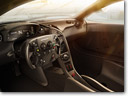

McLaren finally discloses how the new McLaren P1 GTR will look like interiorly. The revealed insides of this automotive monster really can make a person get goose bumps. It looks like something coming out of Marvel Universe! With its boosted cutting-edge power, dynamic look and excellent performance it is transformed into a machine which is set to become the world’s best track weapon ever.
Did anyone say power? More power? How much more power? Well, precisely 83bhp more than the road-going P1 model, taking total output from the 3.8-litre twin-turbo V8 and electric motor to 986bhp.
There is a whole lot more about the McLaren P1 GTR than a simple power boost. I mean “simple” really. Perhaps you can notice from the photos that the new P1 GTR does not have a roll cage. That’s because the car does not need such. In addition, from the official first pictures it becomes apparent that the interior is designed in such a manner that speaks for driver-focused style. The DTM-style seats are positioned directly to the chassis, which in return reduces weight by having no additional mounting brackets.
If it still doesn’t look like a race car enough for you, check out the upgraded steering wheel! Its design is similar to the steering wheel of the MP4-23 F1 driven by the 2008 championship winner Lewis Hamilton. Intended to make all controls easily accessible, all of the key controls along with the mode switches are located in the center of the bespoke steering wheel. The DRS and IPAS are also retained there. It does look bloody amazing indeed!


Source: McLaren
-
Galpin Auto Sports Reveals SEMA-bound Ford Mustang
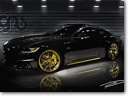
 The SEMA-bound Galpin Auto Sports Ford Mustang is a special vehicle which comes to celebrate the golden anniversary of the production Mustang. The modified pony car features a special gold theme, enhanced engine, custom LEDs and other intricate tweaks. Galpin Auto Sports (GAS) is the tuning arm of the largest Ford dealer in the United States. 2015 GAS Mustang embodies a golden anniversary design philosophy and will be of course premiered at the Specialty Equipment Market Association (SEMA) show.
At first the tuners gave a facelift to the iconic model via a new front fascia, which was restyled to match the three strakes found in the factory headlights. In details, the new headlights now integrate LED turn signals and turn on in sequence to match the rear turn signals. In addition, there have been also installed a carbon fiber front splitter and rocker panels as well as a more aggressive rear diffuser.
Under the hood of this Mustang is positioned the Whipple supercharger, which has been custom powder-coated to appear gold. It sits atop the 5.0-liter Coyote V8 engine. The integrated into the hood glass window has the purpose to show off the engine. More importantly, these modifications are not only a cosmetic change, but also signify a boost in the power output. The engine generates the astounding 725 horsepower (533 kW).
Next, the car is also equipped with suspension components delivered by Steeda and new exhaust by Magnaflow. GAS also reveal that with this black and gold idea, they wanted to get the color as close to 24-carat gold as possible. Speaking of which, this GAS Mustang will be running on 20-inch wheels finished in gold. In the same color are also the side sills, brake calipers and badging.
Inside, the same black-gold theme can be found on the entire range of elements which were previously chrome or metallic. Recaro seats are covered with a fabric finished in black and gold, and the headliner is black microsuede. And if you think that the exterior is finished in paint that appears black, then you will be surprised to see that it is actually filled with gold metallic flecks.
Source: Galpin Auto Sports
-
VATH Motorentechnik GmbH: Between Classic and Modern

Throughout the years the close and inseparable relationship between VATH Motorentechnik GmbH (Motor Engineering ltd.) and Mercedes-Benz has served a great purpose to either of the sides.
The founder, Wolfgang VATH, has created a company which is still continuing to progress and play a fundamental part in the market after all these years. By all means, the VATH Motorentechnik GmbH has gained an excellent worldwide reputation as an engine manufacturer. Highlighting the importance of the original production of cars, VATH tunes their “projects” to their best classic characteristics.
Later on, after the establishment of the German tuner, Jasmin EHRET-VATH, the daughter of Wolfgang VATH, takes on the responsibility to run the executive board of the company which is known for car tuning. No matter what the tuner does, it seems to be booming. Not betraying their motto „Everything that can be conserved – must be conserved anyway“, VATH keeps bringing significant up-to-date enhancements to all after-war Mercedes vehicles. And by not discarding their authenticity, the German tuner manages to preserve the balance between what is modern and what is classic. That’s their philosophy after all.
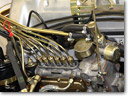
Initially, the work that is being implemented by VATH is on the lower part of the engine and on the crankcase. Doing it in a traditional method, cylinders, for instance, are bored and honored. Pistons are renovated, crankshafts ground, polished and balanced in a really efficient way by the company very own balancing machine. Finally, they get equipped by new bearings. Valve seats undergo a transition as well. They are reamed and, if necessary, valve guides are renewed as well. The refitting of engines for unleaded fuel requires a mounting of hardened valve seat rings. The air ducts are reamed and polished which allows more air passage.
VATH Motorentechnik is an expert when dealing with Mercedes classic models. Beauties such as Pagode, W111 with tail fin, Adenauer, 300 SL or Ponton are dealt with a detailed refitting of automatic and shift gears with heart’s blood. They receive a rear axle retrofitting, optionally with axle ratio modifications.
Undoubtedly then, traditional and classic seem to be the adjectives that best suit VATH Motorentechnik GmbH.


Source: VATH
-
Scion Teases a Sporty iM Concept

 Scion iM Concept is one of the vehicles which we will see having a world premiere at the Los Angeles Auto Show. For this occasion, the brand has released two teaser images that show the future star of the brand. On the photos we see the iM Concept car taking some test shots. They reveal distinctively sporty front end and exactly this has been taken to the spotlight. Scion says that the iM concept vehicle is a reflection of the evolution of company’s design philosophy which aims to catch the attention of youthful customers.
It will probably be a hot hatchback judging form the sporty compact appearance. In fact, rumors say that two new models will be introduced next year. One of these cars will be based on Toyota’s Auris hatchback. Looking at the front of the concept, particularly at the headlights and front grille, in the teaser image, it definitely looks like that this will be a derivative of the Auris.
Form the released images we also see that car will be running on aggressive low-profile tyres wrapped around sporty-looking wheels and featuring drilled brake rotors. If Scion iM is a hatchback as we suppose, than it will be the firs one for the brand.
Another thing coming in question is whether this vehicle will use Auris turbocharged engine, or will there be any new surprises. Another possibility for the iM concept is that it can actually be a model which will replace the-soon-to-be-discontinued xB.
Unfortunately, ahead of the official release date, which is 19th of November, we don’t expect to get more details from Scion. So we have to wait until then to solve the mystery.

Source: Scion
-
Nissan ships first all-electric taxis to Barcelona and Madrid


The Japanese auto maker Nissan has delivered the first all-electric taxis to the Spanish cities of Madrid and Barcelona. The introduction of the new Nissan electric vehicles means that these two cities will enjoy emission-free and quiet transportation from now on.
The vehicles delivered to Barcelona are e-NV200 units and they are the first step in the execution of an agreement between Nissan, the city of Barcelona and the Barcelona metropolitan area. An interesting fact is that the Nissan e-NV200 van is built in Barcelona as well. The delivery of the first electric taxis to Barcelona has taken place at the Expo-electric Formula-e event, which is one of the most important meetings on sustainable mobility in Europe.
Jean-Pierre Diernaz, Director of Electric Vehicles for Nissan Europe, welcomed the news, commenting: “Declining air quality levels are a top concern across Europe and it’s great to see Madrid and Barcelona taking such positive steps in improving air quality through the incorporation of Nissan’s all-electric cars into their taxi fleets. These taxi bring a huge benefit not only for residents but also for the drivers – thanks to the ultra-low running costs only an electric car can offer. This scheme demonstrates that sustainable transportation is easy and affordable for everyone.”
Madrid has received its first Nissan LEAF taxi, which is the best selling electric vehicle in the world with more than 142 000 units sold globally. The official delivery has taken place at Puerta del Sol in Madrid, where “Zero KM” – the measuring starting point of all Spanish roads – is located. Antonio Berzal Prieto, the first 100% electric taxi driver in Madrid to choose electric technology for his business, declared “When I heard that the Nissan LEAF had been approved as a taxi for the city, I quickly looked into all the options it offered me. In addition to the environmental benefits, the costs of ownership are highly competitive and the car’s performance is excellent.”
Source: Nissan


