The guys from the Germany-based Novitec Rosso have slapped us in the face with this Ferrari 458 Italia… which is yellow… and it has no roof. Is there any need to go on? It’s quite a comprehensive package this upgrade but it’s hard to notice because our pupils contract at the sight of the thing. But if you think the jaundice is what makes this car unique, you’d be wrong. The real treat hides underneath – a performance revision and a new exhaust system.
Let’s start off “lightly” – The front splitter is new and so is the diffuser at the back. Also, the taillights loose themselves in dark tint and carbon fiber while the added rear wing on the sticks out. The wheels at the front measure at 21-inches while at the back – 22-inches. Pirelli P-Zero tires look like paint strips on them. Inside, 458 Spider also gets some decorative carbon fiber goodness and custom made leather upholstery.
By fitting a lighter exhaust system and playing around with the engine management system, Novitec Rosso have manged to extract 30 more hp from the 458’s 4.5 V8 drivetrain. That means 600 hp and 570 Nm of torque at the reach of your right foot. What makes this Spider even more track-friendly is the set of racing springs included and the additional sway bars for extra rigidity.
Novitec Rosso Ferrari 458 Italia SpiderNovitec Rosso Ferrari 458 Italia SpiderNovitec Rosso Ferrari 458 Italia SpiderNovitec Rosso Ferrari 458 Italia SpiderNovitec Rosso Ferrari 458 Italia SpiderNovitec Rosso Ferrari 458 Italia SpiderNovitec Rosso Ferrari 458 Italia SpiderNovitec Rosso Ferrari 458 Italia Spider
We really hate it when some tuning houses decide to put some flashy wheels on an already appealing car and call it a project. So when we caught a glimpse of this Fiat 500 Prima Edizione (limited edition) touched by SR Auto, we rolled our eyes. “Here’s another one… what’s it called?” Project Denso they say.
Okay, so it has a set of lightweight Work Meister S1R wheels. Massive two-piece forged things, finished in matte black and line with some bronze. The Fiat’s wheel arches, as we can clearly see, are struggling for air. At this point, we hurried to conclude: “Okay, so that’s about it, right?”
Well, it turned out that’s not the full story. Some behind the curtain work has also been done. We should have guessed that one – lower springs by H&R, good for handling we’ve been told.
But even deeper underneath the shell, a K&N filter system works its magic to provide a bit of extra boost from the air coming in. Further down the road we also find a Magnaflow cat back exhaust system that releases any flow restriction that might have been present on the standard Prima Edizione Fiat 500.
So then, Project Denso it is – 100% fun content (from concentrate).
Keep your eyes peeled as a new Aston Martin might be coming out. Well, we say new, but it actually a special edition of the DBS – the ultimate Aston get’s an “Ultimate” trim. Not much has been disclosed so far so we’ll have to play the guessing game.
There will two versions of it – Coupe and Volante (open top). The exterior shades will range from Silver Fox to Quantum Silver and Carbon Black II. The wheels will be strictly Black Diamond only contrasted by the yellow brake calipers (one would be able to have them also in red or black). The wing mirror caps and lamp in-falls will be garnished with carbon fiber and the rear lights will be smoked. A unique “DBS Ultimate” will finish off the exterior look.
As for the inside, we can clearly see those Obsidian Black, diamond patterned seats with contrasting red stitching – delicious. The inside of the door bares the same design while the headlining is made from Alcantra. On the headrests, we find yet again, a unique DBS Ultimate badge with red in-fill. The flappy paddles behind the well also get a leather treatment in red.
If this really is going to be the “ultimate” Aston Martin DBS then it better develop, at the very least 510 hp and 570 Nm. This is the absolute minimum. Pretty certain that they won’t change the plant – 5.9-liter V12 but squeezing out more juice from it does not sound that impossible.
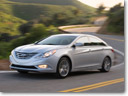
Don’t you hate it when car manufacturers bash one another over which one is the leader in a segment? That’s exactly what Hyundai are now doing with their 2013 Sonata. We had to go trough bulks of comparisons between their car (the 2013 MY) and 2012 MY Altimas and Accords, Malibus and Fusions to actually get to some relevant information. Whichever table we looked at, the Sonata was one step ahead… but is that really the case?
It is cheap, we’ll give them that. At $21,720 you get a Sonata GLS complete with the “Popular Equipment Package”. That roughly means front heated seats and fog lights among other luxuries. Power comes from a Theta II GDI 2.4-liter unit which, judging by the acronym, one might think it’s a diesel. The thing is GDI stands for Gasoline Direct-Injection and that’s what the Sonata uses to spray fuel into the cylinders at pressure of 2,175 psi. Thus the compression ration stands at a high 11.3:1 and the pistons inside are dished so that they can handle the combustion process more efficiently. With all that in mind, we are being told that the Sonata achieves 24 mpg in an urban environment and 35 mpg on the highway. The transmission that comes as standard is a six-speed automatic with SHIFTRONIC and has to deal with 198 horsepower and 184 lb.-ft. of torque. The SE trim also boasts a standard dual exhaust system which adds 2 more hp and 2 more lb.-ft. of torque.
While the 2.4 Theta II GDI is naturally aspirated, the 2.0-liter one is turbocharged. That means even more power and almost no compromises in terms of efficiency – 274 hp at 6000 rpm and 269 lb-ft of torque within the 1,750 – 4,500 rpm range.
On the Hyundai Sonata 2.0T SE trim you get a fully automatic temperature control unit which is convenient. What isn’t convenient, but rather exciting, is the sporty suspension – stiffer springs and larger stabilizer bars, resulting in a 20 percent increase in roll resistance. Add to that 18-inch, low profile tires and a constantly adapting electric power steering and you’ve got yourself a car that does not shy away from a corner.
Driver aids include the usual ABS and ESP systems but also Electronic Brake-force Distribution – depending on the place of load, braking power gets redirected. Six airbags and active front-seat head restrains keep you safe and sound.
It goes without saying, that inside, the connectivity is topnotch – XM Satellite Radio for three months, Bluetooth, a place to plug in your iPod or USB drive and a touch-screen navigation system that comes with the SE and Limited trim levels.
Overall, the Hyundai Sonata sounds like a decent car. The only thing the company needs to do is to stop jabbing the others and gain and focus on their product. The automotive industry should not tolerate dirty play.
We often get figures from car makers that, from time to time beggar belief. Especially when we are talking about estimated mpg data. It goes without saying then, that nothing beats a real life test to see exactly what’s what. That’s exactly what record breaking duo John and Helen Taylor have done – travel 1626.1 miles on a single tank of fuel (a record breaking distance). The car of choice was a 2012, manual Volkswagen Passat TDI SE Clean Diesel.
It was a three day journey with a starting point at Houston Texas. The tank was brimmed up with a batch of ultra-low sulfur diesel and the fuel cap was then sealed by officials. And when we are talking real life, we mean real life – 120 pounds of luggage was stuffed at the back and the driving was done only during daytime hours so that the traffic could also contribute as a factor. On the third day of the journey, after 1626.1 miles, the couple reached Sterling, Virginia where the world record was confirmed – 99.5 miles better than the previous record holder (a Volkswagen Passat 1.6 BlueMotion diesel). The average consumption of the TDI Clean Diesel turned out to be 84.1 mpg.
That’s pretty impressive when we take into account that the 2.0-liter engine inside it generates 140 hp and 236 pound-feet of torque. The given EPA estimated fuel economy for it stands at 43 mpg at the highway. Every single state is quite happy about the Passat’s emissions as it has been fitted with a Selective Catalytic Reduction System (SCR) – some sort of which craft that makes rainbows and butterflies come out from the exhaust.
“The Passat was engineered and designed to be a comfortable yet fun to drive alternative in the midsize segment. The TDI Clean Diesel version unites driving dynamics and fuel efficiency that isn’t found in the competitive set,” said Rainer Michel, Vice President of Product Strategy, Volkswagen of America, Inc. “We’re honored that the Taylors chose the 2012 Passat TDI as the vehicle to set this outstanding distance record. Their record shows just how economical the Passat TDI can be in the right hands.”
This is not Taylor’s first efficiency venture. They are in fact renown for independently researching various ways of efficient driving, holding workshops globally. Their collected data from drivers around the globe is as vast as their ambitions.
John and Helen Taylor next to the Volkswagen Passat TDI SE Clean Diesel
Prior Design seem to be in a very SUV mood considering the fact that they have released yet another program for an old-ish titan. Nor really that old actually – the Mercedes-Benz M Class W164 (the one made from 2005 to 2011). Does it look any different from yesterday’s Range Rover? Well, granted that it is a Mercedes, it does but the Prior Design formula on it is basically the same.
Yes, you know it – a front bumper, side skirts a rear bumper and… mounting material. Not what we call thrilling. Okay, there’s also a hood that comes along. Mind you, that’s how things sound on paper. A quick glance at the gallery and we find that the end result is not that gray (it’s white). Despite the add-on side skirts, the M-class has managed to retain a bit of it’s ground clearance. The rear bumper blends seamlessly with the back fenders and wheel-arches while the front looks simply mean (this being an SUV, it should). There are of course LED daytime running lights. But they are optional. At the price of 329 Euros ($428), we recommend they stay that way.
As usual, all materials are made up of Dura-Flex Fiber Reinforced Plastic which is, as one might suspect, durable and flexible. No modifications on the stock Mercedes M-class whatsoever are needed.
As promised, Toyota have unveiled the RAV4 EV. The event took place at the 26th Electric Vehicle Symposium in Los Angeles. The hopes are high as some expect it to be no less impressive than the current petrol RAV4 V6 in terms of “driving performance, dynamics and cargo capacity. That’s amibtious.
The drivetrain inside it can provide power for 160 km once every charge. After that, you find a 240V/40A charger and “brim it up” fir six hours. Pretty much all the bits underneath have been made by Tesla. It took both companies 22 months to achieve this but eventually, we end up with the “only all-electric SUV on the market”
The torquey electricity powers goes to the front wheels in two manners – Sport and Normal. While on the former, the RAV4 can go from 0 to 60 mph (96.6 km/h) in 7 seconds dead while the top speed climbs up to 160 km. A more leisurely way to drive up to the grocer’s can be the Normal mode – 0-60 mph in 8.6 seconds and 137 km/h at best.
The maximum output of power has been estimated to be 115kW @ 2,800 rpm. The heavy battery pack buried deep down inside the car benefits the center of gravity while the electric motor purrs in a very serene way. Surrisingly, the RAV4 body is also slippery – a 0.30 drag coefficient is the very best among SUV’s apparently.
In terms of body design, there are some slight deviations from the standard look of the Toyota RAV4. The front bumper, upper and lower grille, side mirrors, rear spoiler and under body shape have all been restyled in favor of aerodynamics. Sales are expected to start somewhere around during the late summer of 2012. Bob Carter, group vice president and general manager of Toyota in the United States, hopes that:
“…the RAV4 EV will attract sophisticated early technology adopters, much like the first-generation Prius,”
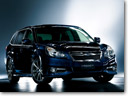
Subaru are letting loose the latest Legacy and Outback models: For Japan, that means not mere MY releases but proper revisions – minor facelifting, chassis and body changes and new engines. The company likes to sum up their actions by using “concepts” which can be articulated in simple phrases. This one is called an “All Performance Enhancement” – the focus falls on fuel efficiency, driveablity and safety.
One of the two new engines (both of them are flat) is an improved version of the familiar, naturally aspirated 2.5-liter one. The Legacies and Outbacks designated with 2.5i usually develop 168 hp and 229 Nm of torque. Now, low to mid speed torque comes even easier. That on the other hand, called for a better CVT so a new Lineatronic transmission was also introduced. It improves fuel-efficiency and tackles the incoming torque more smoothly. Further improvement on the frugality is courtesy to the Impreza derived auto start/stop system.
The Legacy gets a new bumper and revised headlights plus grille thus making it look more wide and sharp. The Outback receives also gets similar optics in its own way. A way that is supposed to convey the image of a flagship SUV. Both of the cars get a 3.5-inch color LCD display at the center of the speedometer. There, the driver can monitor the fuel consumption and the operational situation of the “EyeSight” feature (the camera at the front that monitors the road for obstacles and eventual collisions). Convenient and safe stuff.
What one probably won’t notice is the enhanced rigidity of the Legacy’s body and chassis. By adding a support sub frame at the back and tweaking the spring settings on both ends, one gets a comfortable ride with superior on-the-road stability.
Subaru Outback 2.5 EyeSight (2013)
The other engine goes on the Legacy (wagon or sedan) and the designation will be 2.0GT DIT – Direct Injection Turbo that is. With 2.0-liters of displacement, DOHC and 16 valves, this is a new breed of engines that will hopefully sperad out. By injecting fuel directly into the cylinders, Subaru have made it possible to up the efficiency by 20%. The bore/stroke inside the pots is equally proportioned – 86mm x 86mm. That’s what’s known as a square engine which is ideal for direct fuel injecting. The twin scroll type turbocharger is said to be lively on low speeds and to have helped in extracting 300 hp and 400 Nm of torque.
Add to that the same Lineartronic transmission mentioned above and you get yourself a perfectly decent family car that’s capable of putting a smile on your face trough lively response. What makes it so suitable for a family car – it’s stability, safety and refinement – 18-inch aluminum wheels as standard, minimized vehicle sway and an enlarged stabilizer diameter which in turn offers great stability when changing lanes and cornering.
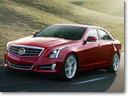
The latest Cadillac ATS RWD sedan, gets a price tag which makes its future look good. Starting from $33,990, the 2.5-liter/30+ mpg model even comes with destination charges. It’s a small poke in the eye for Mercedes-Benz and Audi. Their own compact-sedans (the C250 and A4 respectfully) have a significantly higher price.
Besides the 2.5, for one can get the mid-range power train ($35,795) which is 2.0 but it is turbocharged thus more powerful and less thirsty. Manual and Automatic transmissions are available as is the choice between RWD and AWD. The top of the range model that costs $42,090, incorporates a 3.6-liter V6 engine rated at 320 horsepower. The transmission is strictly automatic and the standard equipment includes leather 8-way power seats with memory for settings storage, adaptive start, CUE tech and much more. Full specifications are due to came later on.
The CUE technology represents Caddilac’s user interface. It’s akin to that used in many smartphones and tablets. The idea is that it uses electrodes to sense the conductive properties of objects, such as a finger – in other words… a touchscreen.
The handling is also expected to be top-notch since the Nürburgring in Germany, among other tracks has been a favorite of Cadillac testing engineers for quite a while. The ATS is also lighter than the aforementioned A4 and C250 by around 100 pounds. The top-of-the-line 3.6 is expected to do 0 to 100 kph in less than 6 seconds.
Ancient gods need accessories as well. That’s why we’ve got news from Prior Design for they have given the iconic Range Rover (2002-2005) a makeover. We are talking about nothing more drastic than a simple body kit but that’s what Prior do and they do it best.
It really is simple – a front bumper, side skirts and a rear bumper. The overall kit does make the Range Rover loose its off-road appeal but since when SUV’s have been for dirt roads? Today, it’s all about the urban look – a sense of security on the rough asphalt, the elevated stance in a traffic jam, the mind-boggling gas station receipt (wait… that’s not a plus). Anyway. Prior have given this particular Range Rover something that will make it stand out from the other icons and there are a lot of them.
Back in the days, these Range Rovers used Jaguar derived V8 engines which, at best, had 5.0-liters of displacement, 503 hp and 625 Nm of Torque – so not that ancient after all. They were, and still are the ultimate statement of clout.
All Prior Design products are made from a Dura-Flex FRP (Fiber Reinforced Plastic) material – sturdy, flexible and paint-friendly. The whole package will set you back with around 2,280 Euros ($2,971)
The Porsche Boxster hits the showrooms in the UK. Prices will start at £37,589 which means that it still will be the cheapest Porsche around and, because of it’s new profile, it will be more accessible as well. By accessible, I mean more appealing to men as well. Let’s be frank. Up until now, women have been the most common sight behind the wheel of a Boxster roadster.
Some highlights: two flat-six engines with direct injection and a recalibrated chassis. It’s 35 kg lighter than the old one and has a 60 mm longer wheelbase (shorter overhangs nevertheless). The front and rear axles are wider and the tires on them are larger. Reports come in that the new Boxster S can lap the Nürburgring-Nordschleife in 7:58 minutes – that’s a 12 second improvement over the old one. Take that and the fact that the interior is partly inspired by the Carrera GT and you’ll get why I think it will be now more appealing to men – it’s more aggressive, sleek and quite frankly bad (in the good sense).
Aggressive and bad are also the drive trains. Fort the Boxster – a downsized (used to be 2.9) 2.7-liter horizontally opposed engine develops 265 hp. That’s 10 more from the old one. The Boxster S (from £45,384) gets 315 hp from it’s 3.4-liter engine. By default, both of these cars will come with a manual six-speed gear box. Optionally, you can get the seven-speed dual-clutch Porsche Doppelkupplungsgetriebe (if you can say this out loud, you get it complementary … not). If you opt for that however, plus the Sport Chrono package, the Porsche Boxster can go from 0 to 100 km/h in 5.5 seconds while the Boxster S does that in 4.8 seconds. In return, with that setup, you get 36.7mpg, and CO2 emissions of 180g/km from the Boxster and 35.3mpg and 188g/km of CO2 from the S.
Standard equipment for the base Porsche includes in Alcantara interior, 18” alloy wheels, Auto stop/start and Sports mode, remote control hood operation, audio CD with 7-inch colour touch-screen control, a universal audio interface offering MP3 connectivity and a three year warranty.
The Boxster S has 19-inch instead of 18-inch wheels, “partial” leather interior and Bi-Xenon headlights.
O.CT-Tuning do not like to beat around the bush. That’s what evident by this example – it’s a Chevrolet Camaro (The Yellow Steam Hummer, they’ve called it) that has no obvious signs of modifications. That doesn’t come as a big surprise, since O.CT-Tuning are apparently renown for their expertise on compressor modifications. Many of their subjects have in fact been Chrysler SRT-8 models. Now it’s time to move on a bigger scale. Why not a genuine Transformer. Bring in more power!
By “modifying” the forced induction system (supercharger), the power of the Camaro can go up from 602 hp and 682 Nm of torque to 630 hp and 730 Nm of rotque. Easy stuff for the compressor wizzards at O.CT-Tuning but we can’t help but thinking – won’t those tires shred themselves as soon as you put your foot down. 100 Nm of torque is like having an additional Smart car under the hood…that’s been infected with rabies
The one thing that complements the enhancement, is the exhaust system. Still very subtle but there nevertheless. Not trying to burst your year drums at low revs, evoking the gods of thunder when you approach the read line – that’s what this is all about. Apart from that, nothing else has been changed. That’s the point when it comes to the Transformers – they need to blend… despite that this is an yellow Chevrolet Camaro we are talking about but hey, that’s Hollywood.
It’s worth noting, that the power tweaking is staged – you can have a little bit more or a whole lot more. To avoid any legal issues or personal worries, genuine documentation is also provided – a certificate of technical inspection and a DTC certificate. Thus, even the scrutinizing law of Switzerland cannot deem this vehicle unfit for road use.
 The guys from the Germany-based Novitec Rosso have slapped us in the face with this Ferrari 458 Italia… which is yellow… and it has no roof. Is there any need to go on? It’s quite a comprehensive package this upgrade but it’s hard to notice because our pupils contract at the sight of the thing. But if you think the jaundice is what makes this car unique, you’d be wrong. The real treat hides underneath – a performance revision and a new exhaust system.


 We really hate it when some tuning houses decide to put some flashy wheels on an already appealing car and call it a project. So when we caught a glimpse of this


 Keep your eyes peeled as a new


 Don’t you hate it when car manufacturers bash one another over which one is the leader in a segment? That’s exactly what


 We often get figures from car makers that, from time to time beggar belief. Especially when we are talking about estimated mpg data. It goes without saying then, that nothing beats a real life test to see exactly what’s what. That’s exactly what record breaking duo John and Helen Taylor have done – travel 1626.1 miles on a single tank of fuel (a record breaking distance). The car of choice was a 2012, manual


 As




 The latest


 Ancient gods need accessories as well. That’s why we’ve got news from


 The


