Author: autoview

  • Peugeot 308 CC Prices And Trim Specifications Announced

         There are three trim levels of the stylish new Peugeot 308 CC – Sport, SE and GT.

    The Sport model introduces the lively 1.6-litre VTi 120 petrol and the accomplished HDi 110 diesel engines, at £19,495 and £20,495 respectively.  The high level of standard equipment includes 16″ alloy wheels, a full body coloured exterior, front fog lights, black / grey Sports cloth trim and black instrument dials. (more…)

  • Porsche confirms pricing for new Panamera Gran Turismo

    Porsche has confirmed UK prices for its forthcoming four seat Panamera gran turismo, which goes on sale on 12 September 2009. The four door performance car will be priced from £72,266 for the Panamera S, £77,269 for the Panamera 4S and £95,298 for the top of the range Panamera Turbo.

    The Porsche Panamera will be available with powerful and efficient V8 power units, the choice of rear or four-wheel drive, and an interior design with a uniquely luxurious and high technology ambience.

    The rear-wheel drive Porsche Panamera S is offered with a six-speed manual gearbox. The seven-speed Porsche Doppelkupplungsgetriebe (PDK) double-clutch transmission is available as an option for £2,289. The Panamera 4S and Turbo have four-wheel drive and feature the PDK gearbox as standard. The active all-wheel drive system is controlled by Porsche Traction Management (PTM) via a multi-plate clutch that adjusts the engine power distribution between the front and rear axles for increased grip and agility.

    The Porsche Panamera offers a unique symbiosis of sporting performance and sheer luxury. Every model offers a full leather interior, Porsche Active Suspension Management (PASM), Bi-Xenon headlights, rear ParkAssist, tyre pressure monitoring, automatic dimming rear view mirrors, Porsche Communication Management with touch-screen satellite navigation and audio controls, and a Bluetooth telephone module – complete with cordless handset for use by rear seat passengers.

    The heated front seats fitted as standard in the Panamera S and 4S are of a sporting style, and can be adjusted electrically in eight different directions for optimum comfort. Adaptive sports seats with higher side bolsters are available as an option across the range.

    Standard on all Panamera models is the ‘Sport’ button, which increases throttle pedal responsiveness, selects the ‘Sport’ suspension setting on the PASM, and the shift patterns of the PDK transmission, where fitted. Offered in combination with PDK is the new Porsche Auto Start/Stop function. This automatically switches off and restarts the engine when stationary to further reduce fuel consumption and emissions – for example, at traffic lights or in congestion.

    The Panamera S and 4S have 18-inch alloy wheels as standard, with a choice of 19-inch and 20-inch alternatives available. The Panamera Turbo rides on 19-inch alloy wheels. As is typical of a Porsche, the braking system of the Panamera is designed to deliver a high level of stopping power. However, similar to all other Porsche models, the race-proven and highly efficient Porsche Ceramic Composite Brake (PCCB) option is also offered for the Panamera.

    Additional features on the Panamera Turbo include PASM with an adaptive air suspension function that actively adjusts the ride height, BOSE® Surround Sound audio system with 14 speakers, metallic paint, multi-function steering wheel, heated rear seats and rear side airbags. Also, the 14-way electric front seat adjustment has a Comfort Memory Package for the various seat positions and the electrically adjustable steering column.

    The Panamera offers comprehensive levels of active and passive safety across the range. In addition to Porsche Stability Management (PSM), there are driver and front passenger airbags, curtain airbags as well as – on the front seats – side and knee airbags, each ensuring maximum protection as standard features in the event of an accident. Rear seat side airbags are available as an option on the Panamera S and 4S.

    A luxurious journey is guaranteed in any of the four seats in the Panamera but, for passengers in the rear, the option of electrically adjustable backrests, cushion length and lumbar support raises the standard further still. It is also possible to specify rear seat ventilation, and a comprehensive rear interior illumination package with high power reading lights.

    For customers seeking the ultimate in-car audio experience, the Panamera is the first Porsche to offer the option of a High-End Surround Sound System from Burmester®, the renowned Berlin audio specialist. A total of 16 loudspeakers masterminded by 16 amplifier channels with an overall output of more than 1,000 watts provide a unique sound, complemented by an active subwoofer together with a 300 W Class D amplifier.

    The superior, yet practical, driving qualities of the Panamera are borne out clearly by the luggage compartment. Opening the rear lid reveals a load capacity of 445 litres (15.6 cu ft) in the Panamera S and 4S. Maximum stowage in the Panamera Turbo is 432 litres or (15.1 cu ft). With the rear seat back rests folded, luggage capacity in all models increases to an ample 1,250 litres or 43.8 cu ft.

    Every Panamera has the assurance of a Porsche Vehicle Tracking System (VTS), a sophisticated vehicle security package approved to Thatcham Category 5 standard, and customers will also be able to explore the potential of their new car by participating in a complimentary course at the new Porsche Driving Experience Centre, Silverstone.

    Porsche Panamera – range overview

    Power

    Torque

    0-62mph*

    Top speed*

    Combined mpg*

    CO2 g/km*

    Panaera S
    4.8-litre V8

    400bhp

    500Nm

    5.4 secs

    176mph

    26.2

    253

    Panamera 4S
    4.8-litre V8

    400bhp

    500Nm

    5.0 secs

    175mph

    25.4

    260

    Panamera Turbo 4.8-litre V8
    twin-turbo

    500bhp

    700Nm

    4.2 secs

    188mph

    23.2

    286

    *all performance data refers to cars with PDK transmission

  • MINI and Airstream, designed by Republic of Fritz Hansen

    Munich. Airstream Inc. and MINI have teamed up to offer the best in both design and functionality with a one-off MINI Cooper S Clubman and Airstream creation designed by Republic of Fritz Hansen. The concept will be presented for the first time at the INTERNI DESIGN ENERGIES exhibition in the courtyards of Università degli Studi di Milano during the upcoming world-renowned Salone del Mobile show in Milan. The exhibition will be open each day from Tuesday 21 to Thursday 30 April from 10:00 a.m. until midnight. (more…)

  • The Ultimate Arsenal Fans’ Car – Gerald Scarfe-Designed Citroen C4 Unveiled For Teenage Cancer Trust Raffle

    Arsenal manager Arsène Wenger and players, Gael Clichy and Robin van Persie joined world famous cartoonist Gerald Scarfe last week to unveil a unique Citroën C4.

    The ‘Ultimate Arsenal Fans’ Car’ was designed by Scarfe in consultation with the players and is being raffled in aid of Arsenal’s Charity of the Season, Teenage Cancer Trust.
    Citroën, Arsenal Football Club’s official car supplier, donated the stylish new C4 to the Club for the unique project to help raise awareness and funds for the Teenage Cancer Trust.

    Tickets to win the car cost just £2 with all funds going to Teenage Cancer Trust.

    The car will be displayed at the Emirates Stadium for the next three Arsenal home matches (14th March Arsenal FC vs. Blackburn, 4th April Arsenal FC vs. Manchester City and 26th April Arsenal FC vs. Middlesbrough).

    Supporters are invited to give their input on what they would like to find inside the hatchback via http://www.arsenal.com/tctcitroenc4

    For more information on the partnership or to donate visit: www.beagoonerbeagiver.org

  • Escape The Doom And Gloom At Race Retro, Britain’S Premiere Historic Motorsport Event

    The appetite for nostalgia is booming and what better way to beat the economic blues than to inject your rose-tinted memories with a healthy splash of high octane excitement? Race Retro, the international historic motorsport show held at Stoneleigh Park, Coventry from the 13th to the 15th March, is a fantastic pulse-quickening event which proves that they don’t race or rallying them like they used to! (more…)

  • Volvo Launches ‘Ice White’ C70 Coupe-Convertible

    Volvo’s striking four-seater C70 Coupé-Convertible packs some extra appeal this spring with the introduction of the ‘Ice White’. Priced at an attractive £24,495 OTR and available to order now, the C70 Ice White features £2,350 worth of extra equipment over the standard 2.0D S model on which it is based which retails at £24,995 OTR.

    Externally, the Volvo C70 Ice White sports the head-turning Ice White finish. The interior boasts sumptuous Calcite leather upholstery with black interior trim and aluminium inlays. The exterior appeal is also boosted with 18” Midir diamond cut alloy wheels. (more…)

  • New Multiair Technology: More Power, Less Fuel, Lower Emissions


    Multiair Technology

    Already a world leader in advanced diesel engine technology, Fiat Group has just launched MultiAir, a fundamental breakthrough in petrol engine design that will dramatically cut fuel consumption, as well as significantly boosting power and torque, cutting carbon dioxide emissions by between 10 and 25 per cent, and up to a 60 per cent reduction in other engine pollutants.

    With two generations of common rail direct injection diesel engine technology, UniJet and MultiJet, to its credit, Fiat has dramatically improved diesel engine performance, economy and emissions. Now, with MultiAir, Fiat has brought together the company’s enviable expertise and technology to make one of the single largest leaps forward for petrol engine design in recent times.

    In short, an engine equipped with Fiat MultiAir technology is more powerful, more responsive across the entire engine speed range, uses considerably less fuel, and reduces all types of exhaust emissions by a substantial amount. It will also assist in enabling Fiat to maintain its lead in low emissions and low fuel consumption technology, which has seen Fiat crowned for the past two years as the number one car maker for the lowest range-wide CO2 emissions.

    The first new engine to be equipped with MultiAir will be the 16-valve 1.4 litre family of naturally aspirated and turbocharged engines, and the first car to go on sale with MultiAir installed will be the Alfa MiTo at the end of 2009. Its second application will be as an integral part of a new two cylinder engine family.

    Development of the Fiat MultiAir system

    In the last decade, the development of Common Rail technology for diesel engines marked a breakthrough in the passenger car market. To be equally competitive in the field of petrol engines, Fiat Group decided to follow the same approach and focus on breakthrough technologies.

    The aim was to provide customers with substantial benefits in terms of fuel economy and driving pleasure, while maintaining the engine’s intrinsic refinement, based on a smooth combustion process and on light structures and components.

    The key parameter to control diesel engine combustion and therefore performance, emissions and fuel consumption, is the quantity and characteristics of the fuel injected into the cylinders. That is the reason why the Common Rail electronic diesel fuel injection system was such a fundamental breakthrough in direct injection diesel engine technology.

    However, the key to controlling petrol engine combustion, and therefore performance, emissions and fuel consumption, is the quantity and characteristics of the fresh air charge in the cylinders. In conventional petrol engines the air mass trapped in the cylinders is controlled by keeping the intake valve opening constant and adjusting upstream pressure through a throttle valve. One of the drawbacks of this simple conventional mechanical control is that the engine wastes about 10 per cent of the input energy in pumping the air charge from a lower intake pressure to the atmospheric exhaust pressure.

    A fundamental breakthrough in air mass control, and therefore in petrol engine technology, is based on direct air charge metering at the cylinder inlet ports by means of advanced electronic actuation and control of the intake valves, while maintaining a constant natural upstream pressure.

    Research on this key technology started in the ’80s, when engine electronic control reached the stage of a mature technology.

    At the outset, world-wide research efforts were focused on the electromagnetic actuation concept, by which valve opening and closing is obtained by alternatively energising upper and lower magnets with an armature connected to the valve. This actuating principle had the intrinsic appeal of maximum flexibility and dynamic response in valve control, but despite a decade of significant development efforts, the main drawbacks of the concept – it being intrinsically not fail-safe and its high energy absorption – could not be fully overcome.

    At this point most automotive companies fell back on the development of the simpler, robust and well-known electromechanical concepts, based on valve lift variation through dedicated mechanisms, usually combined with camshaft phasers to allow control of both valve lift and phase.

    The main limitation of these systems is low flexibility in valve opening schedules and a much lower dynamic response; for example, all the cylinders of an engine bank are actuated simultaneously, thereby excluding any cylinder selective actions. Many similar electromechanical valve control systems were subsequently introduced over the past decade.

    In the mid ’90s, Fiat Group research efforts switched to electro-hydraulic actuation, leveraging on the know-how gained during its Common Rail development. The goal was to reach the desired flexibility of valve opening schedule air mass control on a cylinder-by-cylinder and stroke-by-stroke basis.

    The electro-hydraulic variable valve actuation technology developed by Fiat was selected for its relative simplicity, low power requirements, intrinsic fail-safe nature and low cost potential.

    Fiat MultiAir Technology: how it works

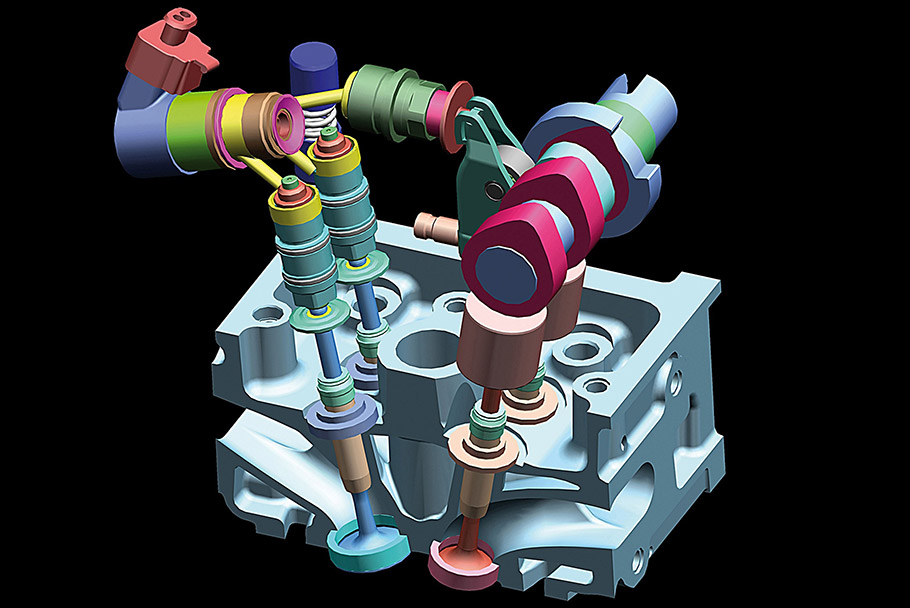
    The operating principle of the system, applied to intake valves, is the following: a piston, moved by a mechanical intake camshaft, is connected to the intake valve through a hydraulic chamber, which is controlled by a normally open on/off solenoid valve.

    When the solenoid valve is closed, the oil in the hydraulic chamber behaves like a solid body and transmits to the intake valves the lift schedule imposed by the mechanical intake camshaft.

    When the solenoid valve is open, the hydraulic chamber and the intake valves are de-coupled; the intake valves do not follow the intake camshaft anymore and close under the valve spring action.

    The final part of the valve closing stroke is controlled by a dedicated hydraulic brake, to ensure a soft and regular landing phase in any engine operating conditions.

    Through solenoid valve opening and closing time control, a wide range of optimum intake valve opening schedules can be easily obtained.

    For maximum power, the solenoid valve is always closed and full valve opening is achieved following completely the mechanical camshaft, which is specifically designed to maximise power at high engine speed (long opening time).

    For low-rpm torque, the solenoid valve is opened near the end of the camshaft profile, leading to early intake valve closing. This eliminates unwanted backflow into the manifold and maximises the air mass trapped in the cylinders.

    In engine part-load, the solenoid valve is opened earlier, causing partial valve openings to control the trapped air mass as a function of the required torque.

    Alternatively the intake valves can be partially opened by closing the solenoid valve once the mechanical camshaft action has already started. In this case the air stream into the cylinder is faster and results in higher in-cylinder turbulence.

    The last two actuation modes can be combined in the same intake stroke, generating a so-called Multilift mode that enhances turbulence and combustion rate at very low loads.

    Further Potential of MultiAir Technology

    All breakthrough technologies open a new world of further potential benefits, which are usually not fully exploited in the first generation.

    Common Rail technology, a Fiat Group worldwide premiere in 1997, paved the way to more than a decade of further technological evolutions such as MultiJet for multiple injections, small diesel engines, and the recent Modular Injection technology, soon to be launched on the market.

    Similarly, MultiAir technology, a Fiat worldwide premiere at this month’s Geneva Motor Show, (March 2009), will pave the way to further technological evolutions for petrol engines:

    • Integration of the MultiAir Direct air mass control with Direct petrol Injection to further improve transient response and fuel economy.
    • Introduction of more advanced multiple valve opening strategies to further reduce emissions.
    • Innovative engine-turbocharger matching to control trapped air mass through a combination of optimum boost pressure and valve opening strategies.

    While electronic petrol injection developed in the ’70s and Common Rail developed in the ’90s were fuel-specific breakthrough technologies, MultiAir Electronic Valve Control technology can be applied to all internal combustion engines whatever fuel they burn.

    MultiAir, initially developed for spark ignition engines burning light fuel ranging from petrol to natural gas and hydrogen, also has wide potential for diesel engine emission reduction.

    Intrinsic NOx reduction of up to 60 per cent can be obtained by internal exhaust gas recirculation (iEGR) realised with intake valves reopening during the exhaust stroke, while optimal valve control strategies during cold start and warm-up bring up to 40 per cent HC and CO reduction of emissions. Further substantial reductions come from the more efficient management and regeneration of the diesel particulate filter and NOx storage catalyst, thanks to the highly dynamic air mass flow control during transient engine operation.

    Diesel engine performance improvement is similar to that of the petrol engine and is based on the same physical principles. Instead, fuel consumption benefits are limited to few percentage points because of the low pumping losses of diesel engines, one of the reasons for their superior fuel economy.

    In the future, powertrain technical evolution might benefit from a progressive unification of petrol and diesel engine designs.

    A MultiAir engine cylinder head can therefore be conceived and developed, where both combustion systems can be fully optimised without compromise. The MultiAir electro-hydraulic actuator is physically the same, with minor machining differences, while internal sub-components are all carried over from Fiat’s FIRE and SGE applications.

  • Major role for UK’s Zytek in electric Smart project

    There hasn’t been much good news for the UK midlands motor industry of late – but UK-based electric car specialist Zytek has received a boost with the contract to build and fit the electric drivetrain for the second-generation Smart Fortwo ED at its facility in Fradley, Staffordshire.

    Zytek has developed an integrated electric drivetrain to drive the rear wheels of the Smart Fortwo. The drivetrain integrates the electric motor, power and control electronics, into one assembly with only three connections: water, high voltage electrics (300V) and low voltage electrics (12v). This replaces the conventional petrol engine and rear axle, and removal of the fuel tank allows room for a battery pack below the floor.

    The second-generation electric Smart will represent a major upgrade on the first version, which has been tested extensively in London since 2007. The new version is based on the second-generation Fortwo model, and the biggest technical change is a move to Lithium Ion batteries instead of sodium-nickel-chloride. This will increase the range life of the battery pack, while cutting recharge times. The batteries are to be supplied by US-based electric sports car maker Tesla.

    The biggest technical change in the new Fortwo ED is a move to Lithium Ion batteries

    The new Smart Fortwo ED will go into production toward the end of the year. It will be used mainly in organised EV test programmes in major European cities, including Berlin, Paris, Rome, Milan and Pisa, with further cities planned.

    In Berlin, the local government and energy providers are installing 500 electricity charging stations, and Daimler is providing more than 100 electric Smart and Mercedes-Benz cars. Several similar programmes are also being considered in the US.

    The plan is to refine the design as a result of feedback from these tests, and make a major ramp-up of production volumes in 2012. Two versions of the Smart ED were shown at Geneva – a standard version and a more exclusive Brabus version, with matt green paint, a cabriolet soft top, LED daytime driving lights, sports suspension and Brabus Monoblock VII alloy wheels.

    Brabus version has matt green paint, cabriolet soft top, and other enhancements

  • Magna Steyr offers shortcut to EV production

    As car manufacturers start to feel the economic pinch, they are looking to outsource more and more of their product development work to suppliers. That’s the view of Austrian-based Magna Steyr, best-known for its contract manufacturing for the likes of Chrysler and Mercedes-Benz.

    The company is keen to show off its design and development capabilities, especially when it comes to electric vehicles. Magna Steyr already has a contract to help Ford develop an electric version of the Focus – and at Geneva it showed an entirely self-designed electric prototype, the Mila EV.

    Magna Steyr describes the Mila EV as a “fully integrated electric vehicle platform which can be used by every OEM to realise their own products, drive and design strategies in the shortest time.”

    The platform is fully engineered and can be built as pure battery-electric car, a hybrid, a natural gas-powered car or even a hydrogen fuel cell vehicle. It’s designed to meet all crash testing standards, while the platform is flexible enough to be ‘right-sized’ to any customer OEM’s requirements.

    Magna Steyr is hoping a manufacturer will buy the basic design “off the shelf” – which would allow it to get a fully engineered electric car into production far more quickly than if it were to start developing such a vehicle on its own.

    Magna Steyr is hoping a manufacturer will buy the Mila EV “off the shelf”

    The design is so flexible that Magna Steyr believes more than one manufacturer could build distinct cars on the same basic architecture, thus leveraging economies of scale which could be shared. And of course, Magna Steyr wants the contract to build the cars “With the proven Flex Plant concept, all versions can be made on one single production line,” said a spokesman.

    The Geneva show car is a 4m-long five-door version, with a 67hp electric motor powered by Magna Steyr-developed lithium-ion batteries. It has an average charging time of 2.5 hours, and it has an ranges of up to 150km. Solar cells integrated in the glass roof provide additional energy generation, and the drag-inducing wing mirrors have been replaced by rear-view cameras.

  • Reinventing the wheel – where there’s a WILL there’s a way

    This neat city car concept hides a secret under the skin, which could help automakers develop lighter and more compact electric cars.

    The WILL hatchback is the first car to feature Michelin’s new Active Wheel, which integrates electric motor, brakes and suspension functions inside the wheel. The car is now under test in France. It has been developed by contract manufacturer Heuliez, and also acts as a showcase for the company’s capabilities. (more…)

  • Jaguar reveals new XKR and XFR with GKN Driveline’s Electronic Torque Manager ETM®

    At the 2009 Geneva motor show this week, Jaguar revealed its new 503 horsepower XKR and XFR models fitted for the first time with the company’s new Active Differential Control system (ADC).  At the heart of Jaguar’s ADC system is GKN Driveline’s ETM® electronic limited slip differential (eLSD).

    The ETM® is a rear axle differential with an integrated active coupling that provides unsurpassed vehicle traction and stability through high speed optimal torque allocation to the powered wheels. Its integrated electronically controlled direct actuation makes it a highly suited module for improving dynamic performance in sports cars such as the new XKR and XFR. (more…)

  • RUF Dakara

    The High Luxury SUV built by RUF is named Dakara and is based on the Porsche Cayenne. The exterior and interior is able to embrace the most ambitious wishes. Because of the 911-headlights, the Dakara affects like a sports car. (more…)