Author: Zahari Mladenov

  • BMW 1 Series

    New technology cuts emissions by up to 21 per cent and improves fuel consumption by up to 24 per cent Tax-busting 60.1mpg 118d is BMW‘s most economical production car. The new BMW 1 Series goes on sale in spring 2007 and features a model line up that includes the most fuel efficient production vehicle BMW has ever produced. The introduction of a three-door model and a revised five-door come as a raft of new fuel-saving innovations are rolled out across the range.

    Technologies such as Brake Energy Regeneration, Automatic Start-Stop function and Electric Power Steering are combined with lower rolling resistant tyres and a gearshift change indicator to encourage economical motoring. These innovations are in addition to the use of variable valve technologies and High-Precision Direct Injection engines on some 1 Series models that boost power output but cut fuel consumption and emissions.

    The BMW 118d, BMW’s most economical car, manages its record 60.1mpg figure courtesy of these features in conjunction with the use of further lightweight engineering. The car now has an aluminium crankcase to save weight. Aside from the BMW Hydrogen 7, the BMW 118d also posts the lowest ever CO2 emissions of any BMW recording 123g/km (putting it into the Band C category for Vehicle Excise Duty).

    BMW 1 Series
    BMW 1 Series

    Other engines in the new 1 Series range record economy improvements of up to 24 per cent compared to the previous model, while emissions have also been cut by up to 21 per cent. These improvements have not been to the detriment of driving pleasure. The new 1 Series is powered by a range of engines whose outputs have increased by up to 20hp with a consequential improvement in performance figures.

    New fuel saving technology
    Brake Energy Regeneration (iGR) makes its debut on the 1 Series. The system uses an Intelligent Alternator Control (IAC) and an Absorbent Glass Mat battery to recycle previously lost energy, in turn saving fuel. This is achieved as the IAC reduces drag on the engine by only engaging when required to charge the battery, whereas a traditional alternator is always pulling power from the engine. Additionally, the energy generated by the engine on over-run (under braking or descending a hill) was previously wasted. Now this lost energy is utilised by the IAC to charge the battery. iGR alone is responsible for a three per cent improvement in fuel economy.

    The new 1 Series comes with Automatic Start-Stop function to cut fuel consumption. Standard on all manual transmission models (except 130i), the system automatically switches the engine off when the vehicle is stationary and the driver puts the car into neutral. To restart the driver only need engage the clutch again before pulling away in the normal manner. Should he not want to use the Automatic Start-Stop function it can be manually switched off.

    The use of Electric Power Steering results in a 90 per cent energy saving compared to a conventional mechanical hydraulic steering system. Power assistance is now provided by an electric motor that works only when required, such as turning a corner. Other fuel saving enhancements have been made courtesy of various ancillary devices, such as the air-conditioning power supply being disconnected from the drivetrain when not in use. Even flaps behind the kidney grille improve economy, closing up for improved aerodynamic efficiency should the engine require less airflow. The feature also improves cold starting times.

    Low running costs
    The plethora of new technology showcased in the BMW 1 Series will have a significant impact on cost of ownership for customers. For the company car driver all but two engine variants now sit in the Band C category for Vehicle Excise Duty. This results in a saving of up to £505 for someone paying 40 per cent tax and up to £278 for those in the 22 per cent tax bracket. For all owners fuel consumption improvement means a 12,000 miles-a-year driver will save approximately £250 off the fuel bill.

    Traction and safety
    All BMW 1 Series models come with Dynamic Stability Control with Dynamic Traction Control for the best combination driving pleasure and safety. DSC allows drivers to make the most of the 1 Series’ 50:50 weight distribution and rear-wheel drive configuration for the best on-road performance. The BMW 130i comes with five additional functions with its DSC+ system for enhanced convenience and driver safety: Hill Start Assistant, Brake Pre-tensioning, Brake Drying, Brake Fade Compensation and Soft Stop.

    All BMW 1 Series have six airbags as standard, the Brake Force Display function on the rear lights to highlight sharp braking and Run-flat tyres with Tyre Puncture Warning System.

    A new style of BMW 1 Series
    To herald the introduction of the latest generation of engines, BMW’s designers have refreshed the interior and exterior styling of the five-door model. The 1 Series now features a larger kidney grille for improved airflow to the engine. The lower front spoiler has also been reprofiled to create a larger air intake, while the spoiler protrudes further for a more pronounced, sporting look. The headlamp cluster remains the same size but a darker cover gives a subtle, more distinguished front end.

    At the rear a restyled bumper gives the impression of a wider, lower car. The rear lamp cluster now features a new arrangement of lights, but retains its original shape.

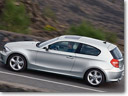
    The new three-door 1 Series features the same styling cues but its side view is naturally different. The passenger doors are longer than those on the five-door model and are also frameless in the style of a coupé. Inside, customers will also be able to choose between either a four-seat or a five-seat configuration. In the four-seat arrangement rear passengers are separated by a central storage compartment and sit in more sculptured seats. As a no-cost option the five-seat layout offers the traditional bench seat standard on the five-door 1 Series. The introduction of higher quality materials and minor changes to the layout of the interior enhance customer comfort and practicality.

    Optional highlights
    The new 1 Series comes with MP3 and USB stick capability for the best in in-car entertainment. Customers with their favourite music loaded on an Apple iPod or a USB stick can now plug these into the car to continue their listening. Tracks are selected via steering wheel controls or the iDrive system.

    The optional Adaptive Headlights that turn to follow the intended course of the car have been improved on the 1 Series. Cornering light function is added to the package as standard. This means two additional lights turn at speeds of between 22 and 40mph to further illuminate the direction of travel on a twisting road.

  • Je Design Seat Leon 1 P FR

    After JE DESIGN, a well-known SEAT customising specialist, tuned the new Leon two months prior to its market launch, the same tuning specialist from Leingarten, Germany, has now turned its attention to the “FR” version.
    The core of the modifications is the power boost to the 2.0 TDI engine. Instead of 125 kW (170 bhp), it now generates a solid 142 kW (193 bhp) with a torque increase from 85 to 410 Nm. The modifications to the engine management system permit better driving performance: A top speed of 224 km/h (series: 218 km/h) and acceleration from 0 to 100 km/h in 7.6 seconds (series: 8.2) send out a clear message! The power boost comes with a TÜV parts certificate. Needless to say, the TDI still complies with the EI regulations. An electronic power boost for the new 2.0 TFSI with 147 KW / 200 bhp leads to a terrific 180 kW (244 bhp) with a torque boost up to 355 Nm at 1,850 rpm. Here, too, the modifications to the engine management system permit enhanced driving performance: A top speed of 235 km/h (series: 229 km/h) and acceleration from 0 to 100 in 6.5 seconds (series: 7.3)! This power boost also comes with a TÜV parts certificate. In each case, the price includes a 1-year guarantee on the engine, drive train and gearbox. Upon request and subject to an extra charge, this can be extended by a further 12 months. A power boost for the new Leon CUPRA 2.0 TFSI with 176 KW / 240 bhp is in the pipeline. (more…)

  • Honda Stream Hyper Sport Concept

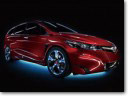
    Honda Stream Hyper Sport ConceptThis medium-sized minivan combines an exciting driving experience with an interior full of entertainment features. Formed around a ”Sculpted by the Wind” theme, the exterior has been designed for optimum aerodynamic performance. (more…)
  • Honda Fit Daily Active Concept

    Honda Fit Daily Active ConceptA small car designed to respond to the needs of today’s portable telephone and video game-oriented youth and add a touch of excitement to everyone’s lives. (more…)
  • BMW M5 Touring

    BMW has announced details of the revised 5 Series Saloon and Touring range, topped off by the new BMW M5 Touring. From its launch in 2003, the E60 5 Series delivered year-on-year sales records and received numerous accolades. The new 5 Series is set to build on that success with more performance, efficiency, practicality and owner appeal. Offering new engine technology to increase performance yet improve economy by up to 25 per cent, and class-leading comfort-focused equipment such as Lane Departure Warning System, the new 5 Series is set to remain the benchmark Executive car. (more…)

  • I2BConcept Wildcat

    I2BConcept WildcatWith a foundation from the Raven the team started to develop a road licensed sport car, The main goal in this project wa to combine a feeling of driving a race car with a daily-use confort.

    A car you can go to a race track with on Sundays or to the office during the week. The conception is a four wheel drive with longitude middle engine.

    It is two seater car with a small luggage-carrier under the front hood.

    The model is designed to be a middle class sports car where the main competitor will be Audi TT, Porsche or Lamborghini Gallardo.

    The next step is to produce a full size model of the car which will be tested in Wind Tunnel in parallel with a virtual simulation of the car in Fluent.

    We hope that after these tests we can be more accurate in technical details of the project. The car needs to be capable to reach 100 km/h in less than 5 seconds.

    Source: I2BConcept

  • Lexus IS-F

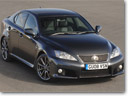
    Much of the development of the new Lexus IS-F took place at Fuji Speedway and the Higashi-Fuji Technical Center in Japan. The Lexus IS-F is based on the proven rear-wheel-drive Lexus IS, which is equipped with a double-wishbone front and multi-link rear suspension. As well as the IS performs, Lexus engineers demanded much more of the all-new IS-F. The result is a performance tuned 5.0-liter V8 engine, topped with specially engineered heads fed by a two-stage intake system, that produces 400-plus horsepower and more than 350 ft.-lbs. of torque. The all-new IS-F is equipped with engine-oil and transmission-fluid coolers for high-speed performance and a cylinder head-scavenging oil pump for high g-force driving.

    The IS-F engine is mated to the world’s first eight-speed direct sport-shift transmission. A new torque-converter lock-up control was developed that allows for a direct, crisp gear change through the constant lock-up of the torque converter in second through eighth gears. In Drive mode, the IS-F transmission performs with great smoothness, and the torque converter allows for great launch ability for fast standing-start acceleration that will register a zero-to-60 time in less than 4.9 seconds.

    This unique transmission also features an advanced Manual mode. A pair of paddles located within a fingertip’s reach behind the steering wheel enables the driver to make ultra-fast up-shift gear changes within a tenth of a second. Downshifts are accompanied by automated and incredibly precise throttle blips to match engine RPM to vehicle speed.

    Lexus IS-F
    Lexus IS-F

    The impressive acceleration achieved by the IS-F requires it be equipped with heavy-duty Brembo brakes designed to the specifications of the Lexus engineering team. Huge, 14.2-inch cross-drilled front discs are gripped by rigid, powerful six-piston aluminum calipers, while 13.6-inch rear cross-drilled discs feature two-piston calipers. High-friction brake pads are equipped on all four wheels. The brakes are finished with the Lexus name displayed on the calipers, a first for a Lexus production vehicle.

    The IS-F features custom-designed 19-inch forged alloy wheels as standard. The wheels were built to Lexus specifications by BBS and are surrounded by high-performance sport tires.

    The attention to performance also extends to a modified suspension that lowers the entire car by more than a half-inch when compared to the base IS, and one full inch when compared to IS models equipped with 18-inch wheels. This specially modified suspension allows for an exciting and energetic drive, whether on a race track or the streets.

    The IS-F features an all-new three-mode version of Lexus’ Vehicle Dynamics Integrated Management (VDIM) system. In addition to the Normal mode, the new VDIM features a Sport mode that allows the driver to push the car even further before its braking-, throttle- and steering-control systems kick in. The third VDIM system mode is Off, which allows the driver to push the IS-F to its ultimate level of handling performance.

    The attention to performance is complemented by modified styling cues that differentiate the IS-F from the standard IS. Lexus engineers provided the IS-F with a dual-exhaust system and quad-tail pipes, wider front fenders, and a larger grille and rear spoiler. Both the hood and lower intake were enlarged to accommodate and cool the V8 engine.

    Like the exterior, the interior of the IS-F receives unique styling with aluminized composite trim and special surface treatments. The instrument panel includes an oil-temperature gauge and shift indicator-lights, while the “F” logo is showcased on the steering wheel and rear-center console.

    In addition to the usual Lexus standards of comfort and convenience, the interior of the IS-F features specially shaped and trimmed seats, which hold the driver comfortably and securely in place. The special sport seats are available in black or a unique high-contrast white and black trim.

    “The intent of creating the IS-F was not to be a competitor to other performance-sport sedans,” said Carter. “Rather, the goal was to create a true performance sedan in a uniquely Lexus way-one that is totally authentic with a unique interpretation of raw driving thrill at all speeds and provides a whole new definition of ‘usable power.’”

  • Lexus LF-A

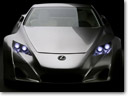
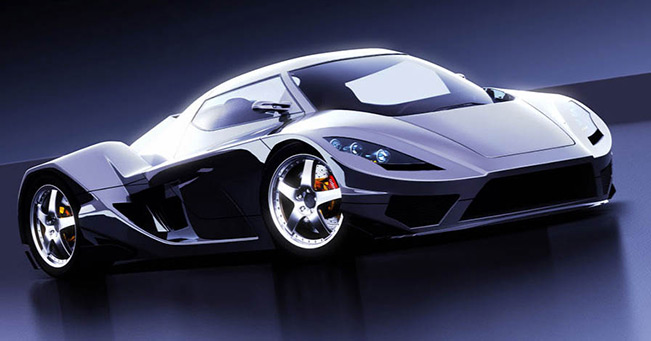
    The Lexus LF-A sports-car concept was originally shown at the 2005 NAIAS to express a bold new direction in styling for the Lexus brand. The goals for the new LF-A are no different than they were with the original concept: To build a supercar with world-class performance that is uniquely Lexus.
    As with all new Lexus vehicles, the styling of the LF-A is rooted in a design direction called L-finesse. The concept of L-finesse was used to shape and detail the original LF-A, and it was used to reshape, redetail and redefine this latest version. Lexus has further refined the styling of the new LF-A to enhance its exotic nature with a greater use of curved surfaces and interesting details. (more…)

  • Honda Accord Coupe Concept

    The Honda Accord Coupe Concept reveals a totally new look for the next-generation Accord, along with key technologies for safety, fuel efficiency and performance, American Honda Motor Co., Inc., announced today at the North American International Auto Show (NAIAS) in Detroit. The Accord is Honda’s best-selling model in North America and its debut at NAIAS marks the first time that an Accord concept vehicle has ever been shown at a major auto show. (more…)
  • Audi Q7 V12 TDI

    A time of 5.5 seconds for the sprint from a standstill to 100 km/h and an electronically governed top speed of 250 km/h put the performance SUV from Audi on a par with high-calibre sports cars. The engine limits its consumption to an average of just 11.9 litres/100 km.

    The new V12 TDI is the crowning glory of an engine line-up brimming with dynamic performance – each and every one of the diesel engines from Audi generates a high output and tremendous pulling power for a sporty drive. This character has emerged over and over again in the brand’s models, not least in the form of the six- and eight-cylinder 2.7 TDI, 3.0 TDI and 4.2 TDI models. (more…)

  • Infiniti QX56

    Following a record setting sales trend and the successful launch of the all-new G sedan, Infiniti is keeping the momentum going with today’s unveiling of the 2008 Infiniti QX full-size luxury sport utility vehicle at the North American International Auto Show in Detroit.
    With a new interior and refined exterior, Infiniti is enhancing and improving what customers already love about the QX – styling, technology, comfort – without compromising its towing capacity and interior roominess. (more…)

  • Kia Kue

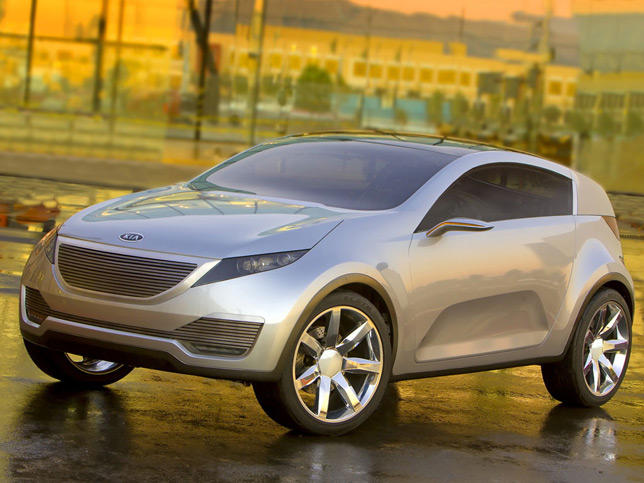
    Kia Motors America (KMA) today during a press conference unveiled the all-new Kia Kue crossover concept vehicle at the North American International Auto Show (NAIAS) in Detroit. The press conference also served as the official public debut in North America for Peter Schreyer, new global design chief of Kia Motors Corporation (KMC).

    “We’ve instilled confidence and integrity in our consumer base with vehicles that provide value, quality and safety,” said Len Hunt, executive vice president and COO of KMA. “Kue embodies the next phase of our brand evolution, which will instill pride and passion in our customers through great design.”

    The Kia Kue employs a different approach to the crossover utility vehicle segment by taking elements of what makes a CUV to a new level, namely performance. Kue is designed first and foremost as a driver’s vehicle. While possessing SUV characteristics and capabilities, the Kia Kue focuses more on giving the driver an exhilarating driving experience on the way to the home improvement center than on how much it can haul.

    The Kia Kue has a monocoque platform that sits on 22-inch tires with a wheelbase of more than 114 inches, packaged in an overall length of 186 inches. Though purely a concept, the Kia Kue does, however, hint at future styling directions for Kia Motors.

    Kia Kue
    Kia Kue

    “Good design shouldn’t look like you are trying too hard,” said Tom Kearns, KMA chief designer. “The future Kia direction will incorporate the ‘less is more’ philosophy but still include a heavy dose of boldness to be distinct.”

    With its four wheels pushed to the corners and exterior skin tautly stretched over its underpinnings, the Kue sits powerful and poised. Draped muscular wheel flares play a nice contrast to crisp beveled sections found elsewhere on the body. Swept back headlights connect to the front grille to create a clean, aggressive down-road appearance. The side window shape flows effortlessly into the rear backlight where two centerline hinging doors open to access rear storage. A single side door that incorporates a negative skive shape opens scissor style for easy ingress and egress.

    On the inside Kue continues the clean, athletic theme with bold understated simplicity. With a four-passenger seating arrangement and custom-built bucket seats, Kue is a vehicle both driver and passengers can enjoy. A technology-driven interface designed to adjust to driver and passenger preference is the focus of the interior functionality. Touch pad and motion-sensing controls are used to adjust things like audio and climate, and the entire system is programmable so that one surface may activate the stereo for one driver and temperature for another. Rear passengers have their own, separate interface.

    The generation-next functionality of the interior is complemented by the use of sophisticated seat and surface materials and a modern color palette. Carefully selected materials and textures are vital components to the interior design of Kue, and they create an upscale feel that is both modern and inviting. A mid dark interior theme with highlights was chosen in place of the typical light interior common to many concept cars. Overall, the Kue interior presents a new perspective of upscale function with an emphasis on comfortable, user-friendly interaction.

    Just as inviting is Kue’s appeal to be driven in a sporty fashion. Fitted with a 400-horsepower, DOHC, supercharged 4.6-liter V8 that twists out 400 lb-ft of torque, Kue is a true performance vehicle. Helping the driver harness all that power is a full-time all wheel drive system yielding predictable driving characteristics both on- and off-road.

    Developed by the KMA design team as an expression of Kia’s global design language, the Kia Kue is a true reflection of the Kia brand and the passion it embraces.